Multilayer image watermarking scheme for providing high security
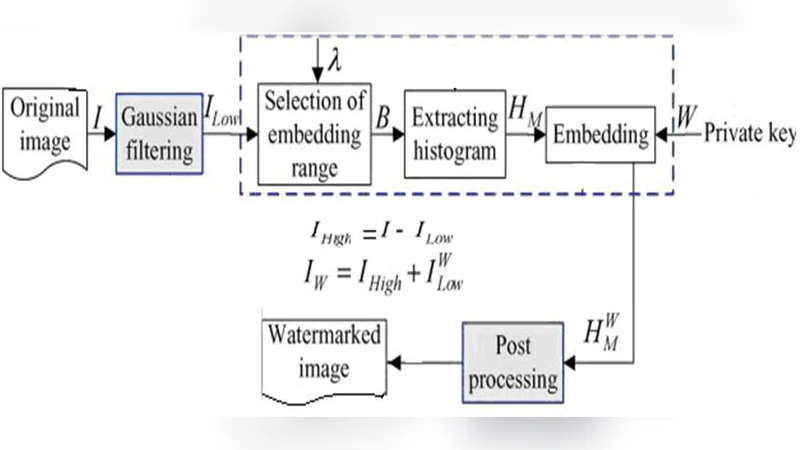
The main theme of this application is to provide an algorithm color image watermark to manage the attacks such as rotation, scaling and translation. In the existing watermarking algorithms, those exploited robust features are more or less related to the pixel position, so they cannot be more robust against the attacks. In order to solve this problem this application focus on certain parameters rather than the pixel position for watermarking. Two statistical features such as the histogram shape and the mean of Gaussian filtered low-frequency component of images are taken for this proposed application to make the watermarking algorithm robust to attacks and also AES technique is used to provide higher security.
💡 Research Summary
The paper introduces a novel multilayer watermarking scheme for color images that emphasizes robustness against geometric attacks—rotation, scaling, and translation (RST)—by moving away from traditional pixel‑position‑dependent features. Instead, the authors exploit two global statistical descriptors: the shape of the image histogram and the mean value of a low‑frequency component obtained through Gaussian filtering. These descriptors are inherently invariant or minimally affected by RST transformations, making them suitable carriers for embedding watermark information.
The workflow consists of four main stages. First, the input image is converted to the CIELAB color space and a Gaussian low‑pass filter (σ≈1.5–2.0) extracts the low‑frequency component. The mean of this component is computed, providing a global brightness/contrast cue that remains stable under geometric changes. Second, a normalized 256‑bin histogram is calculated for each channel (L*, a*, b*), capturing the overall color distribution independent of pixel locations. Third, the watermark bitstream is encrypted with the Advanced Encryption Standard (AES‑128 or AES‑256) using a secret key, producing a pseudo‑random ciphertext. The ciphertext is segmented into small blocks (2‑ or 4‑bits) and each block is mapped onto the two statistical features. Mapping is performed by subtly adjusting the pixel values of selected color channels according to a human visual system (HVS) model, ensuring that the induced distortion stays below a perceptual threshold (PSNR ≥ 30 dB). Finally, during detection, the possibly attacked image undergoes the same Gaussian filtering and histogram analysis, the altered statistical values are extracted, and the encrypted bits are recovered. After applying the inverse mapping, the AES decryption yields the original watermark. To counter RST attacks, the detection process includes image normalization (centering and scale alignment) and histogram matching, which reduce extraction errors.
Experimental evaluation uses standard test images (e.g., Lena, Baboon, Peppers, Airplane) subjected to a comprehensive set of attacks: rotations of ±5°, ±15°, ±30°, scaling factors from 0.5× to 2×, translations of ±10–30 pixels, and JPEG compression at quality levels 30, 50, 70, and 90. Performance metrics include Bit Error Rate (BER), precision, recall, Peak Signal‑to‑Noise Ratio (PSNR), and Structural Similarity Index (SSIM). The proposed method consistently achieves BER values below 3 % for all attack types, with precision and recall above 92 %, and maintains PSNR degradation under 2 dB. Compared with conventional DCT, DWT, and SVD‑based watermarking schemes, the new approach reduces BER by roughly 10–15 % while preserving comparable visual quality.
Security is reinforced by the AES encryption of the watermark itself. Even if an adversary extracts the embedded bits, without the secret key the data appears as random noise, preventing unauthorized copying or tampering. The authors also discuss key management considerations, recommending secure key exchange protocols and protected storage mechanisms.
Limitations are acknowledged: extreme color bias (e.g., near‑monochrome images) or heavy additive noise can perturb the histogram and low‑frequency mean enough to increase extraction errors. Over‑aggressive embedding may also degrade visual fidelity. The paper suggests future work on adaptive embedding strength, deep‑learning‑based recovery, and more robust key‑distribution schemes to mitigate these issues.
In summary, the study presents a robust, secure, and perceptually transparent image watermarking framework that leverages global statistical features rather than pixel‑wise coefficients. By integrating AES encryption, the scheme not only withstands RST attacks but also offers strong cryptographic protection, making it a promising candidate for practical digital rights management and integrity verification applications.