Homotopy type theory and Voevodskys univalent foundations
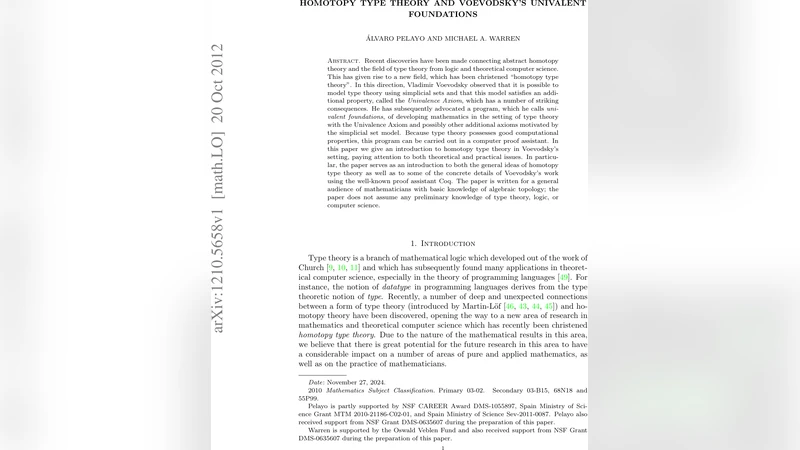
Recent discoveries have been made connecting abstract homotopy theory and the field of type theory from logic and theoretical computer science. This has given rise to a new field, which has been christened “homotopy type theory”. In this direction, Vladimir Voevodsky observed that it is possible to model type theory using simplicial sets and that this model satisfies an additional property, called the Univalence Axiom, which has a number of striking consequences. He has subsequently advocated a program, which he calls univalent foundations, of developing mathematics in the setting of type theory with the Univalence Axiom and possibly other additional axioms motivated by the simplicial set model. Because type theory possesses good computational properties, this program can be carried out in a computer proof assistant. In this paper we give an introduction to homotopy type theory in Voevodsky’s setting, paying attention to both theoretical and practical issues. In particular, the paper serves as an introduction to both the general ideas of homotopy type theory as well as to some of the concrete details of Voevodsky’s work using the well-known proof assistant Coq. The paper is written for a general audience of mathematicians with basic knowledge of algebraic topology; the paper does not assume any preliminary knowledge of type theory, logic, or computer science.
💡 Research Summary
The paper serves as a comprehensive introduction to Homotopy Type Theory (HoTT) and Vladimir Voevodsky’s univalent foundations, targeting mathematicians with a background in algebraic topology but little or no exposure to type theory, logic, or computer science. It begins by contrasting the traditional set‑theoretic foundations, which struggle with higher‑dimensional structures and equivalences, with the perspective of type theory, where propositions are interpreted as “spaces” and proofs as paths (homotopies) within those spaces. This viewpoint naturally accommodates higher‑dimensional paths, allowing a uniform treatment of equivalences, homotopies, and higher homotopies.
Voevodsky’s central contribution, highlighted early in the text, is the construction of a model of type theory in the category of simplicial sets. Simplicial sets are already a standard model for classical homotopy theory, and they provide a concrete ∞‑category in which the type‑theoretic operations (function types, product types, sum types, etc.) can be interpreted while preserving homotopical information. The paper explains in detail how the simplicial set model validates the Univalence Axiom, which asserts that an equivalence between two types can be identified with an equality of those types. In categorical terms, this means that the canonical map from the space of equivalences to the identity type is itself an equivalence. The authors walk the reader through the technical proof, invoking Quillen model structures, fibrant objects, and the existence of homotopy‑inverse equivalences, thereby showing that univalence is not merely a philosophical postulate but a theorem in this model.
Having established the theoretical foundation, the authors turn to the computational side. They describe how the proof assistant Coq can be extended to support HoTT’s distinctive features: universe polymorphism, higher inductive types, and the transport operation along paths. The paper provides concrete Coq code snippets that define the circle S¹ as a higher inductive type, construct its fundamental group, and prove basic properties of the sphere S² and the torus T². These examples illustrate how univalence simplifies reasoning about equivalences: transport along a univalent path automatically rewrites terms in a way that would otherwise require elaborate manual proofs. The authors also discuss the design of tactics that automate such rewrites, making the development of homotopical arguments feasible in a proof‑checking environment.
Beyond the technical exposition, the paper reflects on the broader implications of HoTT and univalent foundations. By treating mathematics as a form of higher‑dimensional geometry, HoTT blurs the line between logical deduction and topological intuition. The Univalence Axiom, together with higher inductive types, provides a powerful language for expressing and manipulating equivalences, which promises to streamline large portions of modern mathematics, especially those involving categorical or homotopical structures. Moreover, because the underlying type theory is constructive, the resulting formalizations are amenable to extraction of computational content, opening avenues for verified algorithms and certified software.
In summary, the paper delivers a balanced mix of theory and practice: it explains the homotopical semantics of type theory, proves the validity of univalence in the simplicial set model, and demonstrates a concrete Coq implementation that brings these ideas to life. It positions HoTT as a viable foundation for mathematics that is both conceptually elegant and practically implementable, inviting mathematicians to explore a new landscape where proofs are paths, equivalences are equalities, and computers become trusted collaborators in the discovery process.
Comments & Academic Discussion
Loading comments...
Leave a Comment