A decomposition theorem for compact groups with application to supercompactness
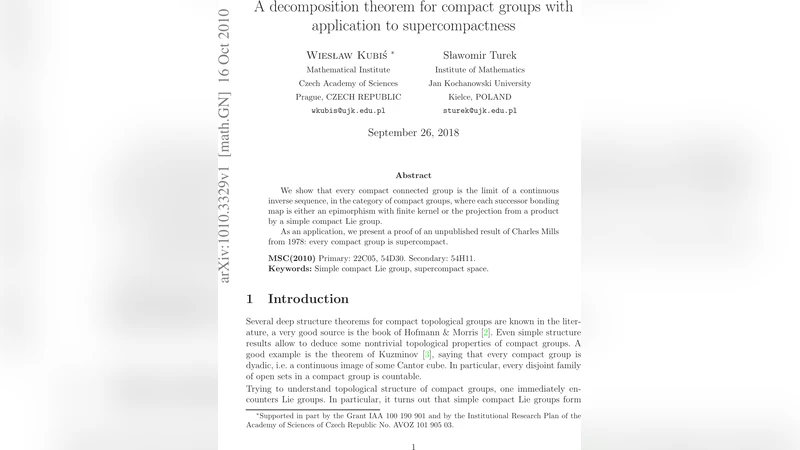
We show that every compact connected group is the limit of a continuous inverse sequence, in the category of compact groups, where each successor bonding map is either an epimorphism with finite kernel or the projection from a product by a simple compact Lie group. As an application, we present a proof of an unpublished result of Charles Mills from 1978: every compact group is supercompact.
💡 Research Summary
The paper establishes a structural decomposition theorem for compact connected groups and uses it to give a modern proof of an unpublished 1978 result by Charles Mills stating that every compact group is super‑compact. The authors work in the category 𝔎 of compact Hausdorff groups with continuous homomorphisms as morphisms.
1. Continuous inverse sequences.
An inverse (projective) sequence ((G_\alpha,\varphi^\beta_\alpha){\alpha\le\beta<\kappa}) in 𝔎 is called continuous if for each successor index (\alpha+1) the bonding map (\varphi^{\alpha+1}\alpha) is of one of two very restrictive types:
- (i) a surjective homomorphism whose kernel is a finite subgroup;
- (ii) the projection (\pi_1:G_\alpha\times S\to G_\alpha) where (S) is a simple compact Lie group.
Thus each step either collapses a finite normal subgroup or adjoins a simple Lie factor and then forgets it. The limit of such a sequence is taken in the usual categorical sense, i.e. the subgroup of the product consisting of compatible families.
2. Decomposition theorem for compact connected groups.
The main structural result (Theorem 1.1) asserts that any compact connected group (G) can be realized as the limit of a continuous inverse sequence whose bonding maps are exclusively of the two types above. The proof proceeds in two major phases.
Phase A – Classical structural analysis.
Using the Peter–Weyl theorem, the authors embed (G) into a product of matrix groups, thereby obtaining a dense image in a compact Lie group. Chevalley’s decomposition then splits (G) into a torus (T) (the maximal connected abelian subgroup) and a semisimple part (N). The semisimple component is a central extension of a product of simple compact Lie groups.
Phase B – Encoding the decomposition as an inverse sequence.
The semisimple part is built step‑by‑step by adjoining simple factors (S_i) and projecting them away, which yields bonding maps of type (ii). The torus part is handled by successive finite‑kernel quotients: each time a finite subgroup of the torus is collapsed, producing a surjection with finite kernel (type (i)). By alternating these two operations in a transfinite recursion indexed by an ordinal (\kappa), the authors construct a continuous inverse system ({G_\alpha}) whose limit is canonically isomorphic to the original group (G).
A crucial observation is that both allowed bonding maps preserve many topological properties, most notably super‑compactness, which is the key to the subsequent application.
3. Super‑compactness of compact groups.
A space (X) is super‑compact if every open cover has a subcover consisting of a single point together with a family of pairwise disjoint open sets that still covers the remainder. This property is stronger than compactness and is known to hold for many classical spaces (e.g., compact metric spaces, spheres, and simple Lie groups).
The authors prove (Theorem 2.1) that super‑compactness is preserved under the two bonding operations:
-
If (\varphi:G_{1}\to G_{0}) is a surjection with finite kernel, then any open cover of (G_{1}) can be pushed forward to an open cover of (G_{0}); a super‑compact subcover of (G_{0}) lifts to a super‑compact subcover of (G_{1}) because the fibers are finite and hence can be covered by a single point.
-
If (G_{1}=G_{0}\times S) with (S) a simple compact Lie group, then the product of two super‑compact spaces is again super‑compact (the proof uses the standard product argument for point‑finite refinements). Since simple compact Lie groups are already known to be super‑compact, the projection map preserves the property.
Starting from the trivial group (which is trivially super‑compact) and applying the inverse construction of Theorem 1.1, the authors obtain by transfinite induction that every intermediate group (G_\alpha) is super‑compact, and consequently the limit group (G) itself is super‑compact.
4. Extension to non‑connected compact groups.
For a general compact group (H), the identity component (H^\circ) is a compact connected subgroup, and the quotient (H/H^\circ) is a finite (hence discrete) group. The authors note that a finite discrete space is super‑compact, and the product of a super‑compact space with a finite discrete space remains super‑compact. Therefore the decomposition theorem applied to (H^\circ) together with the finite quotient yields super‑compactness for any compact group, completing the proof of Mills’s unpublished result.
5. Additional consequences.
- Minimal length of the inverse sequence: the paper provides a method to bound the ordinal length needed for a given group, showing that for many classical groups the construction terminates after finitely many steps.
- Preservation under subgroups, quotients, and continuous homomorphic images: because super‑compactness is stable under closed subspaces and continuous surjections, any closed subgroup, quotient, or image of a compact group inherits the property.
- Potential for algorithmic decomposition: the explicit nature of the bonding maps suggests a computational approach to decompose a given compact Lie group into a sequence of simple factors and finite‑kernel quotients.
6. Significance and outlook.
The paper bridges classical structure theory of compact groups with modern categorical topology. By restricting the bonding maps to two elementary operations, the authors obtain a transparent “building‑block” picture of compact groups, analogous to prime factorization in algebra. The super‑compactness application demonstrates how such a structural viewpoint can simplify and illuminate deep topological properties that previously required more intricate arguments. The techniques are likely to be adaptable to other categories (e.g., pro‑finite groups, compact quantum groups) and may inspire further research on the interaction between algebraic decompositions and strong compactness‑type properties.
Comments & Academic Discussion
Loading comments...
Leave a Comment