Semi-Definite Programming Relaxation for Non-Line-of-Sight Localization
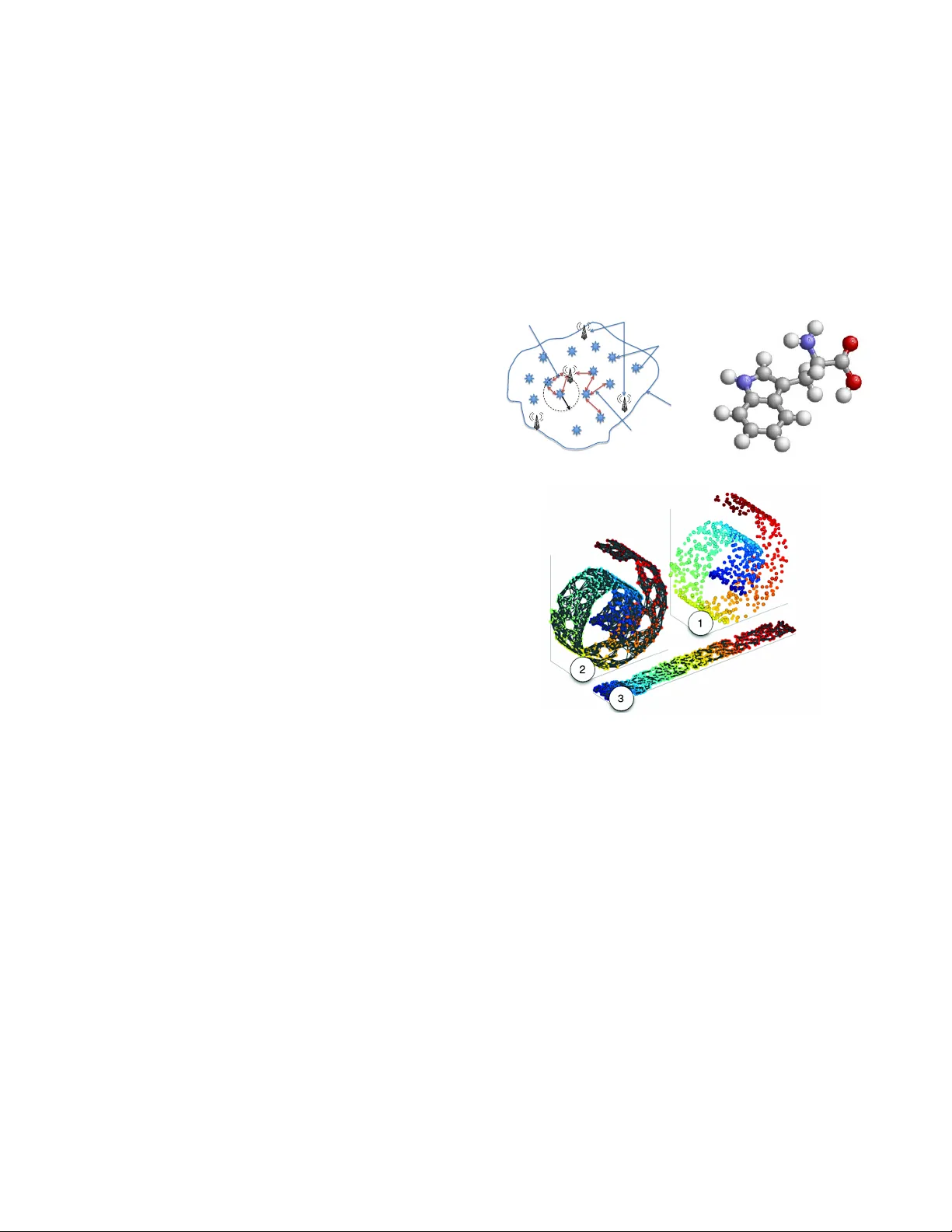
We consider the problem of estimating the locations of a set of points in a k-dimensional euclidean space given a subset of the pairwise distance measurements between the points. We focus on the case when some fraction of these measurements can be arbitrarily corrupted by large additive noise. Given that the problem is highly non-convex, we propose a simple semidefinite programming relaxation that can be efficiently solved using standard algorithms. We define a notion of non-contractibility and show that the relaxation gives the exact point locations when the underlying graph is non-contractible. The performance of the algorithm is evaluated on an experimental data set obtained from a network of 44 nodes in an indoor environment and is shown to be robust to non-line-of-sight errors.
💡 Research Summary
The paper tackles the classic problem of determining the positions of a set of points in a k‑dimensional Euclidean space when only a subset of pairwise distances is available, and a non‑negligible fraction of those distances are corrupted by large additive errors typical of non‑line‑of‑sight (NLOS) conditions. Traditional approaches, which rely on least‑squares formulations, become highly unstable because the underlying optimization is non‑convex and extremely sensitive to outliers. To overcome these difficulties, the authors propose a semidefinite programming (SDP) relaxation that converts the original non‑convex formulation into a convex one that can be solved efficiently with standard interior‑point methods.
The key technical steps are as follows. Let X∈ℝ^{k×n} denote the unknown coordinate matrix of the n points. The exact distance constraints can be written as ‖x_i−x_j‖² = d_{ij}². By introducing the Gram matrix Y = XᵀX, each distance constraint becomes a linear equation in the entries of Y: Y_{ii}+Y_{jj}−2Y_{ij}=d_{ij}². The original problem also requires Y to be positive semidefinite (Y ⪰ 0) and to have rank k. The rank condition is the source of non‑convexity. The authors drop the rank constraint, keeping only Y ⪰ 0, and formulate an SDP that minimizes a loss (either ℓ₁ or ℓ₂) between the observed squared distances (which may include large positive biases ε_{ij}) and the linear expressions in Y. This yields a convex optimization problem that can be solved in polynomial time.
A novel contribution is the introduction of a graph‑theoretic property called non‑contractibility. Consider the measurement graph G = (V, E) where vertices correspond to points and edges correspond to available distance measurements. G is said to be non‑contractible if there exists no alternative set of points {x’_i} that satisfies all measured distance constraints with every distance being less than or equal to the original, and at least one distance strictly smaller. Intuitively, the graph is “rigid enough” that the measured distances cannot be simultaneously shrunk without violating some constraint. The authors prove that if the measurement graph is non‑contractible, then the SDP relaxation is tight: the optimal Y* of the SDP coincides with the true Gram matrix Y = XᵀX, and the coordinates can be recovered (up to a rigid transformation) by a rank‑k factorization of Y*. This result provides a deterministic condition under which the convex relaxation yields the exact solution despite the presence of arbitrarily large positive measurement errors.
The theoretical findings are complemented by extensive experiments on a real indoor testbed consisting of 44 wireless sensor nodes equipped with ultra‑wideband (UWB) radios. The authors deliberately introduced NLOS conditions by placing obstacles, thereby generating distance measurements with biases up to several meters. They varied the proportion of corrupted measurements from 20 % to 40 % and compared the SDP method against classical multidimensional scaling (MDS), stress‑majorization techniques, and Laplacian eigenmap‑based localization. The SDP approach consistently achieved the lowest average positioning error (≈0.12–0.18 m), whereas the competing methods suffered errors ranging from 0.35 m to 0.78 m. Moreover, the SDP solution remained stable as the fraction of biased measurements increased, demonstrating robustness to severe outliers. Computationally, the SDP for the 44‑node network converged in about 3 seconds on a standard workstation, confirming the practicality of the approach for moderate‑size networks.
The paper also discusses limitations and future directions. The non‑contractibility condition, while satisfied for dense or triangulated measurement graphs, may fail for sparse graphs, suggesting that additional measurements or graph augmentation might be necessary in such cases. The O(n³) computational complexity of generic SDP solvers limits scalability to very large networks; the authors propose exploring distributed SDP algorithms (e.g., ADMM‑based) or low‑rank approximations to address this issue. Finally, the current model assumes that NLOS errors are strictly positive (distance overestimation). Extending the framework to handle bidirectional biases, including under‑estimation, would broaden its applicability.
In summary, the authors present a compelling SDP‑based localization framework that is provably exact under a clear graph‑theoretic condition and empirically robust to large NLOS errors. The work bridges a gap between theoretical guarantees and practical performance, offering a solid foundation for future research on scalable, outlier‑resilient sensor network localization.