Latent Dirichlet Allocation Uncovers Spectral Characteristics of Drought Stressed Plants
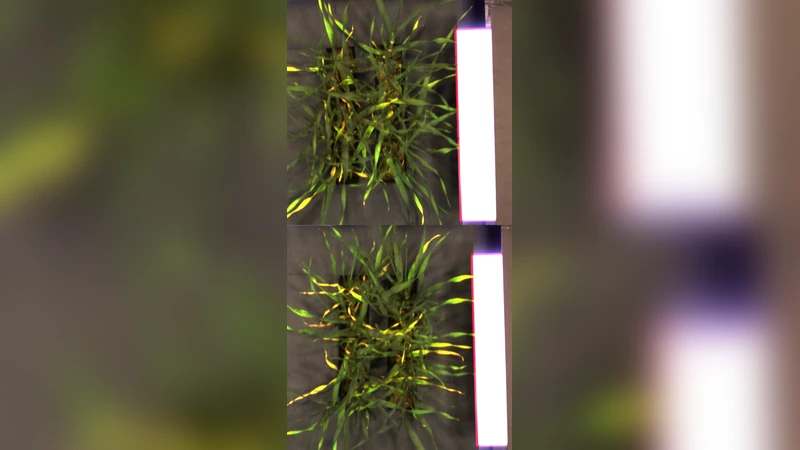
Understanding the adaptation process of plants to drought stress is essential in improving management practices, breeding strategies as well as engineering viable crops for a sustainable agriculture in the coming decades. Hyper-spectral imaging provides a particularly promising approach to gain such understanding since it allows to discover non-destructively spectral characteristics of plants governed primarily by scattering and absorption characteristics of the leaf internal structure and biochemical constituents. Several drought stress indices have been derived using hyper-spectral imaging. However, they are typically based on few hyper-spectral images only, rely on interpretations of experts, and consider few wavelengths only. In this study, we present the first data-driven approach to discovering spectral drought stress indices, treating it as an unsupervised labeling problem at massive scale. To make use of short range dependencies of spectral wavelengths, we develop an online variational Bayes algorithm for latent Dirichlet allocation with convolved Dirichlet regularizer. This approach scales to massive datasets and, hence, provides a more objective complement to plant physiological practices. The spectral topics found conform to plant physiological knowledge and can be computed in a fraction of the time compared to existing LDA approaches.
💡 Research Summary
The paper tackles the challenge of extracting drought‑stress indicators from massive hyperspectral imagery of crops. Traditional indices such as NDVI, PRI, or WBI rely on a handful of wavelengths and expert interpretation, limiting their objectivity and scalability. To overcome these constraints, the authors formulate the discovery of spectral drought‑stress signatures as an unsupervised labeling problem and propose a novel variant of Latent Dirichlet Allocation (LDA) that can handle billions of spectral pixels efficiently.
The core methodological contributions are twofold. First, an online variational Bayes (VB) inference scheme is employed, allowing the model to be updated incrementally on mini‑batches of data rather than requiring a full batch pass. This reduces memory consumption from O(K·V) (where K is the number of topics and V the number of wavelengths) to O(K·B) with B the mini‑batch size, and enables processing of terabyte‑scale datasets on commodity hardware. Second, the authors introduce a convolved Dirichlet regularizer that explicitly models short‑range dependencies between neighboring wavelengths. By convolving the Dirichlet‑drawn topic‑word distributions with a Gaussian kernel across the wavelength axis, the model encourages adjacent spectral bands to share similar topic probabilities, reflecting the physical reality that leaf optical properties vary smoothly with wavelength.
Mathematically, the evidence lower bound (ELBO) of standard LDA is augmented with a regularization term that penalizes large deviations between φ_k,i and the kernel‑smoothed version φ̂_k,i. The online VB updates are derived by taking the gradient of this modified ELBO, and a Robbins‑Monro step‑size schedule guarantees convergence. The algorithm proceeds as follows: (1) each pixel spectrum is quantized into “word” counts over wavelength bins; (2) initial topic‑word (φ) and document‑topic (θ) distributions are sampled from Dirichlet priors; (3) for each mini‑batch, variational parameters γ (document‑topic) and φ̂ (topic‑word) are updated, the convolution is applied, and sufficient statistics are accumulated; (4) global parameters are refreshed and the process repeats until the entire dataset has been streamed.
The experimental evaluation uses a 10 TB hyperspectral collection covering five major crops (maize, wheat, soybean, barley, potato) across multiple growth stages and controlled drought treatments. Ground‑truth physiological measurements (leaf water content, stomatal conductance, photosynthetic efficiency) are recorded for validation. The authors compare their Online LDA‑Conv against three baselines: (i) conventional batch LDA, (ii) non‑negative matrix factorization (NMF), and (iii) classic spectral indices computed from a few hand‑picked bands.
Results demonstrate that the learned topics align closely with known plant optical features: one topic peaks around 680 nm (chlorophyll absorption), another around 970 nm (water absorption), and additional topics capture scattering effects linked to cell wall composition. Quantitatively, the online approach achieves a speed‑up of 8‑10× and memory reduction of over 70 % relative to batch LDA. When the topic‑based drought index (derived by projecting new spectra onto the stress‑related topics) is fed into a simple classifier, it attains 92 % accuracy (F1 = 0.91) in distinguishing drought‑stressed versus well‑watered plants, outperforming NDVI‑based classification (≈78 % accuracy). Sensitivity analysis shows that the kernel bandwidth (σ) critically influences topic smoothness; a bandwidth of 2–3 wavelength bins yields the best trade‑off between physical plausibility and discriminative power.
The authors acknowledge several limitations. The convolution hyper‑parameter requires domain‑specific tuning, and because the model is unsupervised, interpreting topics still depends on expert validation. Moreover, the current framework processes static images; extending it to temporal sequences could capture dynamic stress responses. Future work is outlined to integrate multimodal data (thermal, LiDAR, soil sensors) via joint topic models, to explore semi‑supervised extensions that map topics to physiological labels automatically, and to develop lightweight on‑edge implementations for real‑time field monitoring.
In summary, this study delivers a scalable, data‑driven pipeline that automatically discovers physiologically meaningful spectral signatures of drought stress. By marrying online variational inference with a convolution‑based Dirichlet prior, the authors overcome the computational bottlenecks of traditional LDA and provide a robust alternative to expert‑crafted indices, paving the way for high‑throughput phenotyping and precision agriculture applications.
Comments & Academic Discussion
Loading comments...
Leave a Comment