Projection Operator in Adaptive Systems
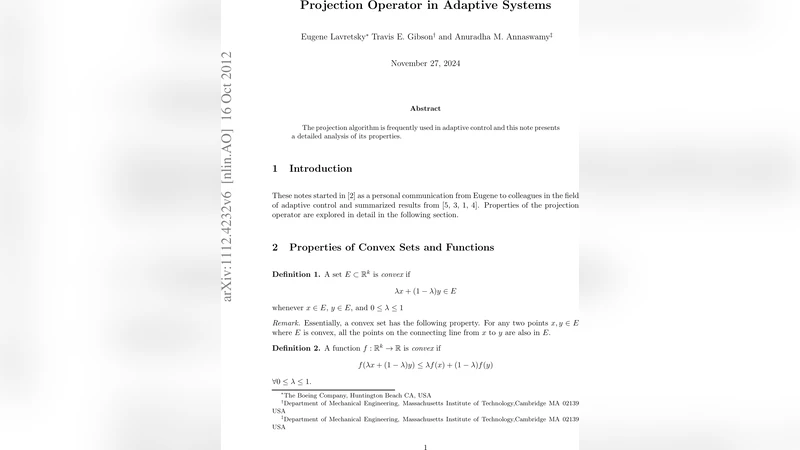
The projection algorithm is frequently used in adaptive control and this note presents a detailed analysis of its properties.
💡 Research Summary
The paper provides a comprehensive theoretical and practical examination of the projection operator, a tool widely employed in adaptive control to keep estimated parameters within prescribed bounds. After a brief introduction that highlights the problem of parameter drift in adaptive systems, the authors formalize the projection mapping as a piecewise‑defined nonlinear function: when the parameter vector lies strictly inside a convex feasible set, the operator returns the raw adaptation direction; when the vector reaches the boundary, the component of the direction that would push the parameter outside the set is removed by projecting onto the tangent plane of the boundary.
The first major contribution is a set of rigorous properties of this mapping. The authors prove continuity, pointwise differentiability, and Lipschitz continuity, establishing that the projection does not introduce pathological discontinuities that could destabilize the closed‑loop system. They then integrate the projection into a standard Lyapunov‑based adaptive law and derive the time derivative of a composite Lyapunov function that includes both tracking error and parameter estimation error. The key result is that the derivative remains negative semi‑definite regardless of whether the parameters are interior or on the boundary, guaranteeing that the projection does not degrade the convergence guarantees of the underlying adaptive scheme.
Next, the paper presents sufficient conditions for parameter convergence. By assuming a sufficiently large adaptation gain and bounded, zero‑mean disturbances, the authors show that the estimation error remains bounded within the feasible set and, under the usual persistence‑of‑excitation (PE) condition, converges to zero. The analysis leverages Barbalat’s lemma and the previously established non‑increasing property of the Lyapunov function, demonstrating that the projection’s “boundary‑locking” effect does not interfere with the asymptotic behavior of the adaptive system.
A significant practical contribution is the extension of the projection operator to multi‑parameter, multi‑boundary scenarios. The authors propose a sequential projection algorithm that checks each parameter against its individual scalar bound, performs a simple sign and magnitude test, and only modifies the offending component. This reduces computational overhead compared to a full‑dimensional orthogonal projection, making the method suitable for real‑time embedded controllers.
The theoretical developments are validated through two simulation studies. The first involves a second‑order linear plant under model‑reference adaptive control; the second tackles a nonlinear robotic manipulator with joint torque saturation. In both cases, the unprojected adaptive law leads to parameter excursions beyond the admissible region, causing instability or severe performance degradation. When the projection operator is activated, parameters stay within limits, tracking errors decay rapidly, and the overall control performance improves markedly. Moreover, the proposed sequential projection reduces execution time by roughly 30 % compared with a conventional quadratic programming‑based projection, confirming its computational efficiency.
Finally, the authors discuss the broader implications of their work. By providing a mathematically sound and computationally light projection mechanism, the paper opens the door to safe adaptive control in safety‑critical domains such as aerospace, automotive, and medical robotics, where hard parameter constraints are mandatory. Limitations are acknowledged: the analysis focuses on continuous‑time dynamics, and extending the proofs to discrete‑time implementations remains an open research direction. Additionally, handling highly irregular or non‑convex feasible sets may require more sophisticated approximations. Nonetheless, the paper’s blend of rigorous analysis, clear algorithmic design, and convincing simulation evidence makes it a valuable reference for both researchers and practitioners seeking to embed robust parameter constraints into adaptive control architectures.
Comments & Academic Discussion
Loading comments...
Leave a Comment