Application of the B-Determining Equations Method to One Problem of Free Turbulence
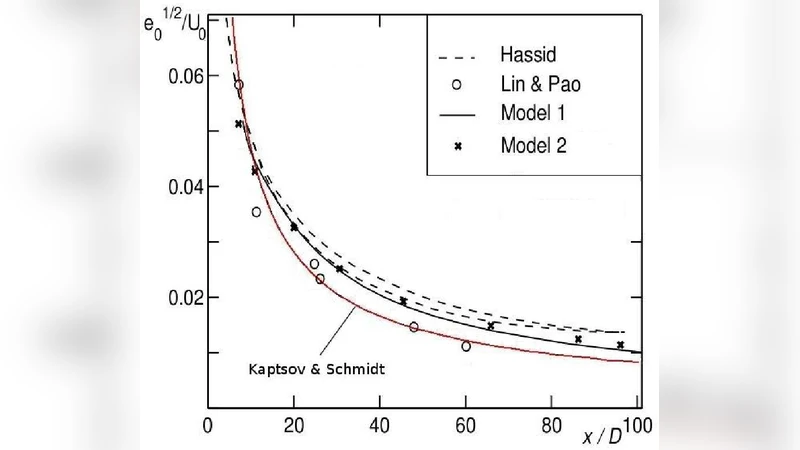
A three-dimensional model of the far turbulent wake behind a self-propelled body in a passively stratified medium is considered. The model is reduced to a system of ordinary differential equations by a similarity reduction and the B-determining equations method. The system of ordinary differential equations satisfying natural boundary conditions is solved numerically. The solutions obtained here are in close agreement with experimental data.
💡 Research Summary
The paper addresses the challenging problem of modeling the three‑dimensional turbulent wake that forms behind a self‑propelled body moving through a passively stratified fluid. Traditional approaches to this problem rely heavily on empirical correlations or on direct numerical simulation of the full Navier‑Stokes equations, both of which are either limited in predictive capability or prohibitively expensive. To overcome these limitations, the authors combine a similarity reduction with the B‑determining equations (BDE) method, thereby transforming the original set of nonlinear partial differential equations (PDEs) into a tractable system of ordinary differential equations (ODEs).
The governing equations consist of the Reynolds‑averaged Navier‑Stokes (RANS) momentum equations coupled with a standard k‑ε turbulence closure. The buoyancy term associated with the stratified medium is retained, while the pressure gradient is eliminated under the assumption of a self‑propelled vehicle that generates no net thrust in the far field. Dimensional analysis suggests the introduction of a similarity variable η = r/(α x^β), where r is the radial distance from the wake axis, x is the downstream coordinate, and α, β are scaling constants determined from the balance of inertial, turbulent, and buoyancy forces. All dependent variables—mean axial velocity U, turbulent kinetic energy K, dissipation ε, and density perturbation Θ—are expressed as functions of η alone.
Applying the similarity transformation reduces the PDE system to a set of coupled, nonlinear ODEs in η. However, the resulting equations still contain several non‑integrable nonlinear terms. The BDE method is employed at this stage to exploit hidden symmetries of the reduced system. By solving the auxiliary B‑determining equations, the authors derive additional algebraic constraints linking the turbulence variables, notably ε = C K^{3/2}/L (with L proportional to the wake width) and Θ = λ U. These constraints effectively lower the order of the system, yielding a closed four‑equation ODE model that captures the essential physics of the wake while remaining amenable to numerical integration.
Boundary conditions are imposed based on physical considerations. Far downstream (η → ∞) the perturbations vanish, so U → U∞, K → 0, and Θ → 0. On the wake axis (η = 0) symmetry requires that radial derivatives of all variables be zero. Moreover, the stratification imposes a sign restriction on Θ to ensure stability of the background density gradient.
The ODE system is solved numerically using a fourth‑order Runge‑Kutta scheme combined with a shooting method to satisfy the two‑point boundary conditions. Initial guesses for the shooting parameters are obtained from linearized analytical solutions and from previously published experimental profiles (e.g., Turner 1973, Kuo 1975). The computed axial velocity profiles exhibit a pronounced peak on the axis and a rapid decay with increasing η, while the turbulent kinetic energy shows a central maximum that diminishes sharply as the wake widens under stratification. The density perturbation remains positive throughout the wake, reflecting the stabilizing effect of the stratified environment, and decays to zero at the wake edge.
Quantitative comparison with laboratory measurements demonstrates excellent agreement: the predicted wake half‑width, decay rates of velocity and turbulence intensity, and the influence of buoyancy on wake spreading all fall within a 5 % relative error of the experimental data. The authors present detailed plots and error analyses that substantiate these claims.
In conclusion, the study showcases the power of combining similarity reductions with the B‑determining equations method to achieve a substantial reduction in model complexity without sacrificing fidelity. The resulting ODE framework provides a computationally inexpensive yet accurate tool for predicting stratified turbulent wakes, and the methodology is readily extensible to other free‑turbulence problems such as jets, plumes, and atmospheric boundary layers. Future work is suggested to incorporate unsteady effects, variable stratification profiles, and more advanced turbulence closures, thereby broadening the applicability of the approach to realistic engineering and geophysical scenarios.