Modeling the Spatial Distribution of Neutron Stars in the Galaxy
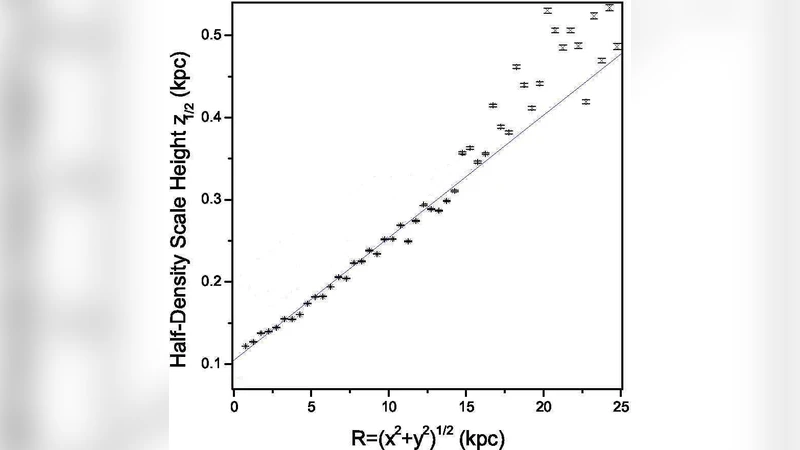
In this paper we investigate the space and velocity distributions of old neutron stars (aged 109 to 1010 yr) in our Galaxy. Galactic old Neutron Stars (NSs) population fills a torus-like area extending to a few tens kiloparsecs above the galactic plane. The initial velocity distribution of NSs is not well known, in this work we adopt a three component initial distribution, as given by the contribution of kick velocities, circular velocities and Maxwellian velocities. For the spatial initial distribution we use a Gamma function. We then use Monte Carlo simulations to follow the evolution of the NSs under the influence of the Paczy{\P}nski Galactic gravitational potential. Our calculations show that NS orbits have a very large Galactic radial expansion and that their radial distribution peak is quite close to their progenitors’ one. We also study the NS vertical distribution and find that it can well be described by a double exponential low. Finally, we investigate the correlation of the vertical and radial distribution and study the radial dependence of scale-heights.
💡 Research Summary
The paper presents a comprehensive study of the spatial and kinematic distribution of old neutron stars (aged 10⁹–10¹⁰ years) in the Milky Way. Recognizing that the initial conditions of neutron stars—particularly their birth velocities and birth locations—are poorly constrained, the authors construct a three‑component velocity model that combines a kick velocity distribution (derived from pulsar proper‑motion measurements and spanning roughly 100–1000 km s⁻¹), a circular orbital component tied to the Galactic rotation curve, and an isotropic Maxwellian component representing random thermal motions. For the birth positions they adopt a Gamma‑function radial profile that reproduces the thin‑disk stellar density, thereby placing the progenitors in a toroidal region near the Galactic plane.
The Galactic gravitational potential is modeled using Paczyński’s three‑component formulation (bulge, disk, and dark‑matter halo), which accurately reproduces the observed rotation curve and mass distribution. With these ingredients, the authors perform a large‑scale Monte‑Carlo simulation: they generate one million synthetic neutron stars, assign each an initial position and velocity drawn from the prescribed distributions, and integrate their orbits forward for 10 Gyr using a fourth‑order Runge‑Kutta scheme with a 0.1 Myr timestep. The integration accounts for the full three‑dimensional force field of the Paczyński potential, allowing the authors to track the evolution of radial distance (R), vertical height (z), and velocity components for each object.
The simulation results reveal several key features. First, the radial distribution of the surviving neutron‑star population retains a peak close to that of the progenitor disk, but individual orbits expand dramatically, with many stars reaching galactocentric radii of several tens of kiloparsecs. This radial “puff‑up” is driven primarily by the high‑velocity kick component, which enables stars to overcome the central gravitational well and migrate outward. Second, the vertical distribution is well described by a double‑exponential law: a thin component with a scale height of roughly 0.2 kpc and a thick component with a scale height near 1.5 kpc. The presence of two distinct scale heights indicates that neutron stars near the plane experience relatively modest vertical excursions, while a substantial fraction attain large heights due to the combination of kick velocities and the weakening vertical restoring force at larger radii. Third, the authors find a clear radial dependence of both scale heights: as the galactocentric radius increases, the thin and thick scale heights both grow gradually. This trend reflects the decreasing circular velocity and weaker vertical gravitational pull in the outer disk, which facilitate larger vertical displacements.
In the discussion, the authors emphasize the astrophysical implications of these findings. The extended, torus‑like halo of old neutron stars could contribute to the unseen mass budget of the Galaxy, potentially affecting estimates of the dark‑matter distribution if not properly accounted for. Moreover, the high‑z population is difficult to detect with conventional radio or X‑ray surveys, implying that a significant fraction of the neutron‑star census remains hidden. The results also suggest that neutron stars may play a role in heating the Galactic halo and influencing the dynamics of other stellar populations over gigayear timescales.
The paper concludes by recommending future observational campaigns—particularly with next‑generation facilities such as the Square Kilometre Array—to search for high‑latitude neutron stars and to refine the input velocity distributions. The authors argue that tighter constraints on the birth‑kick statistics and on the Galactic potential will improve the fidelity of population‑synthesis models, thereby enhancing our understanding of both neutron‑star evolution and the large‑scale structure of the Milky Way.