Random Walks, Electric Networks and The Transience Class problem of Sandpiles
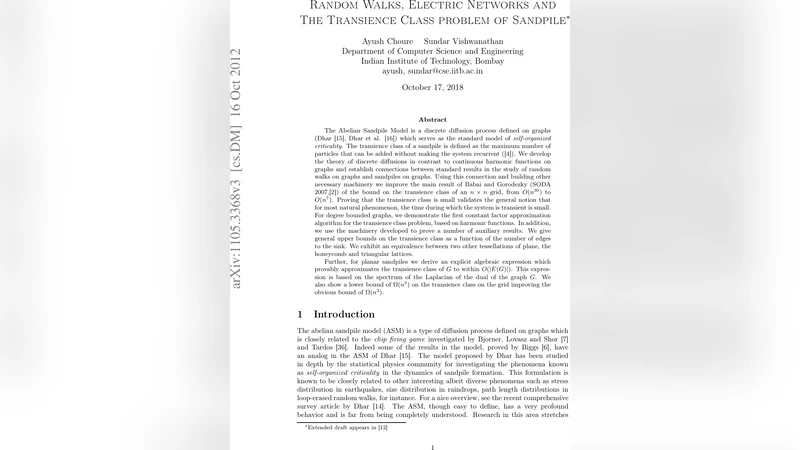
The Abelian Sandpile Model is a discrete diffusion process defined on graphs (Dhar \cite{DD90}, Dhar et al. \cite{DD95}) which serves as the standard model of \textit{self-organized criticality}. The transience class of a sandpile is defined as the maximum number of particles that can be added without making the system recurrent (\cite{BT05}). We develop the theory of discrete diffusions in contrast to continuous harmonic functions on graphs and establish deep connections between standard results in the study of random walks on graphs and sandpiles on graphs. Using this connection and building other necessary machinery we improve the main result of Babai and Gorodezky (SODA 2007,\cite{LB07}) of the bound on the transience class of an $n \times n$ grid, from $O(n^{30})$ to $O(n^{7})$. Proving that the transience class is small validates the general notion that for most natural phenomenon, the time during which the system is transient is small. In addition, we use the machinery developed to prove a number of auxiliary results. We exhibit an equivalence between two other tessellations of plane, the honeycomb and triangular lattices. We give general upper bounds on the transience class as a function of the number of edges to the sink. Further, for planar sandpiles we derive an explicit algebraic expression which provably approximates the transience class of $G$ to within $O(|E(G)|)$. This expression is based on the spectrum of the Laplacian of the dual of the graph $G$. We also show a lower bound of $\Omega(n^{3})$ on the transience class on the grid improving the obvious bound of $\Omega(n^{2})$.
💡 Research Summary
The paper investigates the transience class of the Abelian Sandpile Model (ASM), which measures the maximum number of particles that can be added to an initially empty sandpile before the system inevitably becomes recurrent. While Babai and Gorodezky (SODA 2007) previously established an upper bound of O(n³⁰) for the n × n square grid, empirical evidence suggested a much tighter bound, motivating a deeper theoretical analysis.
The authors’ central contribution is a rigorous connection between the transience class problem and classical concepts from random walks, electric network theory, and spectral graph theory. By interpreting the toppling potential vector (the number of times each vertex topples during a stabilization) as an electric potential, they translate the stabilization process into a system of linear equations governed by the graph Laplacian. Using linear programming duality, they show that the transience class can be expressed in terms of effective resistances between the sink and other vertices. Consequently, the transience class is bounded by quantities that are well‑studied in the theory of random walks and electrical networks.
Exploiting this connection, the paper derives several concrete results:
-
Improved Grid Bound: For the standard n × n grid sandpile, the authors prove an upper bound of O(n⁷), dramatically improving the previous O(n³⁰) bound. The proof combines symmetry arguments, a triangle inequality for potentials, and a careful analysis of corner‑to‑corner potentials on the grid.
-
Constant‑Factor Approximation for Bounded‑Degree Graphs: By identifying a maximal independent set of vertices with zero height (the “zero‑height independent set”), they design an algorithm that computes harmonic functions on the graph and yields a constant‑factor approximation of the transience class. The algorithm runs in near‑linear time with respect to the number of edges.
-
Spectral Approximation for Planar Sandpiles: For planar graphs, the authors give an explicit algebraic expression that approximates the transience class within O(|E(G)|) error. This expression depends on the eigenvalues of the Laplacian of the planar dual graph, linking the problem to effective resistance calculations in the dual network.
-
Equivalence of Honeycomb and Triangular Lattices: By showing that the honeycomb lattice and the triangular lattice are dual to each other, they prove that the transience class results transfer unchanged between these two tessellations.
-
General Upper Bounds via Sink Connections: They establish a family of upper bounds that depend only on the number of edges incident to the sink, providing a versatile tool for analyzing arbitrary sandpile graphs.
-
Improved Lower Bound for Grids: The paper also presents a new lower bound of Ω(n³) for the grid, strengthening the trivial Ω(n²) bound and demonstrating that the transience class grows super‑quadratically with the grid size.
The methodology blends combinatorial sandpile dynamics with analytic tools from probability and electrical engineering. By treating toppling as a diffusion process analogous to a random walk, the authors unlock a suite of powerful techniques—effective resistance, harmonic measure, and spectral analysis—that were previously unavailable to purely combinatorial approaches.
Beyond the main theorems, the paper discusses several open problems, including tightening the gap between the O(n⁷) upper bound and the conjectured O(n⁴) bound, extending the spectral approximation to non‑planar graphs, and developing faster algorithms for exact transience class computation.
Overall, the work establishes a robust theoretical framework that bridges discrete diffusion in sandpiles with continuous harmonic analysis on graphs, yielding both substantial improvements in known bounds and practical algorithms for approximating the transience class across a wide range of graph families.
Comments & Academic Discussion
Loading comments...
Leave a Comment