On the Homology of Completion and Torsion
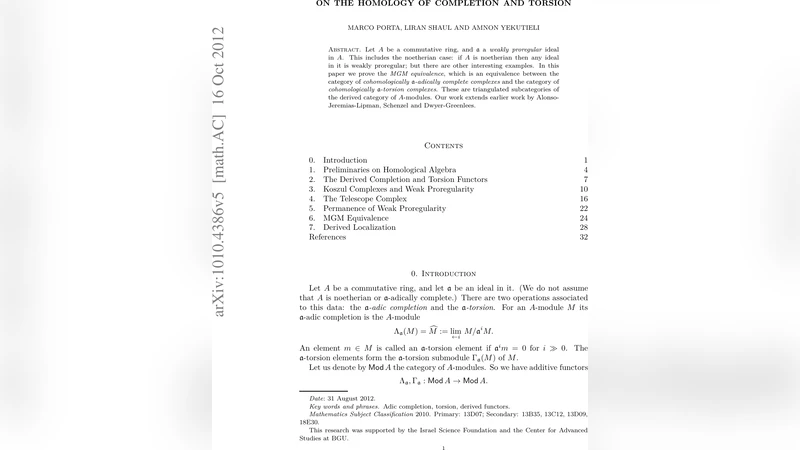
Let A be a commutative ring, and \a a weakly proregular ideal in A. This includes the noetherian case: if A is noetherian then any ideal in it is weakly proregular; but there are other interesting examples. In this paper we prove the MGM equivalence, which is an equivalence between the category of cohomologically \a-adically complete complexes and the category of cohomologically \a-torsion complexes. These are triangulated subcategories of the derived category of A-modules. Our work extends earlier work by Alonso- Jeremias-Lipman, Schenzel and Dwyer-Greenlees.
💡 Research Summary
The paper investigates the relationship between derived completion and derived torsion for a commutative ring A equipped with a weakly proregular ideal 𝔞. Weak proregularity, a condition automatically satisfied in the Noetherian setting, ensures that the inverse systems built from Koszul complexes behave well enough to define homotopy limits and colimits that model the derived functors. The authors construct explicit models: the derived torsion functor RΓ_𝔞 is represented by the Čech complex associated to powers of 𝔞, while the derived completion functor LΛ_𝔞 is modeled by the homotopy limit of Koszul complexes K(𝔞ⁿ). Under the weakly proregular hypothesis these two constructions commute with the necessary derived limits, allowing the definition of natural transformations
η : Id → LΛ_𝔞 ∘ RΓ_𝔞 and
ε : RΓ_𝔞 ∘ LΛ_𝔞 → Id.
The main theorem, often called the MGM equivalence (after Matlis, Greenlees, and May), states that the full triangulated subcategory of the derived category D(A) consisting of cohomologically 𝔞‑adic complete complexes (those X with X ≅ LΛ_𝔞X) is equivalent, via LΛ_𝔞, to the subcategory of cohomologically 𝔞‑torsion complexes (those Y with Y ≅ RΓ_𝔞Y). Moreover, LΛ_𝔞 and RΓ_𝔞 are mutually inverse equivalences, and η and ε satisfy the usual triangular identities, making the pair an adjoint equivalence of triangulated categories.
The proof proceeds in two stages. First, the authors verify that the Čech and Koszul models indeed compute RΓ_𝔞 and LΛ_𝔞 respectively, using the weak proregularity to control the passage to limits. Second, they establish that η and ε are isomorphisms on the appropriate subcategories by constructing explicit homotopies and invoking a spectral sequence originally due to Dwyer–Greenlees that relates local cohomology to derived completion. This spectral sequence collapses under weak proregularity, yielding the required isomorphisms.
The result subsumes earlier work: Alonso–Jeremías–Lipman proved the equivalence for Noetherian rings, while Schenzel introduced the notion of proregular ideals to treat a broader class. The present paper shows that weak proregularity is sufficient and, in many cases, more natural. It also provides concrete non‑Noetherian examples—such as certain valuation rings and completed regular local rings—where the equivalence holds.
Finally, the authors discuss applications and future directions. The MGM equivalence offers a powerful tool for derived deformation theory, allowing one to replace a complex by its 𝔞‑adic completion without loss of information about its 𝔞‑torsion. It also suggests a unified framework for studying local cohomology, completion, and support in derived algebraic geometry, potentially extending to spectral algebraic settings and to non‑commutative contexts where analogous regularity conditions can be formulated.
Comments & Academic Discussion
Loading comments...
Leave a Comment