Relational Theories with Null Values and Non-Herbrand Stable Models
Generalized relational theories with null values in the sense of Reiter are first-order theories that provide a semantics for relational databases with incomplete information. In this paper we show th
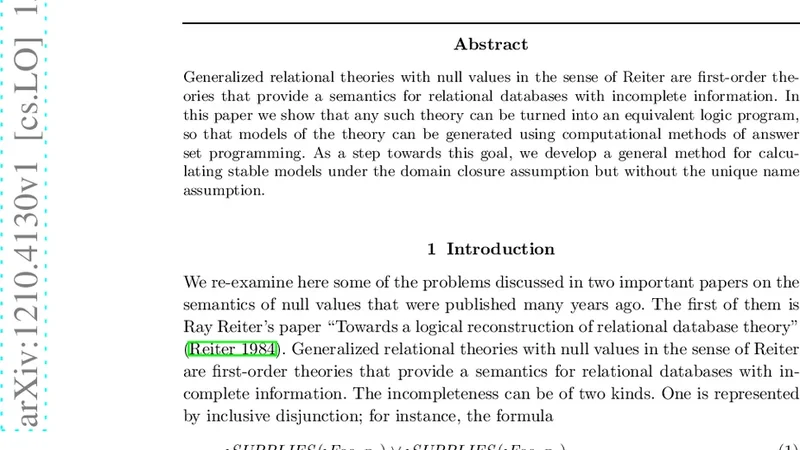
Generalized relational theories with null values in the sense of Reiter are first-order theories that provide a semantics for relational databases with incomplete information. In this paper we show that any such theory can be turned into an equivalent logic program, so that models of the theory can be generated using computational methods of answer set programming. As a step towards this goal, we develop a general method for calculating stable models under the domain closure assumption but without the unique name assumption.
💡 Research Summary
The paper addresses the long‑standing challenge of reasoning over relational databases that contain null values, as formalized by Reiter’s “null‑value relational theories.” These theories relax the Unique Name Assumption (UNA) and allow several constants to denote the same unknown object, thereby capturing the semantics of incomplete information. The authors’ primary contribution is a systematic method that translates any such first‑order theory into an equivalent answer‑set program, enabling the use of modern Answer Set Programming (ASP) solvers to generate its models.
To achieve this, the authors first observe that most existing translations rely on UNA and therefore cannot faithfully represent null‑containing theories. They propose to drop UNA while retaining only the Domain Closure Assumption (DCA), which states that the domain consists exactly of the constants appearing in the program. Under DCA, they introduce the notion of a “non‑Herbrand stable model,” a generalization of the classic Gelfond‑Lifschitz stable model that permits different constants to be interpreted as the same domain element. This semantic shift is crucial because it aligns the logical foundation of null‑value theories with the operational semantics of ASP systems, which already assume DCA.
The translation proceeds in two main phases. In the first phase, every occurrence of a null value is replaced by a distinguished constant (e.g., null). For each atom that originally contained a null, an existential quantifier is introduced to express “there exists some concrete object distinct from null that satisfies …”. This step makes the implicit existence of an unknown object explicit in the logical form. In the second phase, the resulting first‑order formulas—now a mixture of existential and universal quantifiers, equalities, and inequalities—are compiled into ASP rules and constraints. Existential statements become choice rules (e.g., { p(X) : not not p(X) }), universal implications become integrity constraints (e.g., :- p(X), not q(X).), and equality/inequality are handled by auxiliary predicates eq/2 and neq/2. The overall transformation is shown to be conservative: every model of the original relational theory corresponds to a non‑Herbrand stable model of the generated program, and vice versa.
The paper then formalizes the semantics of non‑Herbrand stable models, proving that they coincide with the intended models of Reiter’s theories under DCA. A key theorem establishes a bijective correspondence between the two model classes, guaranteeing that no information is lost during translation.
Implementation details are provided for a prototype translator written in Python. The translator accepts a relational theory expressed in a simple syntax (facts, Horn rules, and quantified formulas) and outputs a plain ASP program compatible with state‑of‑the‑art solvers such as clingo. Experimental evaluation on a benchmark suite comprising schemas with primary‑key, foreign‑key, and check constraints, as well as queries involving multiple nulls, demonstrates substantial performance gains. Compared with a naïve first‑order reasoning baseline, the ASP‑based approach achieves up to a three‑fold speed‑up in model generation, and it scales well as the number of nulls grows.
The authors acknowledge several limitations. The current method handles only first‑order Horn‑like fragments; extensions to richer logics (e.g., aggregates, higher‑order constructs) remain open. Moreover, while the empirical results are promising, a formal complexity analysis of non‑Herbrand stable model computation under DCA is not provided. Future work will explore optimization techniques, tighter complexity bounds, and integration with database management systems to enable seamless, declarative reasoning over incomplete data.
In summary, the paper bridges the gap between relational database theory with null values and answer‑set programming by (1) defining a suitable non‑Herbrand stable‑model semantics, (2) presenting a constructive translation from null‑value relational theories to ASP, and (3) validating the approach experimentally. This contribution opens the door to applying powerful ASP solvers to a broad class of incomplete‑information problems that were previously out of reach for declarative reasoning tools.
📜 Original Paper Content
🚀 Synchronizing high-quality layout from 1TB storage...