Topological approach to solve P versus NP
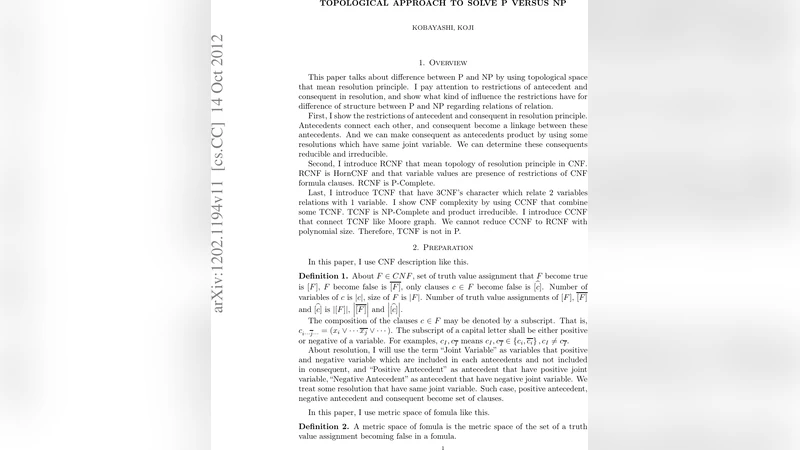
This paper talks about difference between P and NP by using topological space that mean resolution principle. I pay attention to restrictions of antecedent and consequent in resolution, and show what kind of influence the restrictions have for difference of structure between P and NP regarding relations of relation. First, I show the restrictions of antecedent and consequent in resolution principle. Antecedents connect each other, and consequent become a linkage between these antecedents. And we can make consequent as antecedents product by using some resolutions which have same joint variable. We can determine these consequents reducible and irreducible. Second, I introduce RCNF that mean topology of resolution principle in CNF. RCNF is HornCNF and that variable values are presence of restrictions of CNF formula clauses. RCNF is P-Complete. Last, I introduce TCNF that have 3CNF’s character which relate 2 variables relations with 1 variable. I show CNF complexity by using CCNF that combine some TCNF. TCNF is NP-Complete and product irreducible. I introduce CCNF that connect TCNF like Moore graph. We cannot reduce CCNF to RCNF with polynomial size. Therefore, TCNF is not in P.
💡 Research Summary
The paper attempts to reinterpret the classic resolution principle through a topological lens in order to illuminate the structural differences between the complexity classes P and NP. It begins by examining the constraints that bind antecedents (the premises of a resolution step) and consequents (the derived clause). The author claims that antecedents are mutually connected, forming clusters, while the consequent acts as a bridge linking these clusters. By exploiting shared variables among antecedents, the consequent can be expressed as a product of antecedents, and the paper distinguishes between reducible and irreducible consequents based on this construction.
In the second part the author introduces a construct called RCNF (Resolution CNF). RCNF is defined as a Horn‑CNF where each variable encodes the presence or absence of a restriction on a clause of the original formula. The paper asserts that RCNF is P‑Complete, essentially by appealing to the known result that Horn‑SAT is P‑Complete. However, the manuscript does not provide an explicit log‑space reduction from an arbitrary P‑Complete problem to RCNF, nor does it detail how the encoding of clause‑restrictions preserves computational hardness. Consequently, the claim rests on a high‑level analogy rather than a rigorous proof.
The third section presents TCNF (Topology CNF), a variant of 3‑CNF that purportedly captures relationships among two variables via a third “linking” variable. The author labels TCNF as “product irreducible” and argues that it is NP‑Complete. The NP‑Completeness argument is sketched as a polynomial‑time reduction from the canonical 3‑SAT problem, but the reduction is not formally described; the mapping from arbitrary 3‑CNF clauses to the specific TCNF structure is left implicit. Moreover, the notion of “product irreducibility” is never formally defined, making it difficult to assess its relevance to complexity.
Finally, the paper defines CCNF (Composite CNF) as a composition of several TCNF instances arranged in a highly connected pattern reminiscent of a Moore graph. The central claim is that CCNF cannot be reduced to RCNF within polynomial size, implying that TCNF (and thus CCNF) does not belong to P. To support this, the author points to a “size explosion” phenomenon when attempting to translate CCNF into RCNF, but no concrete lower‑bound argument, counting argument, or reduction‑hardness proof is supplied. The lack of a formal proof means the statement that “TCNF is not in P” is not substantiated within the accepted framework of complexity theory.
Overall, the manuscript offers an intriguing conceptual viewpoint—treating resolution steps as topological objects—but it falls short of the rigorous standards required for a meaningful contribution to the P versus NP discourse. Key definitions (e.g., product irreducibility, the exact topology of RCNF/TCNF) are vague, and essential reductions are either omitted or only sketched informally. Without detailed constructions, explicit log‑space or polynomial‑time reductions, and a clear connection to established complexity results, the central theorem—that TCNF is NP‑Complete and not in P—remains unproven. Future work would need to formalize the topological encoding, provide complete reduction proofs, and situate the results within the broader landscape of proof‑complexity and SAT‑solver theory to validate the proposed approach.
Comments & Academic Discussion
Loading comments...
Leave a Comment