A diffusion-induced transition in the phase separation of binary fluid mixtures subjected to a temperature ramp
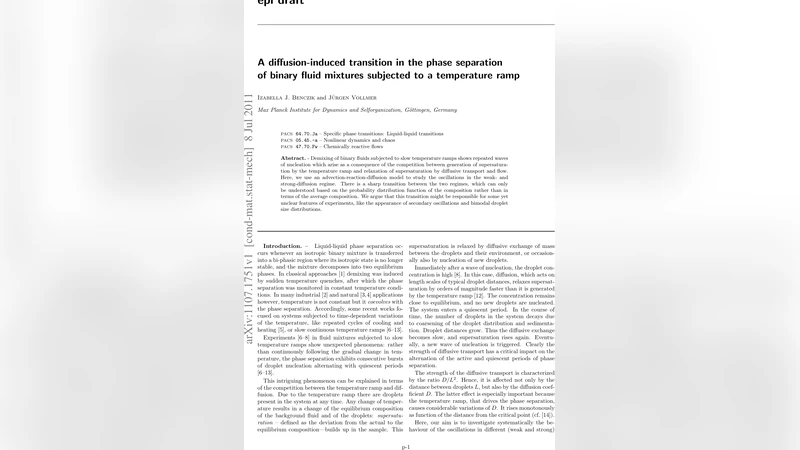
Demixing of binary fluids subjected to slow temperature ramps shows repeated waves of nucleation which arise as a consequence of the competition between generation of supersaturation by the temperature ramp and relaxation of supersaturation by diffusive transport and flow. Here, we use an advection-reaction-diffusion model to study the oscillations in the weak- and strong-diffusion regime. There is a sharp transition between the two regimes, which can only be understood based on the probability distribution function of the composition rather than in terms of the average composition. We argue that this transition might be responsible for some yet unclear features of experiments, like the appearance of secondary oscillations and bimodal droplet size distributions.
💡 Research Summary
**
The paper investigates the oscillatory phase‑separation dynamics of a binary fluid mixture that is subjected to a slow, continuous temperature ramp. In such a system, the equilibrium composition of the bulk fluid changes with temperature, causing a supersaturation (the deviation of the local composition from its instantaneous equilibrium value) to build up continuously. Supersaturation can be relaxed in two ways: (i) diffusive exchange of material between droplets and the surrounding fluid, and (ii) nucleation of new droplets when the local composition falls below a critical threshold. Because the temperature ramp continuously generates supersaturation, the system exhibits a sequence of “active” periods with rapid droplet nucleation followed by “quiescent” periods during which diffusion dominates and the supersaturation decays.
To capture these competing processes the authors employ an advection‑reaction‑diffusion (ARD) model for a scalar field σ(x,t) that represents the normalized composition (σ=1 in equilibrium, 0<σ<1 out of equilibrium). The governing equation is
∂σ/∂t + u·∇σ = Γ(σ) – ξσ + D∇²σ,
where ξ is the temperature‑dependent decay rate, D the diffusion coefficient, u a prescribed chaotic shear flow, and Γ(σ) a stochastic nucleation term. Nucleation is triggered when σ falls below a threshold σ_th = 2/3, with a piecewise‑linear probability a(σ). When nucleation occurs, σ in the affected cell and its eight neighbours is reset to σ=1, mimicking the creation of a droplet at equilibrium composition. The flow is a time‑periodic alternating shear that generates chaotic trajectories; its strength is measured by the Peclet number Pe = λL²/D (λ is the Lyapunov exponent of the flow). The characteristic size of homogeneous patches is ε* = L·Pe⁻¹ᐟ², which balances stretching by the flow and smoothing by diffusion.
Numerical simulations are performed on a square lattice (N×N cells) with periodic boundaries. The cell size is fixed at ε* and the flow amplitude A = 0.8, temperature‑ramp decay rate ξ = 0.04, and droplet interaction radius r₀ = ε* are held constant. The diffusion coefficient D is varied from 0.05 to 0.55, covering three regimes:
-
Weak‑diffusion regime (D ≈ 0.05–0.10).
Diffusion is too slow to relax supersaturation between nucleation events. The period of the nucleation oscillations increases with D, while the amplitude decays faster than in the diffusion‑less case. The probability distribution function (pdf) of σ remains essentially single‑peaked, and the small‑σ tail rarely reaches the nucleation threshold. -
Intermediate‑diffusion regime (D ≈ 0.14–0.16).
Here the system displays a pronounced transition. The oscillation period reaches a maximum, and secondary (or “2nd”) oscillations appear between the primary nucleation bursts. The σ‑pdf becomes bimodal: a large peak near σ = 1 (droplets already at equilibrium) coexists with a smaller peak that hovers near the nucleation threshold. This secondary peak is pushed rightward by diffusion (toward equilibrium) but leftward by the temperature ramp (toward the threshold). The competition yields repeated crossings of the threshold, generating the secondary bursts. Quantitatively, the decay rate of the oscillation amplitude γ_amplit and the decay rate of the average composition γ_σ both exhibit sharp extrema in this D range. γ_σ drops from a value close to ξ (the pure‑cooling rate) to a significantly lower value, indicating that diffusion now substantially slows the overall composition decay. -
Strong‑diffusion regime (D ≈ 0.25–0.55).
Diffusion is fast enough to erase supersaturation before the temperature ramp can drive σ below the threshold. The oscillation period shortens again, secondary bursts disappear, and both γ_amplit and γ_σ decrease smoothly with further increase of D. The σ‑pdf quickly collapses back to a single peak at σ = 1 after each nucleation event; the secondary peak never develops.
The transition point D_tr is identified as the diffusion coefficient at which the oscillation period is maximal and the secondary oscillations cease. Systematic scans show D_tr scales linearly with the cooling rate: D_tr ≈ 4 ξ (e.g., D_tr ≈ 0.16 for ξ = 0.04, D_tr ≈ 0.08 for ξ = 0.02). This scaling can be interpreted physically: the diffusion length Λ = D/ξ, which measures how far supersaturation can be relaxed during one cooling time, becomes comparable to the homogeneous‑patch size ε* (set by the balance of advection and diffusion). When Λ ≈ ε*, the system sits at the brink between diffusion‑dominated and ramp‑dominated dynamics, giving rise to the observed transition.
A key conceptual insight is that the transition cannot be captured by the mean composition σ_av alone. The full σ‑pdf is essential: in the weak‑diffusion regime the pdf remains narrow, in the strong‑diffusion regime it collapses rapidly to equilibrium, while in the intermediate regime the pdf is bimodal and its evolution determines the timing of nucleation bursts. Consequently, experimentally observed phenomena such as bimodal droplet‑size distributions and secondary oscillations can be understood as manifestations of this pdf‑bimodality.
The authors conclude that controlling the Peclet number (through flow strength) and the cooling rate offers a route to tailor the oscillatory behavior and droplet statistics in practical applications where temperature ramps are unavoidable (e.g., polymer processing, oil recovery, or material synthesis). The ARD framework presented provides a quantitative tool for predicting when a system will reside in the weak‑, intermediate‑, or strong‑diffusion regime and for anticipating the associated dynamical signatures.
Comments & Academic Discussion
Loading comments...
Leave a Comment