Designing Open Source Computer Models for Physics by Inquiry using Easy Java Simulation
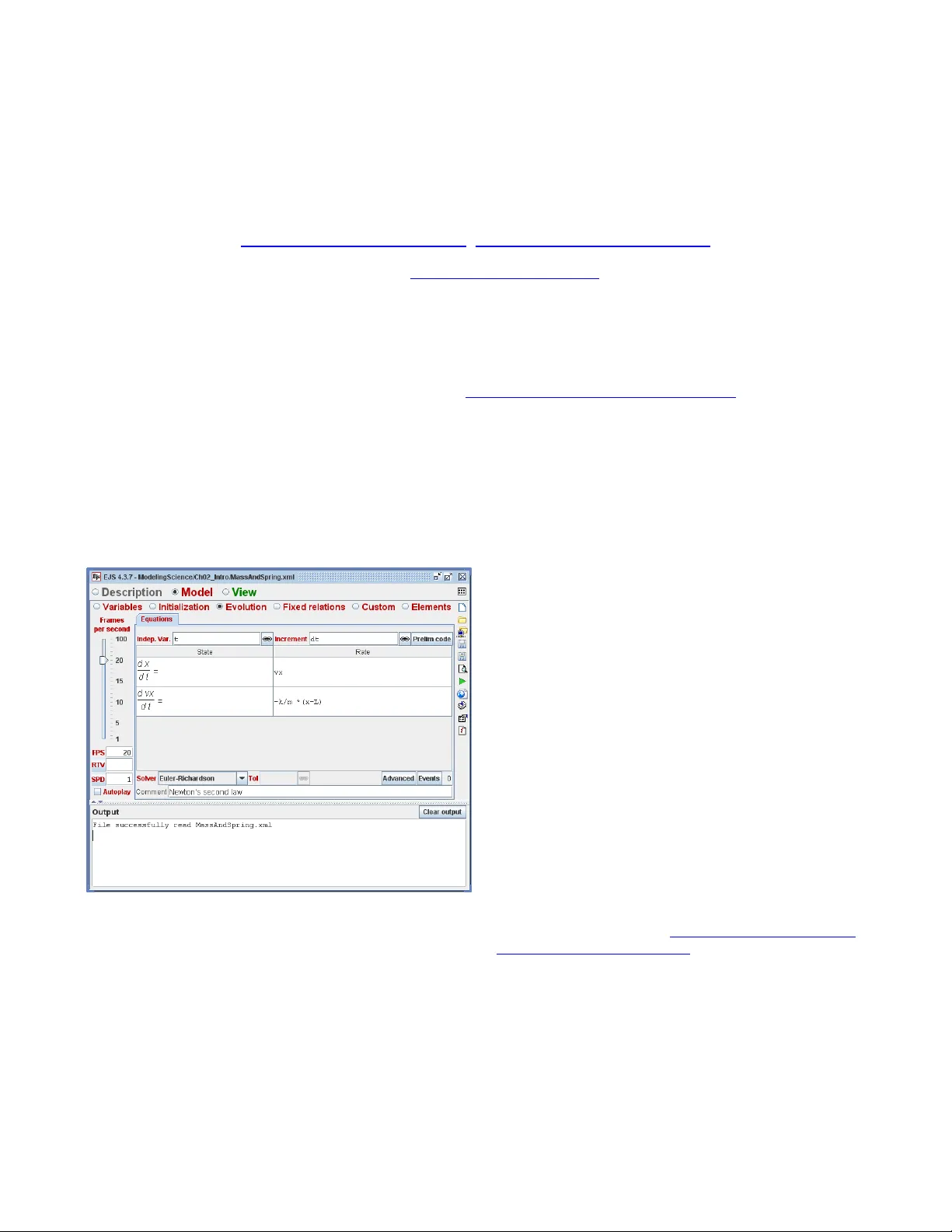
The Open Source Physics community has created hundreds of physics computer models (Wolfgang Christian, Esquembre, & Barbato, 2011; F. K. Hwang & Esquembre, 2003) which are mathematical computation representations of real-life Physics phenomenon. Since the source codes are available and can be modified for redistribution licensed Creative Commons Attribution or other compatible copyrights like GNU General Public License (GPL), educators can customize (Wee & Mak, 2009) these models for more targeted productive (Wee, 2012) activities for their classroom teaching and redistribute them to benefit all humankind. In this interactive event, we will share the basics of using the free authoring toolkit called Easy Java Simulation (W. Christian, Esquembre, & Mason, 2010; Esquembre, 2010) so that participants can modify the open source computer models for their own learning and teaching needs. These computer models has the potential to provide the experience and context, essential for deepening students conceptual understanding of Physics through student centred guided inquiry approach (Eick, Meadows, & Balkcom, 2005; Jackson, Dukerich, & Hestenes, 2008; McDermott, Shaffer, & Rosenquist, 1995; Wee, Lee, & Goh, 2011).
💡 Research Summary
The paper presents a practical framework for creating, customizing, and deploying open‑source physics computer models using the Easy Java Simulation (EJS) authoring toolkit. It begins by outlining the Open Source Physics (OSP) community’s extensive repository of hundreds of simulation models that represent real‑world phenomena through mathematical equations. Because these models are released under permissive licenses such as Creative Commons Attribution (CC‑BY) or the GNU General Public License (GPL), educators are legally free to modify the source code, adapt it to specific instructional goals, and redistribute the resulting versions without infringing copyright.
EJS serves as the technical bridge between physics theory and interactive software. The environment provides two main editors: a Model Builder where users input differential or algebraic equations, define parameters, initial conditions, and numerical integration methods (Euler, Runge‑Kutta, etc.); and a View Builder where graphical components—plots, animations, sliders, and control panels—are assembled. EJS automatically translates the mathematical description into Java code, compiles it, and exports a runnable JAR file or a web‑compatible applet. This workflow lowers the barrier for teachers who lack extensive programming experience, allowing them to focus on pedagogical design rather than low‑level coding details.
To illustrate the process, the authors walk through two concrete case studies. In the first, a simple pendulum model is re‑engineered: the gravitational constant and string length become user‑adjustable sliders, a real‑time angle‑versus‑time graph is added, and energy‑conservation diagnostics are displayed. In the second case, an RLC electrical circuit model is transformed so that resistance, inductance, and capacitance are each controlled by interactive sliders, while voltage and current waveforms are plotted simultaneously. These modifications enable students to formulate hypotheses (e.g., “What happens to the oscillation period if I increase the length?”) and instantly test them, thereby fostering a guided‑inquiry learning environment.
The paper situates these activities within a robust body of physics education research. It cites McDermott, Shaffer, and Rosenquist’s work on conceptual conflict, Hestenes, Dukerich, and Jackson’s research on dynamic modeling, and several studies (Eick et al., 2005; Jackson et al., 2008; Wee, 2012) that demonstrate how interactive simulations promote deeper conceptual change compared with traditional lecture‑based instruction. Moreover, the authors argue that teacher‑generated, curriculum‑aligned simulations increase student motivation and engagement, echoing findings from Wee, Lee, and Goh (2011).
Legal and dissemination considerations are also addressed. Because the underlying OSP models are open‑source, any derivative work must retain attribution to the original creators and be shared under the same license. This “share‑alike” requirement ensures that improvements circulate freely within the global teaching community, creating a virtuous cycle of resource enrichment.
In summary, the paper delivers a step‑by‑step guide to leveraging EJS for the rapid development of customized physics simulations, demonstrates the pedagogical advantages of embedding these tools in inquiry‑based curricula, and highlights the collaborative potential of open‑source licensing. By empowering educators to become both consumers and producers of simulation content, the approach promises to raise the quality of physics instruction worldwide and to provide an ever‑growing, freely accessible repository of interactive learning experiences.