Complexity of Ising Polynomials
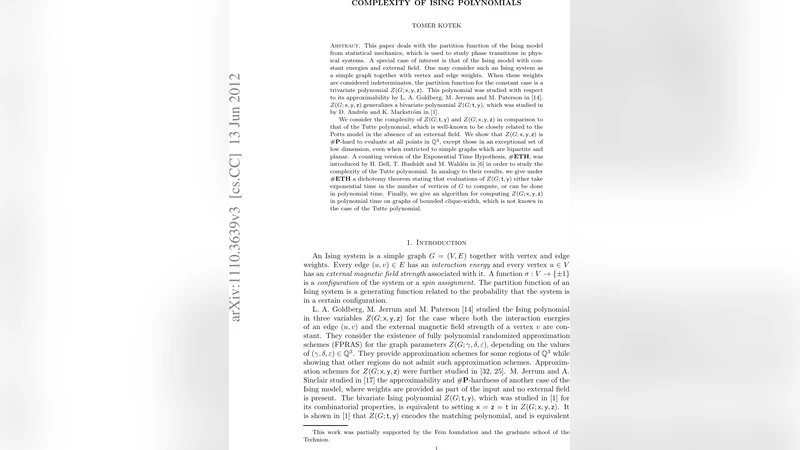
This paper deals with the partition function of the Ising model from statistical mechanics, which is used to study phase transitions in physical systems. A special case of interest is that of the Ising model with constant energies and external field. One may consider such an Ising system as a simple graph together with vertex and edge weights. When these weights are considered indeterminates, the partition function for the constant case is a trivariate polynomial Z(G;x,y,z). This polynomial was studied with respect to its approximability by L. A. Goldberg, M. Jerrum and M. Paterson in 2003. Z(G;x,y,z) generalizes a bivariate polynomial Z(G;t,y), which was studied by D. Andr'{e}n and K. Markstr"{o}m in 2009. We consider the complexity of Z(G;t,y) and Z(G;x,y,z) in comparison to that of the Tutte polynomial, which is well-known to be closely related to the Potts model in the absence of an external field. We show that Z(G;\x,\y,\z) is #P-hard to evaluate at all points in $mathbb{Q}^3$, except those in an exception set of low dimension, even when restricted to simple graphs which are bipartite and planar. A counting version of the Exponential Time Hypothesis, #ETH, was introduced by H. Dell, T. Husfeldt and M. Wahl'{e}n in 2010 in order to study the complexity of the Tutte polynomial. In analogy to their results, we give a dichotomy theorem stating that evaluations of Z(G;t,y) either take exponential time in the number of vertices of $G$ to compute, or can be done in polynomial time. Finally, we give an algorithm for computing Z(G;x,y,z) in polynomial time on graphs of bounded clique-width, which is not known in the case of the Tutte polynomial.
💡 Research Summary
The paper investigates the exact computational complexity of the Ising model’s partition function when both interaction energies and external fields are constant, formalized as a trivariate polynomial Z(G; x, y, z). This polynomial generalizes the well‑studied bivariate version Z(G; t, y) (obtained by setting x = z = t). The authors compare these Ising polynomials to the Tutte polynomial, which corresponds to the Potts model without an external field, and they establish several new hardness and algorithmic results.
The first major result (Theorem 2) shows that evaluating Z(G; γ, δ, ε) is #P‑hard for essentially all rational triples (γ, δ, ε)∈ℚ³, except for a low‑dimensional exceptional set B that is a finite union of algebraic sets of dimension two. This hardness persists even when the input graph is restricted to be simple, bipartite, and planar, mirroring known hardness for the Tutte polynomial on such graph classes.
The second contribution (Theorem 1) provides a complete dichotomy for the bivariate Ising polynomial Z(G; t, y). If t∈{−1, 0, 1} or y = 0, the polynomial can be computed in polynomial time; in these cases the polynomial encodes well‑understood combinatorial quantities such as the matching polynomial, the number of perfect matchings, or the number of maximum cuts. For all other rational pairs (γ, δ), the evaluation is #P‑hard, and under the counting version of the Exponential Time Hypothesis (#ETH) it requires exponential time Ω(cⁿ) for some c > 1, where n is the number of vertices. The lower bound is proved by constructing a family of “Φ‑graphs” that allow interpolation of the variable t, analogous to the use of Θ‑graphs for the Tutte polynomial.
The third result (Theorem 3) addresses algorithmic tractability on restricted graph classes. Using the logical framework for graph parameters and known algorithms for bounded tree‑width, the authors show that Z(G; x, y, z) can be computed in O(n·f(k)) time on graphs whose clique‑width is at most k, where f is a function depending only on k. Consequently, the polynomial is polynomial‑time computable on any fixed‑k clique‑width class (including all graphs of bounded tree‑width). However, they also prove that, unless FPT = W
Comments & Academic Discussion
Loading comments...
Leave a Comment