Contemporary Semantic Web Service Frameworks: An Overview and Comparisons
The growing proliferation of distributed information systems, allows organizations to offer their business processes to a worldwide audience through Web services. Semantic Web services have emerged as a means to achieve the vision of automatic discovery, selection, composition, and invocation of Web services by encoding the specifications of these software components in an unambiguous and machine-interpretable form. Several frameworks have been devised as enabling technologies for Semantic Web services. In this paper, we survey the prominent Semantic Web service frameworks. In addition, a set of criteria is identified and the discussed frameworks are evaluated and compared with respect to these criteria. Knowing the strengths and weaknesses of the Semantic Web service frameworks can help researchers to utilize the most appropriate one according to their needs.
💡 Research Summary
The paper provides a comprehensive survey of the major Semantic Web Service (SWS) frameworks that have been proposed to fulfill the vision of fully automated service discovery, selection, composition, and invocation. It begins by outlining the limitations of traditional Web service technologies (WSDL, SOAP, UDDI) which rely on human‑readable documentation and therefore cannot support end‑to‑end automation. To overcome this, a semantic layer is required that encodes service capabilities, inputs, outputs, pre‑ and post‑conditions, and non‑functional attributes in a machine‑interpretable form.
The authors categorize existing frameworks into two broad families: (1) annotation‑based approaches that enrich existing WSDL descriptions with semantic metadata (e.g., SAWSDL, WSMO‑LD) and (2) model‑centric approaches that build a full ontological representation of services (e.g., OWL‑S, WSMO). For each family they discuss the underlying technologies, the role of ontologies (OWL, RDF, WSML), and the mechanisms for linking syntactic and semantic layers (lifting/lowering, mediators, goal‑oriented matching).
Four representative frameworks are examined in depth:
-
OWL‑S – a three‑layer architecture (ServiceProfile, ServiceModel, ServiceGrounding) that uses OWL ontologies to describe functional and non‑functional aspects. It offers the richest expressivity but requires dedicated tooling and a reasoning engine, which raises implementation complexity.
-
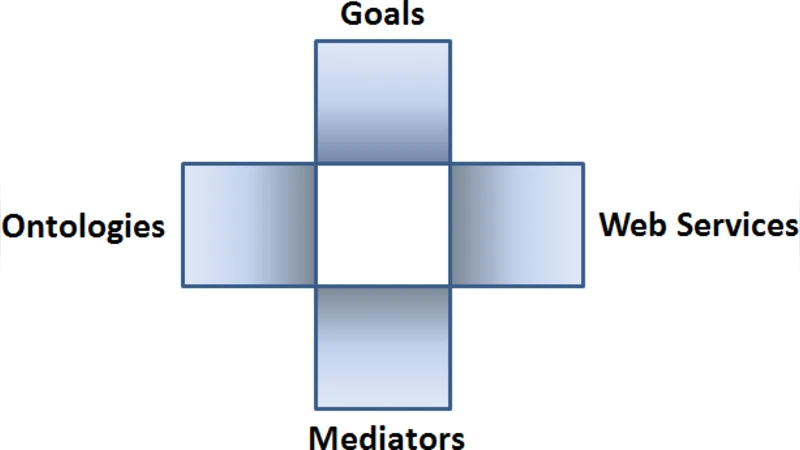
WSMO – the Web Service Modeling Ontology introduces a multi‑level meta‑model (WSMO‑LD, WSMO‑F, WSMO‑S) that separates annotation, functional description, and execution. Its mediator concept enables heterogeneous service integration, and the Goal‑Oriented approach supports sophisticated composition scenarios.
-
SAWSDL – a lightweight extension of WSDL that adds modelReference, lifting, and lowering annotations. It preserves full compatibility with existing SOAP/REST services, making adoption easy, but its semantic expressivity is limited to simple class/property mappings and does not support advanced reasoning.
-
SADI – a REST‑centric framework that directly couples RDF/OWL ontologies with HTTP resources. It automatically generates input/output transformations, which is ideal for data‑intensive scientific domains, yet it lacks a formal process model for complex business workflows.
To evaluate these frameworks, the authors define a set of criteria:
- Expressivity – the ability to model detailed functional, non‑functional, and constraint information.
- Interoperability – compatibility with other standards, tools, and legacy services.
- Automation Support – how well the framework integrates with discovery, matchmaking, and composition algorithms.
- Implementation Effort – learning curve, tooling availability, and integration cost.
- Scalability & Extensibility – capacity to accommodate new domains, protocols, and evolving requirements.
- Standardization & Community – maturity of specifications, presence of open‑source implementations, and active developer ecosystems.
Using both qualitative assessment and quantitative case studies, the paper shows that high‑expressivity frameworks (OWL‑S, WSMO) excel in enterprise‑level scenarios where complex business rules, multi‑step workflows, and QoS constraints must be reasoned about automatically. However, they demand substantial upfront investment in ontology engineering and reasoning infrastructure. In contrast, annotation‑based solutions (SAWSDL) and lightweight REST‑oriented approaches (SADI) are more suitable for rapid prototyping, integration of legacy services, or domains where data transformation is the primary concern.
The authors present three illustrative use‑cases:
-
Enterprise e‑commerce platform – requires sophisticated order processing, inventory management, and dynamic pricing. An OWL‑S‑based service registry combined with a reasoning engine enabled automatic composition of supplier and logistics services.
-
Scientific data integration – a consortium of bio‑informatics databases exposed their data via REST endpoints. SADI automatically generated RDF views and facilitated SPARQL‑based queries across heterogeneous sources, demonstrating the strength of REST‑semantic coupling.
-
Government open‑data portal – existing SOAP APIs were semantically annotated using SAWSDL, allowing a public service catalog to be searchable by functional keywords without re‑engineering the underlying services.
In the discussion, the paper identifies several open challenges: the lack of standardized non‑functional metadata (security, trust, QoS) hampers fully automated selection; current reasoning engines are often heavyweight and not well suited for cloud‑native, elastic environments; and there is a growing interest in hybrid models that combine lightweight annotations with richer ontological descriptions to balance ease of adoption and expressive power. The authors advocate for:
- Development of a unified QoS/ security ontology that can be plugged into any SWS framework.
- Integration of lightweight, incremental reasoning techniques (e.g., rule‑based forward chaining) with scalable cloud services.
- Creation of open‑source toolchains that cover the entire lifecycle—from ontology design, through service annotation, to runtime execution and monitoring.
In conclusion, the paper provides a clear decision matrix for researchers and practitioners: select OWL‑S or WSMO when maximal automation and deep semantic reasoning are required; choose SAWSDL for quick semantic enrichment of existing services; adopt SADI for data‑driven, RESTful ecosystems. By mapping each framework’s strengths and weaknesses against the defined criteria, the study equips the community with actionable guidance for aligning technology choices with project goals, resource constraints, and long‑term maintenance considerations.