A relative theory of universal central extensions
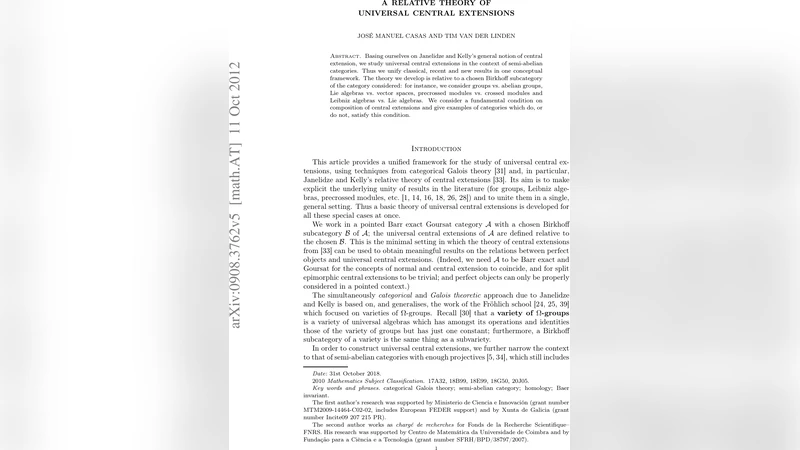
Basing ourselves on Janelidze and Kelly’s general notion of central extension, we study universal central extensions in the context of semi-abelian categories. Thus we unify classical, recent and new results in one conceptual framework. The theory we develop is relative to a chosen Birkhoff subcategory of the category considered: for instance, we consider groups vs. abelian groups, Lie algebras vs. vector spaces, precrossed modules vs. crossed modules and Leibniz algebras vs. Lie algebras. We consider a fundamental condition on composition of central extensions and give examples of categories which do, or do not, satisfy this condition.
💡 Research Summary
The paper develops a relative theory of universal central extensions (UCEs) within the setting of semi‑abelian categories, using Janelidze‑Kelly’s general notion of central extension as a foundation. Rather than treating centrality as an absolute property, the authors fix a Birkhoff subcategory 𝔅 of the ambient category 𝒞 and define a “𝔅‑central extension” as a regular epimorphism whose kernel is 𝔅‑central, i.e., becomes trivial after passing to the 𝔅‑reflection. This relative viewpoint unifies classical cases (groups versus abelian groups) and more recent examples (Lie algebras versus vector spaces, precrossed modules versus crossed modules, Leibniz algebras versus Lie algebras).
A central technical contribution is the introduction of a composition condition, denoted (C). Condition (C) specifies when the composite of two 𝔅‑central extensions remains 𝔅‑central. It requires that the kernels of the two extensions be 𝔅‑regular and that the crossed effect of the second kernel on the image of the first be 𝔅‑regular as well. The authors prove that in any semi‑abelian category where regularity is preserved under pullback and where the crossed effect behaves well, condition (C) holds automatically. Consequently, the existence and uniqueness of a universal 𝔅‑central extension can be established by constructing the initial object among all 𝔅‑central extensions.
The paper illustrates the theory with several concrete categories. In the category of groups with 𝔅 = abelian groups, condition (C) is always satisfied, recovering the classical Schur‑multiplicator picture. For Lie algebras over a field with 𝔅 = vector spaces, the same holds, giving the familiar Lie‑algebraic UCE. In contrast, for Leibniz algebras with 𝔅 = Lie algebras, the authors present counter‑examples where the composition of two 𝔅‑central extensions fails to be 𝔅‑central, showing that condition (C) is not automatic in this setting. The analysis of precrossed modules versus crossed modules demonstrates how a regularization process (crossed‑module reflection) restores condition (C), linking the theory to higher‑dimensional homology.
Finally, the authors prove a general existence theorem: if the 𝔅‑regular kernels are sufficiently “complete” (i.e., the class of 𝔅‑central extensions admits a colimit), then there exists a universal 𝔅‑central extension, unique up to isomorphism. This result subsumes all known cases and provides a clear categorical criterion for the existence of UCEs in new algebraic contexts. The paper concludes by suggesting future work on identifying further Birkhoff subcategories that satisfy condition (C), exploring connections with higher homology, and extending the framework to non‑abelian 2‑categories and quantum algebraic structures.
Comments & Academic Discussion
Loading comments...
Leave a Comment