Coding for Fast Content Download
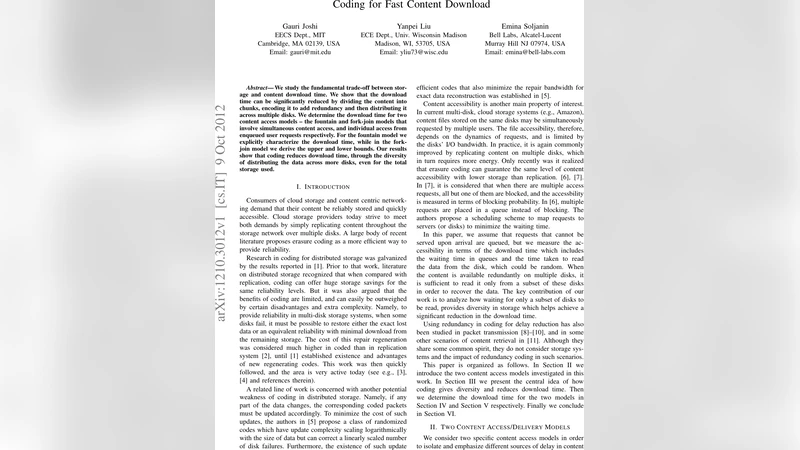
We study the fundamental trade-off between storage and content download time. We show that the download time can be significantly reduced by dividing the content into chunks, encoding it to add redundancy and then distributing it across multiple disks. We determine the download time for two content access models - the fountain and fork-join models that involve simultaneous content access, and individual access from enqueued user requests respectively. For the fountain model we explicitly characterize the download time, while in the fork-join model we derive the upper and lower bounds. Our results show that coding reduces download time, through the diversity of distributing the data across more disks, even for the total storage used.
💡 Research Summary
The paper addresses a fundamental performance problem in large‑scale storage systems: how to reduce the time required to download a piece of content without incurring prohibitive storage overhead. The authors propose a coding‑based strategy that first partitions a file into k chunks, then applies a Maximum Distance Separable (MDS) code to generate n (encoded) chunks (n ≥ k). Because any k of the n chunks suffice to reconstruct the original file, the system gains resilience to slow or failed disks while keeping the total storage cost essentially the same as simple replication (the storage factor is n/k).
Two distinct access scenarios are examined.
- Fountain Model – A user simultaneously requests all n disks and waits for the first k responses. Assuming independent exponential service times with rate μ, the authors use order‑statistics to derive an exact expression for the expected download latency:
E
Comments & Academic Discussion
Loading comments...
Leave a Comment