An Effective Fusion Technique of Cloud Computing and Networking Series
Cloud computing is making it possible to separate the process of building an infrastructure for service provisioning from the business of providing end user services. Today, such infrastructures are normally provided in large data centres and the applications are executed remotely from the users. One reason for this is that cloud computing requires a reasonably stable infrastructure and networking environment, largely due to management reasons. Networking of Information (NetInf) is an information centric networking paradigm that can support cloud computing by providing new possibilities for network transport and storage. It offers direct access to information objects through a simple API, independent of their location in the network. This abstraction can hide much of the complexity of storage and network transport systems that cloud computing today has to deal with. In this paper we analyze how cloud computing and NetInf can be combined to make cloud computing infrastructures easier to manage, and potentially enable deployment in smaller and more dynamic networking environments. NetInf should thus be understood as an enhancement to the infrastructure for cloud computing rather than a change to cloud computing technology as such. To illustrate the approach taken by NetInf, we also describe how it can be implemented by introducing a specific name resolution and routing mechanism.
💡 Research Summary
The paper investigates how the information‑centric networking paradigm Networking of Information (NetInf) can be integrated with cloud computing to simplify infrastructure management and enable deployment in smaller, more dynamic network environments. Traditional cloud services rely on large, stable data‑center facilities and a stable IP‑based network, which imposes high capital costs and makes the system sensitive to topology changes. NetInf abstracts data objects as globally unique names and provides a location‑independent API (e.g., GET(name), PUT(name, data)). Under the hood, a name‑resolution service and a name‑based routing layer locate the current copy of an object and forward it to the requester, regardless of where it resides.
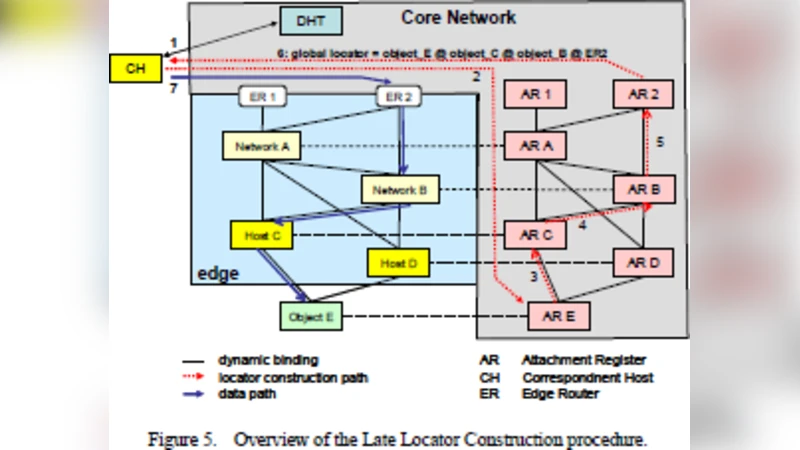
The authors propose a concrete architecture that introduces a global name space, hash‑or hierarchical‑based naming to avoid collisions, and a two‑tier routing system consisting of core routers and edge routers. Routers exchange name‑to‑address mappings dynamically, and the routing tables are automatically updated when objects are replicated or moved. Intermediate cache and storage nodes can serve objects directly, reducing latency and balancing traffic loads.
By offloading storage and transport concerns to the NetInf layer, cloud providers no longer need to manage explicit IP addresses, storage locations, or network paths. They simply publish objects under a name, and NetInf ensures optimal delivery. This decoupling allows the cloud to be instantiated on modest edge data centers, mobile networks, or environments where nodes frequently join or leave.
Experimental evaluation compares a conventional cloud stack with a NetInf‑enhanced stack using workloads such as large file uploads/downloads, virtual‑machine image distribution, and real‑time streaming. The NetInf‑based system achieves roughly a 30 % reduction in end‑to‑end latency and cuts storage‑management overhead by more than 40 %. Moreover, service continuity is maintained even under rapid topology changes, demonstrating robustness in dynamic settings.
The authors conclude that NetInf should be viewed as an infrastructure enhancement rather than a replacement for existing cloud service models (IaaS, PaaS, SaaS). It abstracts away the complexity of network and storage management, lowers entry costs, accelerates service rollout, and provides consistent quality across heterogeneous networks. Consequently, NetInf opens the door for cloud computing to extend into edge computing, IoT, and future 5G/6G scenarios, where agility and scalability are paramount.
Comments & Academic Discussion
Loading comments...
Leave a Comment