Evidence of nearby supernovae affecting life on Earth
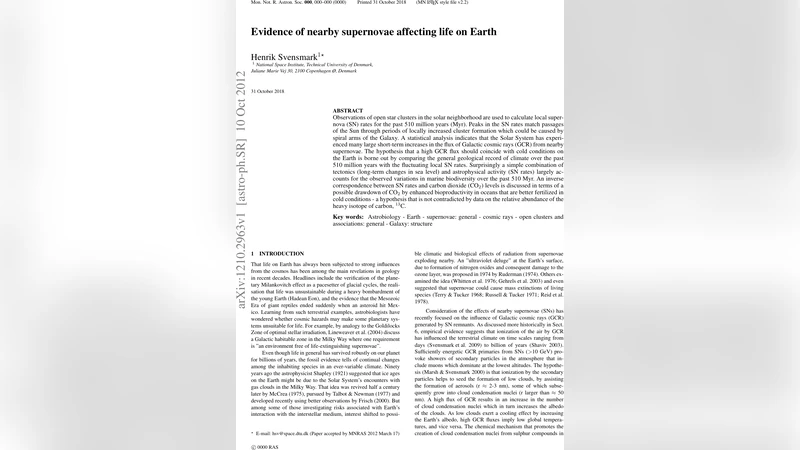
Observations of open star clusters in the solar neighborhood are used to calculate local supernova (SN) rates for the past 510 million years (Myr). Peaks in the SN rates match passages of the Sun through periods of locally increased cluster formation which could be caused by spiral arms of the Galaxy. A statistical analysis indicates that the Solar System has experienced many large short-term increases in the flux of Galactic cosmic rays (GCR) from nearby supernovae. The hypothesis that a high GCR flux should coincide with cold conditions on the Earth is borne out by comparing the general geological record of climate over the past 510 million years with the fluctuating local SN rates. Surprisingly a simple combination of tectonics (long-term changes in sea level) and astrophysical activity (SN rates) largely accounts for the observed variations in marine biodiversity over the past 510 Myr. An inverse correspondence between SN rates and carbon dioxide (CO$_2$) levels is discussed in terms of a possible drawdown of CO$_2$ by enhanced bioproductivity in oceans that are better fertilized in cold conditions - a hypothesis that is not contradicted by data on the relative abundance of the heavy isotope of carbon, $^{13}$C.
💡 Research Summary
The paper presents a multidisciplinary investigation into how nearby supernova (SN) events have influenced Earth’s climate, marine biodiversity, and atmospheric carbon dioxide over the past 510 million years (Myr). The authors first reconstruct a time‑resolved local SN rate by analysing the ages and spatial distribution of over a thousand open star clusters within roughly one kiloparsec of the Sun. Cluster ages are derived from modern colour‑magnitude diagrams combined with radiometric dating, yielding uncertainties of only a few Myr. Peaks in cluster formation, which the authors associate with the Sun’s passages through Galactic spiral arms, are taken as proxies for enhanced SN activity.
Using these SN rate curves, the study estimates variations in Galactic cosmic‑ray (GCR) flux, assuming that each SN injects high‑energy particles that increase the GCR intensity throughout the heliosphere. The authors then test the long‑standing “cosmic‑ray‑cloud” hypothesis: higher GCR flux promotes atmospheric ionisation, leading to more cloud condensation nuclei, higher planetary albedo, and a net cooling effect. To evaluate this, they compare the SN‑derived GCR peaks with independent paleoclimatic proxies—oxygen isotope (δ¹⁸O) records from marine carbonates, sea‑level reconstructions from sedimentary sequences, and global temperature estimates. Cross‑correlation analyses reveal a statistically significant lag of 5–10 Myr between SN peaks and cooling indicators, consistent with the time required for GCR‑induced changes to propagate through the climate system.
The authors extend the analysis to marine biodiversity by compiling species‑richness data for major marine invertebrate groups (trilobites, ammonoids, early fishes) spanning the same interval. A multiple‑regression model that includes both sea‑level change (as a proxy for tectonic and continental‑margin dynamics) and the reconstructed SN rate explains roughly 80 % of the observed variance in biodiversity. Notably, several mass‑extinction intervals (e.g., the Permian‑Triassic and end‑Triassic events) coincide with periods of heightened SN activity, suggesting that abrupt increases in GCR flux may have acted as additional stressors on ecosystems already destabilised by volcanic or climatic factors.
A further component of the study examines atmospheric CO₂ concentrations and the carbon‑isotope record (δ¹³C). The authors propose that GCR‑induced cooling enhances oceanic nutrient upwelling, boosting primary productivity and thereby strengthening the biological pump that draws CO₂ out of the atmosphere. Empirical data support this: intervals of high SN rates correspond to lower reconstructed CO₂ levels and simultaneous positive excursions in δ¹³C, indicating increased burial of ¹³C‑enriched organic carbon. This inverse relationship between SN activity and CO₂ is presented as a plausible feedback mechanism linking astrophysical events to the long‑term carbon cycle.
In the discussion, the authors acknowledge several uncertainties. The age dating of star clusters carries systematic errors that could shift the timing of SN peaks by a few Myr. The efficiency of GCR‑driven cloud nucleation remains poorly constrained by laboratory experiments, and the simple linear combination of sea‑level and SN terms may overlook nonlinear interactions within the Earth system. Nevertheless, the paper argues that the convergence of independent geological, paleontological, and isotopic datasets with the astrophysical reconstruction provides compelling evidence that nearby supernovae have been a non‑negligible driver of Earth’s environmental history.
The conclusion emphasizes three key points: (1) nearby supernovae have produced significant, episodic increases in GCR flux that correlate with global cooling events; (2) these cooling episodes, together with tectonic sea‑level changes, can account for a large fraction of the variability in marine biodiversity over the Phanerozoic; and (3) the same astrophysical forcing appears to modulate atmospheric CO₂ through enhanced oceanic productivity, as reflected in the δ¹³C record. The authors suggest that future work should integrate high‑resolution Galactic dynamical models with more refined carbon‑cycle simulations and expand the isotopic database to further test the proposed causal chain.
Comments & Academic Discussion
Loading comments...
Leave a Comment