Protein Inference and Protein Quantification: Two Sides of the Same Coin
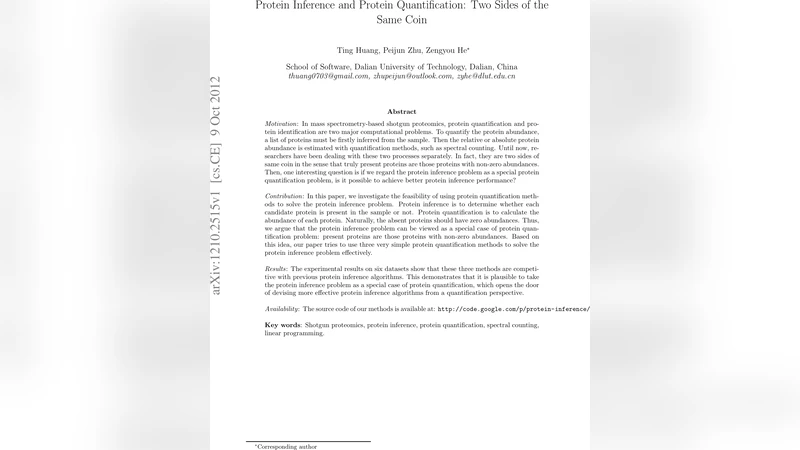
Motivation: In mass spectrometry-based shotgun proteomics, protein quantification and protein identification are two major computational problems. To quantify the protein abundance, a list of proteins must be firstly inferred from the sample. Then the relative or absolute protein abundance is estimated with quantification methods, such as spectral counting. Until now, researchers have been dealing with these two processes separately. In fact, they are two sides of same coin in the sense that truly present proteins are those proteins with non-zero abundances. Then, one interesting question is if we regard the protein inference problem as a special protein quantification problem, is it possible to achieve better protein inference performance? Contribution: In this paper, we investigate the feasibility of using protein quantification methods to solve the protein inference problem. Protein inference is to determine whether each candidate protein is present in the sample or not. Protein quantification is to calculate the abundance of each protein. Naturally, the absent proteins should have zero abundances. Thus, we argue that the protein inference problem can be viewed as a special case of protein quantification problem: present proteins are those proteins with non-zero abundances. Based on this idea, our paper tries to use three very simple protein quantification methods to solve the protein inference problem effectively. Results: The experimental results on six datasets show that these three methods are competitive with previous protein inference algorithms. This demonstrates that it is plausible to take the protein inference problem as a special case of protein quantification, which opens the door of devising more effective protein inference algorithms from a quantification perspective.
💡 Research Summary
In shotgun proteomics, the tasks of protein identification (inference) and protein quantification are traditionally treated as separate computational steps. The authors of this paper propose a unifying perspective: protein inference can be regarded as a special case of protein quantification, where truly present proteins correspond to non‑zero abundance estimates. Under this premise, they investigate whether simple quantification algorithms can be directly employed to decide protein presence/absence, thereby bypassing dedicated inference models.
Three elementary quantification strategies are examined. The first is a raw spectral counting approach that aggregates the number of MS/MS spectra assigned to each protein. The second uses PeptideProphet scores, weighting each peptide’s contribution by its confidence and summing these weights per protein. The third employs a linear least‑squares model that fits peptide‑level intensities to protein‑level abundance estimates. In each case, a pre‑defined abundance threshold is applied: proteins with aggregated values above the threshold are declared present, while those at or below are considered absent.
The authors evaluate these methods on six publicly available shotgun proteomics datasets, encompassing diverse organisms and experimental designs (e.g., ISB18, human liver, yeast). Performance is benchmarked against three widely used inference tools—ProteinProphet, Fido, and Percolator—using precision, recall, F1‑score, and ROC‑AUC as metrics. Results show that all three quantification‑based approaches achieve competitive recall and overall F1‑scores, often matching or surpassing the reference methods. Notably, the raw spectral count method delivers high sensitivity with minimal computational overhead, while the PeptideProphet‑weighted sum effectively suppresses noisy peptide contributions, improving precision. The least‑squares model captures subtle abundance differences but is more sensitive to threshold selection.
A systematic analysis of the abundance threshold reveals the classic precision‑recall trade‑off: lower thresholds boost recall at the expense of precision, whereas higher thresholds improve precision but risk missing low‑abundance proteins. This behavior mirrors that of traditional inference algorithms, indicating that quantification‑based inference still requires careful parameter tuning to meet specific experimental goals.
The paper’s key contributions are threefold. First, it reframes protein inference as a quantification problem, offering a conceptual bridge between two historically distinct pipelines. Second, it demonstrates that even the most straightforward quantification schemes can rival sophisticated inference models, suggesting that the added complexity of Bayesian networks or graph‑based probabilistic frameworks may be unnecessary for many applications. Third, it highlights that the same tunable parameters governing quantification (e.g., abundance thresholds, weighting schemes) can be leveraged to balance precision and recall, providing users with a unified control knob for both identification and quantification objectives.
Future directions proposed by the authors include integrating more advanced quantification techniques—such as label‑free quantification (LFQ), MS1‑based intensity measures, or deep‑learning‑driven abundance estimators—into the inference framework to further enhance accuracy. They also envision multi‑task learning models that simultaneously predict condition‑specific protein presence while estimating abundances across multiple experimental states, thereby exploiting inter‑sample variability. Finally, hybrid approaches that combine the strengths of quantification‑derived abundance scores with probabilistic inference (e.g., feeding quantification outputs into ProteinProphet‑like Bayesian networks) could yield even more robust protein identification pipelines.