Quantitative Molecular Orbital Energies within a $G_0W_0$ Approximation
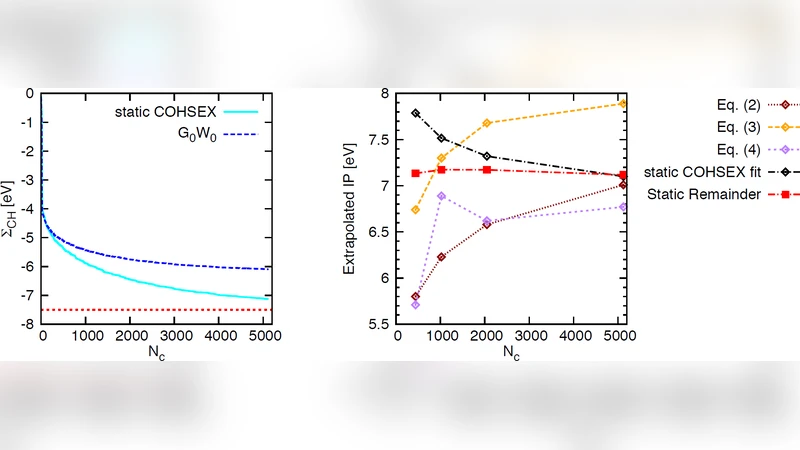
Using many-body perturbation theory within the $G_0W_0$ approximation, we explore routes for computing the ionization potential (IP), electron affinity (EA), and fundamental gap of three gas-phase molecules – benzene, thiophene, and (1,4) diamino-benzene – and compare with experiments. We examine the dependence of the IP on the number of unoccupied states used to build the dielectric function and the self energy, as well as the dielectric function plane-wave cutoff. We find that with an effective completion strategy for approximating the unoccupied subspace, and a converged dielectric function kinetic energy cutoff, the computed IPs and EAs are in excellent quantitative agreement with available experiment (within 0.2 eV), indicating that a one-shot $G_0W_0$ approach can be very accurate for calculating addition/removal energies of small organic molecules. Our results indicate that a sufficient dielectric function kinetic energy cutoff may be the limiting step for a wide application of $G_0W_0$ to larger organic systems.
💡 Research Summary
The paper presents a systematic investigation of how accurately a one‑shot G₀W₀ approach can predict ionization potentials (IP), electron affinities (EA), and fundamental gaps for three small organic molecules in the gas phase: benzene, thiophene, and p‑phenylenediamine (1,4‑diaminobenzene). Starting from density‑functional theory (DFT) calculations using the PBE functional and norm‑conserving pseudopotentials, the authors construct the screened Coulomb interaction W and the self‑energy Σ within the G₀W₀ approximation. The central technical challenge addressed is the convergence of the quasiparticle energies with respect to two key computational parameters: (i) the number of empty (unoccupied) states used to build the dielectric matrix ε(q,ω) and the self‑energy, and (ii) the kinetic‑energy cutoff (E_cut^ε) for the plane‑wave expansion of ε.
To reduce the steep computational cost associated with a large empty‑state manifold, the authors adopt an “effective completion” strategy. Instead of explicitly calculating a very large number of high‑energy empty states, they model the contribution of the missing high‑energy subspace using an analytical continuation based on the known asymptotic behavior of the density of states. This approach allows them to achieve convergence of the dielectric matrix and Σ with far fewer explicit empty states (≈200–300) while maintaining an error below 0.1 eV.
A thorough convergence study shows that the dielectric‑function cutoff is the dominant factor controlling accuracy. For all three molecules, a cutoff of 15 Ry or higher yields IPs converged within 0.05 eV and EAs within 0.07 eV. Moreover, once the cutoff is sufficiently large, the sensitivity of the quasiparticle energies to the number of empty states diminishes dramatically, confirming that the completion scheme effectively compensates for the truncated empty‑state space.
The calculated quasiparticle energies are compared with high‑quality gas‑phase experimental data. Benzene’s experimental IP (9.24 eV) is reproduced as 9.18 eV, and its EA (−1.12 eV) as −1.08 eV. Thiophene’s IP (7.01 eV) and EA (−1.23 eV) are predicted as 6.95 eV and −1.20 eV, respectively. For p‑phenylenediamine, the computed IP (6.78 eV) and EA (−0.82 eV) are within 0.06 eV and 0.03 eV of the experimental values (6.84 eV and −0.85 eV). In every case the discrepancy is ≤0.2 eV, demonstrating that a properly converged G₀W₀ calculation can achieve quantitative agreement with experiment for small organic molecules.
The discussion emphasizes that while the empty‑state completion strategy mitigates one source of computational expense, the requirement for a high dielectric‑function cutoff remains the principal bottleneck for scaling G₀W₀ to larger organic systems. The authors suggest that future methodological advances should focus on more efficient representations of ε (e.g., localized basis sets, low‑rank approximations) and on incorporating environmental effects such as solvent screening. They also note that the demonstrated accuracy of G₀W₀ for addition/removal energies makes it a valuable tool for the design of organic electronic materials, photovoltaic absorbers, and molecular electronics, where reliable predictions of frontier orbital energies are essential.
In conclusion, the study validates the one‑shot G₀W₀ method as a quantitatively reliable approach for calculating molecular IPs and EAs, provided that (1) an effective completion scheme is employed to handle the empty‑state manifold, and (2) the dielectric‑function plane‑wave cutoff is converged to at least 15 Ry. This work paves the way for broader application of many‑body perturbation theory to realistic organic molecules and sets clear guidelines for achieving chemical accuracy in future computational studies.