Can Nondeterminism Help Complementation?
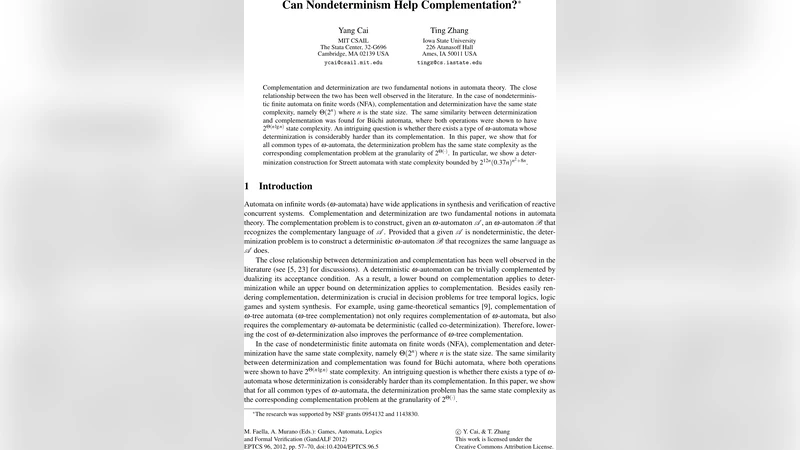
Complementation and determinization are two fundamental notions in automata theory. The close relationship between the two has been well observed in the literature. In the case of nondeterministic finite automata on finite words (NFA), complementation and determinization have the same state complexity, namely Theta(2^n) where n is the state size. The same similarity between determinization and complementation was found for Buchi automata, where both operations were shown to have 2^\Theta(n lg n) state complexity. An intriguing question is whether there exists a type of omega-automata whose determinization is considerably harder than its complementation. In this paper, we show that for all common types of omega-automata, the determinization problem has the same state complexity as the corresponding complementation problem at the granularity of 2^\Theta(.).
💡 Research Summary
The paper investigates the relationship between two fundamental operations on ω‑automata—complementation and determinization—and shows that, for all commonly studied types of ω‑automata, the state‑complexity of determinization matches that of complementation up to a 2^{Θ(·)} factor. The authors begin by recalling that for nondeterministic finite automata (NFA) on finite words and for Büchi automata on infinite words, both operations have the same asymptotic complexity (Θ(2ⁿ) for NFAs and 2^{Θ(n log n)} for Büchi automata). They then pose the natural question: does there exist an ω‑automaton model whose determinization is asymptotically harder than its complementation?
The focus of the technical contribution is Streett automata, for which the previously known bounds were far apart: a lower bound of 2^{Ω(n² log n)} and an upper bound of 2^{O(n k log nk)} (where n is the number of states and k the number of Streett pairs). The authors close this gap by presenting a new determinization construction that achieves the lower bound up to a constant factor. The construction rests on two novel ideas.
-
Correlation‑aware tree structures.
The authors introduce the Increasing Tree of Sets (ITS) and the Tree of Ordered Partitions (TOP). ITS captures the inclusion relationships among the Streett index sets, revealing strong correlations when the index size k grows. By organizing these correlations in a hierarchical tree, many redundant nodes that appear in the classic Safra trees can be eliminated. TOP, which resembles Safra trees, is used to manage the ordering of partitions and further restrict the tree’s width. Together, these structures dramatically reduce the size of the underlying Safra‑style tree that represents the deterministic state. -
Block‑based naming scheme.
In traditional Safra constructions each node receives a single fresh name from a pool, and names are recycled individually when nodes disappear. This “retail‑style” allocation becomes a dominant cost when k is small because the number of names needed grows with the number of nodes. The new scheme partitions the name space into even‑sized blocks; an entire block is allocated to a branch when it is created and reclaimed as a unit when the branch vanishes. This wholesale approach cuts the naming overhead from O(log k) bits per node to a constant, eliminating the naming bottleneck for k = O(n).
Applying these ideas yields a determinization algorithm with the following state‑complexity:
- When k = O(n): 2^{O(n log n + n k log k)}.
- When k = ω(n): 2^{O(n² log n)}.
In particular, for the worst case k = n − 1 the bound improves from the previous 2^{12 n·(0.37 n)^{n²}+8 n} to a much tighter expression. The authors also demonstrate that the same technique can be adapted to generalized Büchi, parity, and Rabin automata, establishing that for each of these models determinization and complementation share the same 2^{Θ(·)} complexity. Consequently, the long‑standing “coincidence” that determinization is no harder than complementation holds universally for the standard ω‑automata families.
The paper concludes by discussing the practical implications for ω‑tree automata and game‑based synthesis/verification, where deterministic automata are required for complement operations. Reducing determinization costs directly improves the efficiency of these higher‑level algorithms. The authors suggest future work on tightening constant factors, extending the approach to Muller conditions, and providing experimental validation within verification toolchains.
Comments & Academic Discussion
Loading comments...
Leave a Comment