Exact Quantum Algorithms for the Leader Election Problem
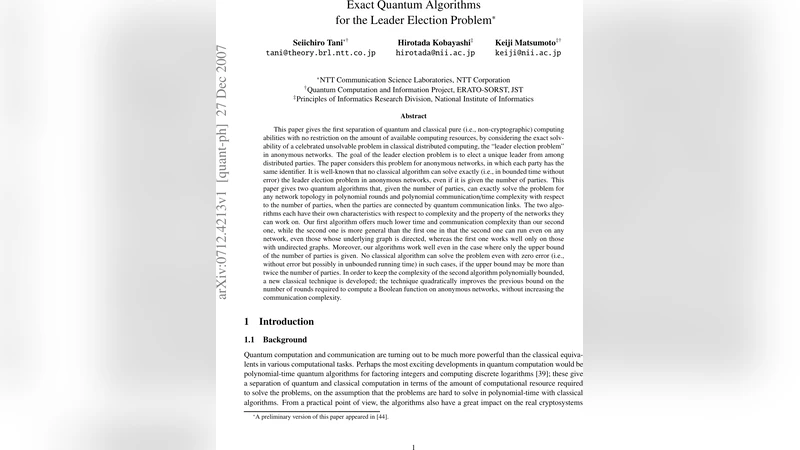
This paper gives the first separation of quantum and classical pure (i.e., non-cryptographic) computing abilities with no restriction on the amount of available computing resources, by considering the exact solvability of a celebrated unsolvable problem in classical distributed computing, the ``leader election problem’’ on anonymous networks. The goal of the leader election problem is to elect a unique leader from among distributed parties. The paper considers this problem for anonymous networks, in which each party has the same identifier. It is well-known that no classical algorithm can solve exactly (i.e., in bounded time without error) the leader election problem in anonymous networks, even if it is given the number of parties. This paper gives two quantum algorithms that, given the number of parties, can exactly solve the problem for any network topology in polynomial rounds and polynomial communication/time complexity with respect to the number of parties, when the parties are connected by quantum communication links.
💡 Research Summary
The paper establishes the first unconditional separation between quantum and classical computing abilities for a pure (non‑cryptographic) task without any resource restrictions, by solving exactly the leader election problem on anonymous networks. In an anonymous network every node starts with the same identifier, so classical deterministic algorithms cannot break symmetry, and even randomized algorithms cannot guarantee zero error because there is a non‑zero probability that all nodes generate the same random bits. Consequently, no classical exact (bounded‑time, zero‑error) algorithm exists for a broad class of topologies, especially those containing cycles.
The authors present two quantum protocols that, given the exact number of parties n, elect a unique leader with certainty in polynomial time and communication cost, regardless of the underlying graph structure. Both protocols assume synchronous communication over quantum channels and no noise.
Algorithm I works on undirected (bidirectional) graphs. In each of n – 1 phases every eligible node prepares a qubit in the superposition (|0⟩+|1⟩)/√2, while ineligible nodes prepare |0⟩. The nodes then collectively test, via a distributed quantum circuit, whether all eligible nodes have the same qubit content. The test creates a superposition of the “all equal” and “not all equal” classical cases. After the test the parties perform a reversible “uncomputation” step to erase garbage, which requires bidirectional communication. Measuring the ancillary qubit collapses the system into one of two possibilities: (1) a state that guarantees at least one eligible node will obtain a different classical bit after measurement, thereby reducing the eligible set, or (2) a cat‑state where all eligible nodes would obtain the same bit. In the latter case the protocol applies a family of unitary operations U_k or V_k (depending on parity of k = n – i + 1) that transform the cat‑state into a configuration that still reduces the eligible set. The whole phase therefore eliminates at least one candidate. The protocol repeats this phase n – 1 times, guaranteeing a single leader. Complexity: each phase uses O(D·n²) quantum communication (D = maximum degree), total rounds O(n²), overall time O(D·n³) = O(n³), and total communication O(|E|·n²). Quantum communication volume is O(n⁴) qubits, which dominates the classical bits.
Algorithm II is more general: it works on any strongly connected directed graph as well as undirected ones. It avoids the reversible uncomputation step, thereby eliminating the need for bidirectional links. The protocol begins with a single round of quantum communication that distributes enough entanglement (e.g., a GHZ‑type state) among all nodes. After this initialization, the algorithm proceeds entirely with local quantum operations and classical messages (LOCC). The key technical tool is the “folded view”, a novel data structure extending Ordered Binary Decision Diagrams (OBDDs). Each node builds a hierarchical representation of the global Boolean function that decides eligibility, by folding information from its neighbors. Using this representation the nodes can compute the exact number of eligible parties and decide which subset to eliminate, all with only O(n log n) classical rounds after the initial quantum round. The time complexity becomes O(D·n⁵ (log n)²), while quantum communication is reduced to O(|E| log n) qubits (essentially one entangled qubit per edge). Classical communication remains polynomial, O(D·|E|·n³ (log D) log n) bits. The round complexity is O(n log n), a dramatic improvement over Algorithm I’s O(n²) rounds.
Both algorithms can be adapted to the case where only an upper bound N on the number of parties is known. Algorithm I simply replaces n with N in all formulas, preserving its polynomial bounds. Algorithm II, however, requires the exact count to manage the folded view; the authors therefore propose a “Generalized Algorithm II” that first determines the exact n using the upper bound N and then proceeds as before. This variant incurs an extra polynomial factor, yielding O(D·N⁶ (log N)²) time and O(N log N) rounds, with quantum communication O(|E| N log N) qubits.
The paper also discusses practical considerations. The protocols assume ideal, noiseless quantum channels and unitary operations with precision scaling as O(1/n). In realistic settings, decoherence and finite precision would introduce errors, so the algorithms are primarily of theoretical interest, demonstrating a clear computability advantage of quantum distributed computing over any classical counterpart. The authors argue that this advantage is stronger than previous separations based on speed or resource consumption; here the quantum model can solve a problem that is provably unsolvable exactly by any classical algorithm, even with unlimited computational power.
In summary, the authors introduce two exact quantum leader‑election protocols for anonymous networks, achieving polynomial‑time and polynomial‑communication performance while overcoming fundamental symmetry‑breaking barriers that cripple classical algorithms. The work opens new directions for quantum distributed algorithm design, especially for tasks where symmetry breaking and exact correctness are essential.
Comments & Academic Discussion
Loading comments...
Leave a Comment