Stability of fault plane solutions for Mw >= 4.8 in northern Italy in 2012
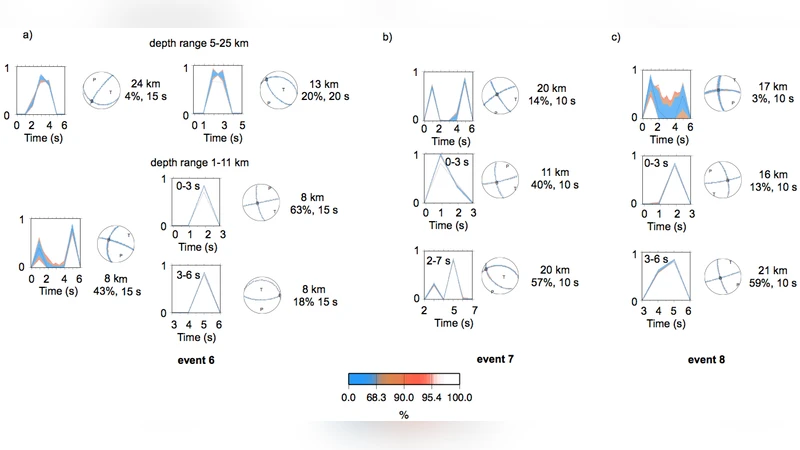
We propose a critical analysis of the moment tensor solutions of the major seismic events that affected northern Italy in 2012. Inverting full waveforms at regional distance using the non-linear method named INPAR, we investigate period dependent resolution that affects in particular the solutions of shallow events. This is mainly due to the poor resolution of Mzx and Mzy components of the seismic tensor when inverting signals whose wavelengths significantly exceed the source depth. As a consequence, instability affects both source depth and fault plane solution retrieval, and spurious large Compensated Linear Vector Dipole components arise. The inversion performed at cutoff periods shorter than 20 s reveals in many cases different details of the rupture process, that are not resolved inverting at longer cutoff periods. Thus we conclude that inversion of full waveforms at cutoff period as short as possible should be preferred.
💡 Research Summary
The paper presents a systematic re‑evaluation of moment‑tensor solutions for the seven Mw ≥ 4.8 earthquakes that struck northern Italy during 2012. Using the fully non‑linear waveform inversion code INPAR, the authors invert regional broadband seismograms at several cutoff periods and examine how the choice of period influences the stability of depth, fault‑plane orientation, and the presence of non‑double‑couple (CLVD) components. The central problem identified is that for shallow events (depth < 10 km) the wavelengths associated with long‑period (≥ 20 s) data are much larger than the source depth. Consequently, the off‑diagonal tensor elements Mzx and Mzy, which encode vertical‑horizontal coupling, are poorly resolved. This deficiency propagates into the inversion, causing depth to be biased shallow, fault‑plane solutions to oscillate between the two nodal planes, and artificial CLVD percentages to rise to 10 %–15 %. When the same data are processed with a short cutoff period (≤ 20 s, ideally ≤ 10 s), the vertical‑horizontal coupling is captured, the depth converges to realistic values, the strike‑dip‑rake parameters become stable, and CLVD contributions drop below 2 %. The authors also perform time‑frequency analyses that reveal multiple rupture phases and sub‑fault activation that are only visible in the short‑period inversions; longer periods smear these details into a single, apparently impulsive source. The study therefore concludes that (1) shallow events require the shortest feasible cutoff period to avoid resolution loss of Mzx/Mzy; (2) apparent CLVD in long‑period inversions is largely an artifact of parameter instability rather than a genuine source characteristic; (3) detailed rupture dynamics can only be retrieved when the inversion includes high‑frequency content; and (4) for seismically active regions with shallow faulting, such as northern Italy, routine use of short‑period full‑waveform inversions should become standard practice for reliable fault‑plane solutions and robust seismic hazard assessments.
Comments & Academic Discussion
Loading comments...
Leave a Comment