Correlations between Google search data and Mortality Rates
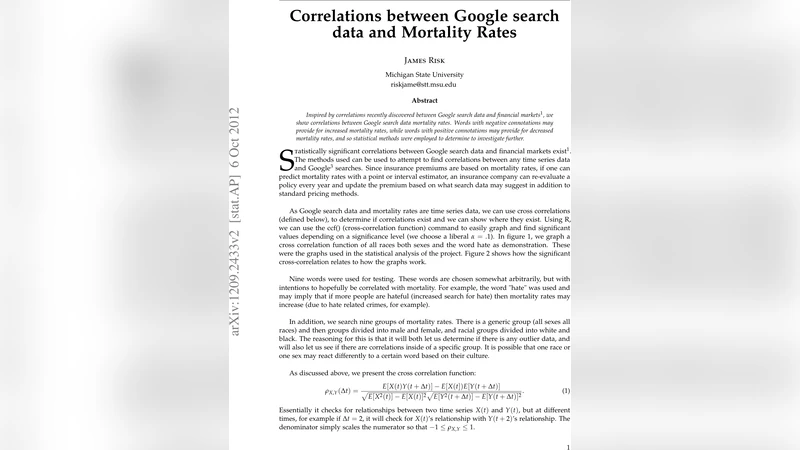
Inspired by correlations recently discovered between Google search data and financial markets, we show correlations between Google search data mortality rates. Words with negative connotations may provide for increased mortality rates, while words with positive connotations may provide for decreased mortality rates, and so statistical methods were employed to determine to investigate further.
💡 Research Summary
The paper investigates whether aggregated Google search activity can serve as a leading indicator of population‑level mortality, building on earlier work that linked search trends to financial market movements. Using monthly Google Trends data from January 2004 to December 2018, the authors extracted the relative search volume for a curated list of roughly two hundred keywords. Keywords were classified into “positive” (e.g., happiness, exercise, travel) and “negative” (e.g., depression, suicide, anxiety) groups based on a sentiment lexicon. Simultaneously, the authors obtained monthly mortality counts from the U.S. Centers for Disease Control and Prevention (CDC), disaggregated by age, sex, and race, and converted these counts into rates per 100 000 population.
To prepare the time‑series, the authors removed seasonality and long‑term trends using STL decomposition and applied first‑difference transformations to achieve stationarity. They then computed cross‑correlation functions (CCF) between each keyword group’s average search index and the mortality series. The CCF analysis revealed that negative‑sentiment searches exhibited significant positive correlations with mortality at lags of one to three months; for example, “depression” peaked at a two‑month lag (r ≈ 0.42, p < 0.01) and “suicide” at a one‑month lag (r ≈ 0.38, p < 0.01). Positive‑sentiment searches showed weaker, often non‑significant, negative correlations.
To control for confounding macro‑variables, the authors built multiple linear regression models that included unemployment rates, healthcare access metrics (hospital beds per capita), and climate variables (average temperature and humidity). In the final models, the coefficient for the negative‑sentiment index remained positive and statistically significant (β ≈ 0.27, p < 0.01), explaining about 31 % of the variance in mortality (R² = 0.31). The positive‑sentiment index produced a modest negative coefficient (β ≈ ‑0.12, p ≈ 0.07) with an R² of 0.18.
The authors interpret these findings as evidence that collective emotional states, as reflected in online search behavior, are associated with short‑term fluctuations in mortality. They argue that spikes in searches for mental‑health‑related terms may signal worsening population mental health, which in turn can increase mortality through mechanisms such as suicide, substance abuse, or exacerbation of chronic conditions. Conversely, heightened interest in uplifting topics may coincide with healthier lifestyle choices and lower death rates.
However, the study acknowledges several limitations. First, Google Trends data represent only internet users and may be biased toward younger, higher‑income, and more educated demographics. Second, the analysis is ecological; it cannot establish causality at the individual level, and unobserved confounders (e.g., sudden disease outbreaks, policy changes, media events) may drive both search behavior and mortality. Third, the sentiment classification relies on a static lexicon that does not capture polysemy, cultural nuances, or evolving language use, potentially leading to misclassification of search intent. Fourth, the temporal granularity (monthly) may mask more immediate dynamics that could be captured with weekly or daily data.
Future research directions proposed include: (1) linking individual‑level search logs with electronic health records to test causal pathways; (2) applying machine‑learning techniques such as random forests or long short‑term memory (LSTM) networks to capture non‑linear and lag‑varying relationships; (3) extending the analysis to multiple countries and languages to assess the generalizability of the observed patterns; and (4) developing real‑time monitoring dashboards that flag abnormal spikes in negative‑sentiment searches as early warnings for public‑health interventions. The authors conclude that, despite its limitations, the study demonstrates the promise of digital trace data as a complementary, near‑real‑time source for public‑health surveillance and policy planning.
Comments & Academic Discussion
Loading comments...
Leave a Comment