Climate Science: Is it currently designed to answer questions?
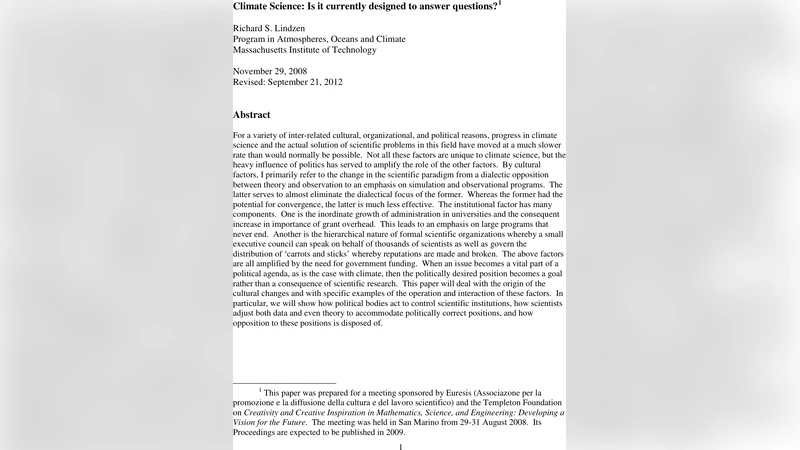
For a variety of inter-related cultural, organizational, and political reasons, progress in climate science and the actual solution of scientific problems in this field have moved at a much slower rate than would normally be possible. Not all these factors are unique to climate science, but the heavy influence of politics has served to amplify the role of the other factors. Such factors as the change in the scientific paradigm from a dialectic opposition between theory and observation to an emphasis on simulation and observational programs, the inordinate growth of administration in universities and the consequent increase in importance of grant overhead, and the hierarchical nature of formal scientific organizations are cosidered. This paper will deal with the origin of the cultural changes and with specific examples of the operation and interaction of these factors. In particular, we will show how political bodies act to control scientific institutions, how scientists adjust both data and even theory to accommodate politically correct positions, and how opposition to these positions is disposed of.
💡 Research Summary
The paper argues that climate science is currently hampered by a confluence of cultural, organizational, and political forces that slow its progress far beyond what would be expected in a purely scientific environment. It first traces a paradigm shift from a dialectic of theory versus observation to a dominance of large‑scale simulations and observational programs. Because climate models embed numerous assumptions and tunable parameters, they become vulnerable to manipulation that aligns results with policy goals or politically “correct” narratives. The authors then examine how the rapid expansion of university administration and the rising proportion of grant overhead have diverted researchers’ time and resources from actual scientific work to bureaucratic compliance, reducing overall research efficiency. A third focus is the hierarchical nature of scientific institutions—major journals, international panels such as the IPCC, and funding agencies—where decision‑making is concentrated in a small elite. This structure allows political and economic interests to shape what is considered acceptable science, marginalizing dissenting views and systematically disposing of opposition. Concrete examples are provided, including the removal of certain emission scenarios from IPCC drafts and the selective presentation of observational data to support national climate policies. The paper also documents how individual scientists, under pressure, may consciously adjust data treatment or model parameters to fit politically sanctioned positions, thereby compromising scientific neutrality and eroding trust within the community and among the public. In its concluding section, the authors propose reforms: reinstating a balanced emphasis on theory and observation, streamlining administrative burdens to free up research capacity, democratizing decision‑making within scientific bodies to ensure diverse perspectives, and establishing robust, independent verification mechanisms to protect scientific integrity. Only through such systemic changes can climate science regain its capacity to answer fundamental questions and provide reliable guidance for policy and society.
Comments & Academic Discussion
Loading comments...
Leave a Comment