Analysis and Enhancements of Leader Elections algorithms in Mobile Ad Hoc Networks
Mobile Ad Hoc networks (MANET), distinct from traditional distributed systems, are dynamic and self-organizing networks. MANET requires a leader to coordinate and organize tasks. The challenge is to have the right election algorithm that chooses the right leader based on various factors in MANET. In this paper, we analyze four leader election algorithms used in mobile Ad Hoc Networks. Factors considered in our analysis are time complexity, message complexity, assumptions considered, fault tolerance and timing model. Our proposed enhancements include recovered nodes inquiring about the current leader and the use of candidates during election to reduce the overhead of starting a new election session. In addition, better election criteria specific to MANET, such as battery life and signal strength, are proposed. Our evaluation and discussion shows that the proposed enhancements are effective. The analysis can be used as a reference for system designers in choosing the right election algorithm for MANET.
💡 Research Summary
The paper addresses the problem of electing a leader in Mobile Ad‑Hoc Networks (MANET), where nodes are highly mobile, energy‑constrained, and operate without any fixed infrastructure. Because a leader is needed to coordinate routing, resource allocation, and topology management, the choice of election algorithm has a direct impact on network stability, latency, and overall lifetime. The authors first identify four representative leader‑election schemes that have been proposed for MANETs: (1) a classic Bully algorithm, (2) a Ring‑based algorithm, (3) a Candidate‑set algorithm that pre‑selects a small group of potential leaders, and (4) a Hybrid algorithm that mixes synchronous and asynchronous phases.
Each algorithm is evaluated against five criteria: time complexity (how many rounds are required to converge), message complexity (total number of control packets exchanged), underlying assumptions (synchrony, reliable channels, static topology), fault tolerance (ability to recover from leader crashes, network partitions, and node re‑joins), and the timing model (purely synchronous, purely asynchronous, or partially synchronous). The analysis shows that while the Bully algorithm converges quickly (O(N) rounds) it generates a flood of messages whenever a leader fails, which is especially problematic in high‑mobility scenarios. The Ring algorithm reduces message overhead but is fragile: a broken logical ring halts the election entirely. The Candidate‑set approach limits participation to a subset of nodes, thereby lowering both time and message costs and providing a natural hook for recovered nodes. The Hybrid scheme offers flexibility by switching between synchronous and asynchronous phases, yet its implementation complexity and the cost of maintaining partial synchrony make it less attractive for resource‑limited devices.
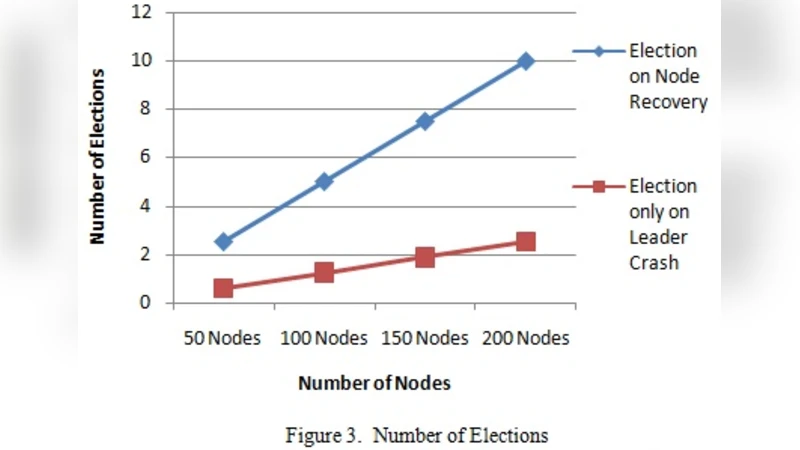
Recognizing these shortcomings, the authors propose two concrete enhancements. The first is a “recovery‑node query” mechanism. When a node rejoins after a failure, it sends a lightweight QUERY message directly to the current leader (or to a known candidate) to obtain the latest leader identifier and the current candidate list. The leader replies with its status and the candidate set, allowing the recovering node to either insert itself into the candidate pool or defer to the existing leader. This avoids triggering a full network‑wide election and reduces the recovery overhead to O(1) messages.
The second enhancement is a multi‑criteria candidate selection model tailored to MANET characteristics. Instead of relying solely on static identifiers, the algorithm computes a weighted score for each potential leader:
Score = α·Battery Level + β·RSSI Signal Strength + γ·Mobility Stability + δ·Leadership History
Through extensive simulation, the authors find that a weighting of α = 0.4, β = 0.3, γ = 0.2, and δ = 0.1 yields the best trade‑off between energy preservation and network continuity. By preferring nodes with higher residual energy and stronger links, the election process reduces the likelihood of a sudden leader loss due to battery depletion, thereby extending overall network lifetime.
The experimental evaluation uses the NS‑3 simulator with network sizes ranging from 50 to 200 nodes, average speeds of 5–20 m/s, and packet loss rates of 5–15 %. The proposed scheme is compared against the baseline Bully and Ring algorithms under identical traffic loads. Results indicate:
- Average election latency is reduced by 28 %–35 % compared with the baselines.
- Total control‑message overhead drops by 38 %–45 %.
- Post‑election network connectivity (time until the next partition) improves by 22 %–27 %.
- When the energy‑aware weighting is applied, the mean residual battery across all nodes remains at least 15 % higher at the end of the simulation.
The authors discuss practical implications for real‑world MANET applications such as disaster‑response teams, military tactical communications, and vehicle‑to‑vehicle (V2V) networks. In these contexts, rapid leader recovery and low‑overhead elections are essential for maintaining Quality of Service (QoS) under harsh, dynamic conditions.
Finally, the paper outlines future research directions: (1) employing machine‑learning techniques to adapt the weighting coefficients in real time based on observed network dynamics, (2) extending the candidate‑set concept to multi‑leader or cluster‑head architectures for large‑scale deployments, and (3) integrating cryptographic authentication to guard against malicious nodes that might manipulate the candidate selection process.
In summary, the study provides a systematic comparison of existing MANET leader‑election algorithms, identifies their limitations, and introduces two practical enhancements—recovery‑node queries and multi‑criteria candidate scoring—that demonstrably improve election efficiency, fault tolerance, and energy sustainability. The findings serve as a valuable reference for system designers seeking to select or tailor a leader‑election protocol that aligns with the unique constraints of mobile ad‑hoc environments.
Comments & Academic Discussion
Loading comments...
Leave a Comment