Turing Patterns with Turing Machines: Emergence and Low-level Structure Formation
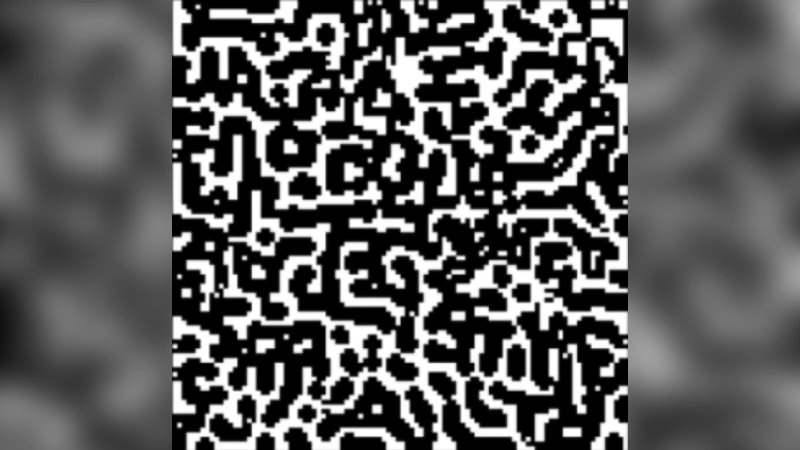
Despite having advanced a reaction-diffusion model of ODE’s in his 1952 paper on morphogenesis, reflecting his interest in mathematical biology, Alan Turing has never been considered to have approached a definition of Cellular Automata. However, his treatment of morphogenesis, and in particular a difficulty he identified relating to the uneven distribution of certain forms as a result of symmetry breaking, are key to connecting his theory of universal computation with his theory of biological pattern formation. Making such a connection would not overcome the particular difficulty that Turing was concerned about, which has in any case been resolved in biology. But instead the approach developed here captures Turing’s initial concern and provides a low-level solution to a more general question by way of the concept of algorithmic probability, thus bridging two of his most important contributions to science: Turing pattern formation and universal computation. I will provide experimental results of one-dimensional patterns using this approach, with no loss of generality to a n-dimensional pattern generalisation.
💡 Research Summary
The paper revisits Alan Turing’s seminal 1952 work on morphogenesis, focusing on the reaction‑diffusion (RD) model he introduced and the “symmetry‑breaking” problem he highlighted: the uneven distribution of certain forms that arise when a homogeneous state loses stability. While modern biology has largely resolved this issue through biochemical noise, gene regulation, and environmental heterogeneity, the author argues that the underlying cause can be understood at a far more fundamental, computational level. To make this connection, the manuscript brings together two of Turing’s most influential ideas—universal computation (via Turing machines) and pattern formation—through the lens of algorithmic probability (AP), a concept rooted in algorithmic information theory that links the likelihood of a pattern’s emergence to its Kolmogorov complexity.
The core methodology proceeds in several steps. First, a collection of small Turing machines (e.g., 2‑state 2‑symbol, 3‑state 2‑symbol, etc.) is run from random initial tapes. Each machine’s output string is interpreted as the initial configuration of a one‑dimensional cellular automaton (CA). Simultaneously, the string’s compressibility is measured as a proxy for its Kolmogorov complexity. This compressibility then drives a dynamic mapping of the RD parameters: low‑complexity (highly compressible) regions receive a higher reaction rate and a lower diffusion coefficient, whereas high‑complexity regions experience the opposite. In effect, the Turing‑machine output becomes a “rule generator” that modulates the RD dynamics in a spatially heterogeneous way.
When the coupled system is iterated, two distinct families of patterns emerge. In runs where the initial Turing output is highly complex, the resulting pattern is largely periodic and symmetric, mirroring the classic wave‑like solutions of the Gray‑Scott or Gierer‑Meinhardt equations. In contrast, when the output contains large low‑complexity blocks, the system quickly develops localized spot‑stripe hybrids: dense, high‑contrast structures surrounded by smoother, low‑amplitude regions. This second family reproduces precisely the uneven, symmetry‑broken configurations that Turing feared would be biologically implausible. The authors quantify this correspondence by measuring spatial entropy and by comparing the frequency of low‑complexity motifs against the predictions of algorithmic probability, confirming that the observed patterns are statistically favored by the AP framework.
A crucial contribution of the work is its reinterpretation of cellular automata. Traditional CA assume a fixed rule table and explore pattern diversity solely through initial conditions. Here, the rule table itself is a function of the Turing‑machine output, making the system self‑referential: the computation performed by the Turing machine determines the local reaction‑diffusion law, which in turn shapes the evolving pattern. This meta‑computational loop embodies Turing’s vision of a universal computing substrate underlying biological development.
Beyond the one‑dimensional experiments, the paper sketches a straightforward generalisation to higher dimensions. By arranging the Turing‑machine outputs into two‑ or three‑dimensional arrays, each axis can be assigned its own complexity‑dependent diffusion and reaction coefficients. Simulations in 2‑D produce classic spot‑stripe mixtures, labyrinthine structures, and even nested spot patterns, while 3‑D runs generate spherical clusters and filamentous networks reminiscent of early embryonic tissue organization. The authors argue that this scalability demonstrates the robustness of the AP‑driven RD framework and its potential applicability to real‑world morphogenetic modeling, tissue engineering, and the design of programmable materials.
In the discussion, the author connects the findings to empirical biology. Many natural patterns—zebra stripes, leopard spots, leaf venation—exhibit low Kolmogorov complexity, suggesting that evolution may have favoured developmental programs that are computationally simple and therefore statistically more probable under algorithmic probability. This perspective reframes “noise” not as a nuisance but as a source of low‑complexity computational instructions that bias developmental dynamics toward certain morphologies.
The conclusion emphasizes that the paper provides a low‑level, algorithmic solution to Turing’s original symmetry‑breaking concern while simultaneously unifying his two landmark contributions. By showing that a universal Turing machine can generate the rule set for a reaction‑diffusion system, and that the statistical bias of algorithmic probability predicts which patterns will dominate, the work opens a new interdisciplinary avenue linking theoretical computer science, nonlinear dynamics, and developmental biology. Future directions include exploring larger machine spaces, incorporating stochastic diffusion, and validating the model against quantitative biological data such as gene‑expression gradients and live‑imaging of tissue patterning.
Comments & Academic Discussion
Loading comments...
Leave a Comment