Continuity in Information Algebras
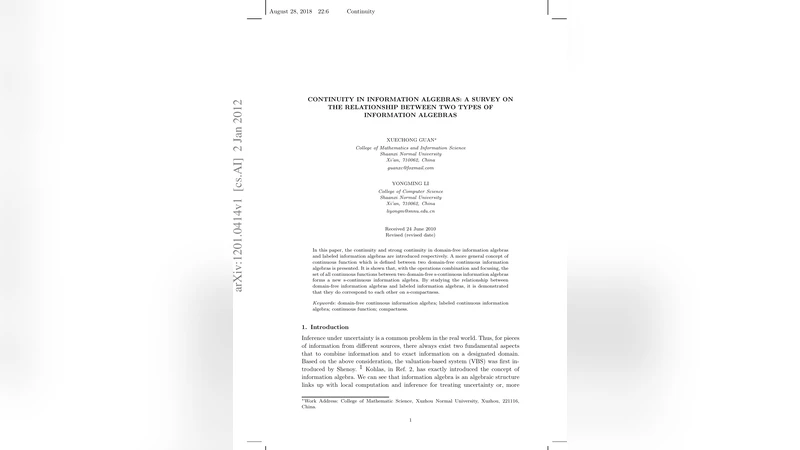
In this paper, the continuity and strong continuity in domain-free information algebras and labeled information algebras are introduced respectively. A more general concept of continuous function which is defined between two domain-free continuous information algebras is presented. It is shown that, with the operations combination and focusing, the set of all continuous functions between two domain-free s-continuous information algebras forms a new s-continuous information algebra. By studying the relationship between domain-free information algebras and labeled information algebras, it is demonstrated that they do correspond to each other on s-compactness.
💡 Research Summary
This paper extends the algebraic framework of information algebras by introducing the notions of continuity and strong continuity (s‑continuity) for both domain‑free and labeled variants. An information algebra is defined by two primitive operations: combination, which aggregates pieces of information, and focusing, which extracts information relevant to a particular domain. While the algebraic properties of these operations have been studied extensively, a systematic treatment of continuity—i.e., the ability to approximate any element by “small” elements—has been lacking.
In the first part the authors formalize continuity for domain‑free information algebras. The underlying partially ordered set is required to be a complete lattice, and each element must be representable as the supremum of a directed set of way‑below elements (the “basis”). Strong continuity strengthens this requirement by demanding that every element be the directed supremum of way‑below elements, mirroring the classic domain‑theoretic notion of a continuous dcpo.
The second major contribution is the definition of a continuous function between two s‑continuous domain‑free algebras A and B. Such a function f : A → B must preserve combination (f(x⊗y)=f(x)⊗f(y)), commute with focusing (f(x⇓_d)=f(x)⇓_d), and respect the way‑below relation (x≪y ⇒ f(x)≪f(y)). This ensures that f maintains the informational structure and the approximation hierarchy of its arguments.
The authors then prove a central theorem: the collection C(A,B) of all continuous functions from A to B, equipped with pointwise combination ( (f⊗g)(x)=f(x)⊗g(x) ) and pointwise focusing ( (f⇓_d)(x)=f(x⇓_d) ), itself forms an s‑continuous information algebra. C(A,B) is a complete lattice, its basis consists of pointwise way‑below functions, and the two operations satisfy associativity, commutativity, and identity laws. Consequently, the space of information‑preserving transformations inherits the same algebraic and continuity structure as the underlying algebras, opening the way to higher‑order reasoning, meta‑inference, and functional programming models within the information‑algebraic setting.
The third part investigates the relationship between labeled information algebras (where each element carries an explicit domain label) and domain‑free algebras. By introducing s‑compactness—a property stating that every element is the supremum of a finite set of compact (way‑below) elements—the paper shows that a labeled algebra is s‑compact if and only if its associated domain‑free algebra is s‑compact. This establishes a bijective correspondence: one can strip labels from an s‑compact labeled algebra to obtain an s‑compact domain‑free algebra, and conversely, labels can be re‑attached without destroying the continuity structure.
Overall, the work provides a robust theoretical bridge between domain theory and information algebra, enriches the algebraic toolkit with continuous function spaces, and demonstrates that continuity concepts survive the transition between labeled and unlabeled representations. Potential applications include the design of continuous inference engines, approximation‑aware data‑fusion systems, and the development of algorithms that exploit the lattice‑theoretic structure of information transformations. Future research directions suggested by the authors involve extending the framework to probabilistic information algebras, investigating computational aspects of focusing in real‑time settings, and exploring optimization techniques that leverage the s‑compact basis for efficient reasoning.