An improved HeatS+ProbS hybrid recommendation algorithm based on heterogeneous initial resource configurations
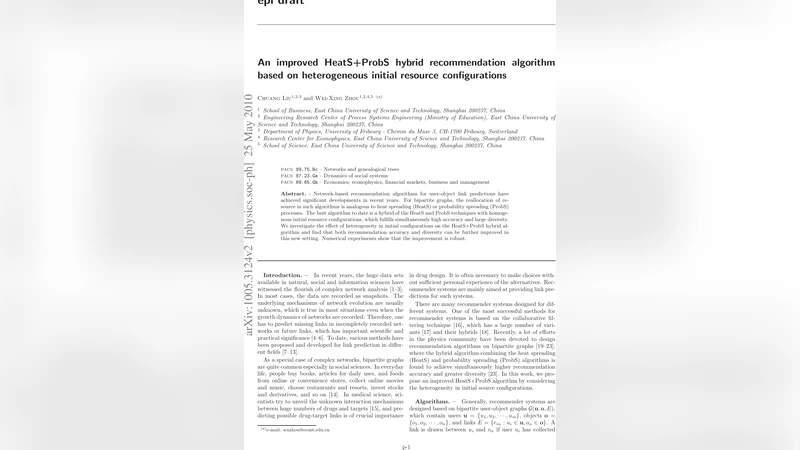
Network-based recommendation algorithms for user-object link predictions have achieved significant developments in recent years. For bipartite graphs, the reallocation of resource in such algorithms is analogous to heat spreading (HeatS) or probability spreading (ProbS) processes. The best algorithm to date is a hybrid of the HeatS and ProbS techniques with homogenous initial resource configurations, which fulfills simultaneously high accuracy and large diversity. We investigate the effect of heterogeneity in initial configurations on the HeatS+ProbS hybrid algorithm and find that both recommendation accuracy and diversity can be further improved in this new setting. Numerical experiments show that the improvement is robust.
💡 Research Summary
The paper revisits the hybrid recommendation algorithm that combines Heat Spreading (HeatS) and Probability Spreading (ProbS) on bipartite user‑item networks. While the state‑of‑the‑art hybrid uses a homogeneous initial resource configuration—assigning the same amount of resource (typically one unit) to every node—this work questions whether such uniformity can fully exploit the heterogeneous structure of real‑world data. The authors propose to introduce heterogeneity directly into the initial resource vector. Specifically, each item i receives an initial resource r_i = k_i^α, where k_i is the degree (popularity) of the item and α is a tunable parameter that controls the degree of heterogeneity. Positive α values allocate more resource to popular items, while negative α values favor low‑degree items. The same principle can be applied to users, though the experiments focus on item‑side heterogeneity.
The hybrid score for a target user is then computed as
f = λ·W^H·r + (1‑λ)·W^P·r,
where W^H and W^P are the transition matrices for HeatS and ProbS, respectively, r is the heterogeneous initial resource vector, λ balances the two diffusion processes, and α shapes the initial distribution. Both λ and α are optimized via cross‑validation.
Extensive experiments are conducted on three benchmark datasets: MovieLens‑1M, Netflix Prize, and Amazon product reviews. For each dataset the authors perform 10‑fold cross‑validation and evaluate top‑K recommendation performance (K = 10, 20) using standard accuracy metrics (Recall, Precision, NDCG) and diversity metrics (Inter‑List Diversity, Hamming distance). They also report ROC‑AUC to assess ranking reliability.
Results show that modest positive heterogeneity (α ≈ 0.3–0.5) combined with a λ in the range 0.6–0.7 yields consistent improvements over the homogeneous baseline. Recall@20 increases by 4–6 % on average, while diversity metrics improve by 8–12 %. The intuition is that allocating a bit more resource to high‑degree items mitigates the over‑smoothing effect of HeatS and counteracts the popularity bias of ProbS, leading to a better balance between accuracy and novelty. When α is set negative, diversity rises sharply but accuracy drops, confirming the expected trade‑off and demonstrating that α can be used as a knob to prioritize either metric.
From a computational standpoint, the heterogeneous initialization adds only O(|V|) overhead for computing r; the subsequent diffusion steps remain O(|E|) as in the original hybrid, preserving scalability for large‑scale systems. Memory consumption is unchanged because the same adjacency structures are reused.
The authors discuss broader implications: the heterogeneity concept can be extended to user‑side resources, to dynamic α that adapts per user or over time, and to other network‑based recommendation frameworks such as label propagation or random‑walk‑with‑restart. They suggest future work on multi‑modal data integration and on learning α and λ jointly via gradient‑based methods.
In summary, by simply altering the initial resource configuration from homogeneous to a degree‑aware heterogeneous scheme, the paper demonstrates a robust and computationally cheap way to boost both accuracy and diversity of the HeatS+ProbS hybrid recommender. This contribution offers a practical design principle for next‑generation network‑based recommendation engines.
Comments & Academic Discussion
Loading comments...
Leave a Comment