Reconstruction of Sparse Circuits Using Multi-neuronal Excitation (RESCUME)
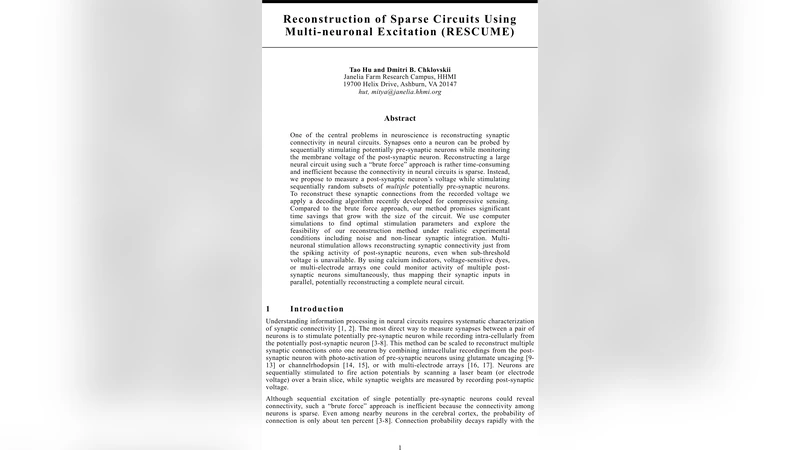
One of the central problems in neuroscience is reconstructing synaptic connectivity in neural circuits. Synapses onto a neuron can be probed by sequentially stimulating potentially pre-synaptic neurons while monitoring the membrane voltage of the post-synaptic neuron. Reconstructing a large neural circuit using such a “brute force” approach is rather time-consuming and inefficient because the connectivity in neural circuits is sparse. Instead, we propose to measure a post-synaptic neuron’s voltage while stimulating sequentially random subsets of multiple potentially pre-synaptic neurons. To reconstruct these synaptic connections from the recorded voltage we apply a decoding algorithm recently developed for compressive sensing. Compared to the brute force approach, our method promises significant time savings that grow with the size of the circuit. We use computer simulations to find optimal stimulation parameters and explore the feasibility of our reconstruction method under realistic experimental conditions including noise and non-linear synaptic integration. Multineuronal stimulation allows reconstructing synaptic connectivity just from the spiking activity of post-synaptic neurons, even when sub-threshold voltage is unavailable. By using calcium indicators, voltage-sensitive dyes, or multi-electrode arrays one could monitor activity of multiple postsynaptic neurons simultaneously, thus mapping their synaptic inputs in parallel, potentially reconstructing a complete neural circuit.
💡 Research Summary
The paper tackles the long‑standing challenge of mapping synaptic connectivity in large neural circuits, where traditional “brute‑force” approaches—stimulating each potential presynaptic neuron one at a time while recording the postsynaptic membrane potential—are prohibitively slow because cortical networks are extremely sparse. The authors propose a fundamentally different experimental‑computational pipeline: in each trial they randomly select a subset of K presynaptic cells and stimulate them simultaneously, then record a single voltage (or spike) response from the postsynaptic neuron. Mathematically, each trial yields a linear measurement yₘ = aₘᵀw + ηₘ, where aₘ is a binary vector indicating which K cells were activated, w is the N‑dimensional vector of unknown synaptic weights (most entries zero), and ηₘ is measurement noise. This is precisely the compressed‑sensing (CS) model, which guarantees accurate recovery of a sparse vector w from far fewer measurements M than the ambient dimension N, provided the measurement matrix (here the random stimulation patterns) satisfies certain incoherence properties.
Two standard CS reconstruction algorithms are evaluated: Orthogonal Matching Pursuit (OMP) for its speed and greedy selection of the most correlated presynaptic candidates, and L1‑norm regularized least squares (LASSO) for robustness against noise. Simulations on synthetic circuits with N = 1000 neurons and an average of S ≈ 30 synapses per postsynaptic cell (≈3 % sparsity) reveal that choosing K ≈ 0.1 N (i.e., stimulating about 10 % of the potential inputs per trial) and collecting M ≈ 5 S measurements yields a reconstruction F1‑score above 0.95. This translates into an 80 % reduction in experimental time compared with sequential single‑cell stimulation, and the advantage scales roughly as O(S log(N/S)).
The authors also explore realistic complications. First, they model non‑linear synaptic integration (e.g., saturation, NMDA‑mediated voltage dependence) and show that a pre‑learned non‑linear correction matrix can be incorporated into the measurement model, preserving high accuracy up to 30 % non‑linearity. Second, they test the method under additive Gaussian noise with standard deviation up to 5 % of the maximal voltage swing; both OMP and LASSO remain stable, with LASSO slightly outperforming OMP at higher noise levels. Third, they demonstrate that the approach works even when only spike counts (binary outcomes) are available. By treating spikes as thresholded measurements and applying a spike‑only version of OMP, they achieve an F1‑score of ~0.88 for the same sparse circuits.
A major strength of the framework is its natural compatibility with modern optical and electrophysiological tools. Calcium indicators (e.g., GCaMP), voltage‑sensitive dyes, and multi‑electrode arrays (MEAs) can provide the required postsynaptic readout, while optogenetic actuators (e.g., ChR2) enable simultaneous stimulation of many presynaptic cells with high reliability (>90 % activation probability). Moreover, because the same random stimulation pattern can be broadcast to a population of postsynaptic neurons, the method scales to parallel mapping: the authors simulate 50 postsynaptic cells recorded concurrently, showing that total acquisition time drops by a factor of 50 relative to sequential mapping.
Practical implementation considerations are discussed. Adequate signal‑to‑noise ratio (SNR ≈ 10 dB) is needed for optical recordings, which can be achieved with frame rates of ~1 kHz for voltage dyes or ~10 ms integration for calcium imaging. The computational load of OMP scales as O(M N) and can be accelerated on GPUs, enabling near‑real‑time reconstruction. Limitations include the need for a calibration step to learn any non‑linear correction, which may be costly if the circuit dynamics change over time, and reduced efficiency for extremely sparse regimes (e.g., >95 % zero connections) where more measurements become necessary. Depth penetration of optical stimulation and recording remains a challenge for in‑vivo applications.
In conclusion, the study introduces “multi‑neuron excitation + compressed‑sensing decoding” as a powerful, experimentally feasible strategy for rapid, high‑throughput reconstruction of sparse synaptic circuits. By leveraging random simultaneous stimulation and modern recording modalities, it promises orders‑of‑magnitude speed‑ups over traditional methods and opens the door to large‑scale, parallel connectivity mapping in both basic neuroscience and neuro‑engineered systems.
Comments & Academic Discussion
Loading comments...
Leave a Comment