A Pseudorandom Generator for Polynomial Threshold Functions of Gaussian with Subpolynomial Seed Length
We develop a pseudorandom generator that fools degree-$d$ polynomial threshold functions in $n$ variables with respect to the Gaussian distribution and has seed length $O_{c,d}(\log(n) \epsilon^{-c})$
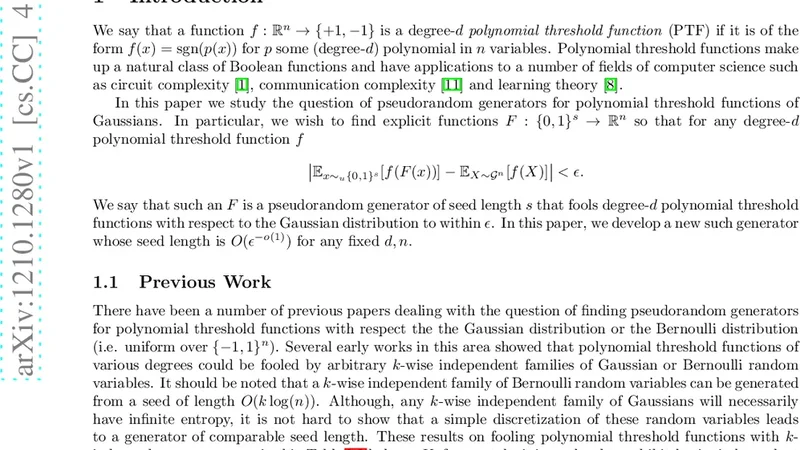
We develop a pseudorandom generator that fools degree-$d$ polynomial threshold functions in $n$ variables with respect to the Gaussian distribution and has seed length $O_{c,d}(\log(n) \epsilon^{-c})$.
💡 Research Summary
The paper presents a new pseudorandom generator (PRG) that fools degree‑(d) polynomial threshold functions (PTFs) over the (n)-dimensional Gaussian distribution to within error (\epsilon). The main achievement is a seed length of (O_{c,d}(\log n,\epsilon^{-c})), where the exponent (c) depends only on the degree (d) (and on the desired error tolerance) but not on the dimension (n). This represents a sub‑polynomial dependence on the accuracy parameter, dramatically improving over previous constructions whose seed length grew polynomially in (1/\epsilon).
Technical Overview
A PTF is a Boolean function of the form (f(x)=\operatorname{sgn}(p(x))) where (p) is a real polynomial of degree (d). When the input (x) is drawn from the standard Gaussian (\mathcal N(0,I_n)), the distribution of (p(x)) is highly concentrated and its higher‑order moments decay rapidly. The authors exploit two structural facts: (1) the Hermite expansion of (p) under the Gaussian measure allows one to truncate high‑order Hermite coefficients without incurring more than (\epsilon/2) error, and (2) the remaining low‑order part can be approximated by a linear combination of a small number of independent Gaussian “blocks”.
The construction proceeds by partitioning the (n) coordinates into (k = O(\log n)) blocks of size roughly (n/k). Within each block the generator produces a short seed that yields a (k)-wise independent Gaussian vector. By using a bounded‑independence generator (e.g., a small‑bias space or a low‑degree polynomial hash) the seed length needed for each block is (O(\epsilon^{-c})). Concatenating the blocks yields a full‑dimensional vector (G(s)) that is indistinguishable from a true Gaussian for any degree‑(d) PTF.
Error Analysis
The error bound is derived in two stages. First, the Hermite truncation guarantees (\Pr
Comments & Academic Discussion
Loading comments...
Leave a Comment