Criticality and self-organization in branching processes: application to natural hazards
The statistics of natural catastrophes contains very counter-intuitive results. Using earthquakes as a working example, we show that the energy radiated by such events follows a power-law or Pareto distribution. This means, in theory, that the expected value of the energy does not exist (is infinite), and in practice, that the mean of a finite set of data in not representative of the full population. Also, the distribution presents scale invariance, which implies that it is not possible to define a characteristic scale for the energy. A simple model to account for this peculiar statistics is a branching process: the activation or slip of a fault segment can trigger other segments to slip, with a certain probability, and so on. Although not recognized initially by seismologists, this is a particular case of the stochastic process studied by Galton and Watson one hundred years in advance, in order to model the extinction of (prominent) families. Using the formalism of probability generating functions we will be able to derive, in an accessible way, the main properties of these models. Remarkably, a power-law distribution of energies is only recovered in a very special case, when the branching process is at the onset of attenuation and intensification, i.e., at criticality. In order to account for this fact, we introduce the self-organized critical models, in which, by means of some feedback mechanism, the critical state becomes an attractor in the evolution of such systems. Analogies with statistical physics are drawn. The bulk of the material presented here is self-contained, as only elementary probability and mathematics are needed to start to read.
💡 Research Summary
The paper addresses a striking statistical feature of natural catastrophes, using earthquakes as the primary example: the radiated energy follows a power‑law (Pareto) distribution. Empirically, the probability density of earthquake energy (E) behaves as (P(E)\propto E^{-\alpha}) with (\alpha) typically between 1.5 and 2. Because (\alpha\le 2), the theoretical mean (\langle E\rangle) diverges, meaning that any finite sample mean is not representative of the underlying population. Moreover, the power‑law exhibits scale invariance, so no characteristic energy scale can be defined. These facts challenge conventional statistical approaches that rely on well‑defined averages and variances.
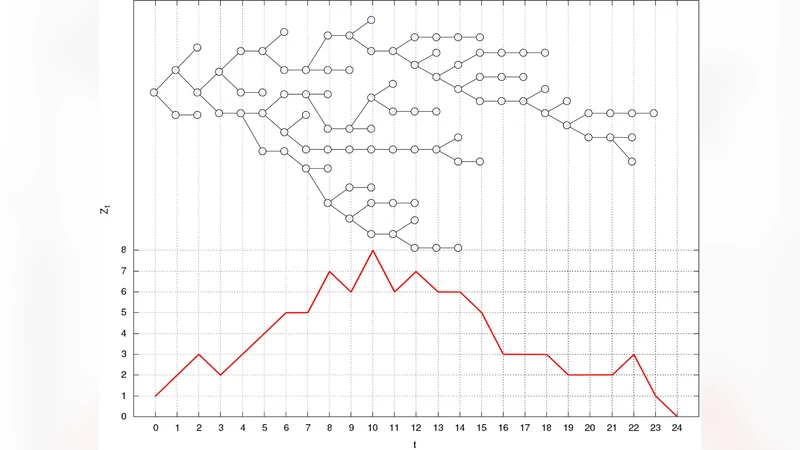
To explain this counter‑intuitive behavior, the authors introduce a branching process originally formulated by Galton and Watson. In this framework, the slip of a fault segment (a “parent”) can trigger slips in neighboring segments (its “children”) with a probability distribution (p_k) for the number (k) of triggered segments. The process evolves generation by generation, and its statistical properties are captured by the probability‑generating function (G(s)=\sum_{k=0}^{\infty}p_k s^k). The key parameter is the mean offspring number (\mu = G’(1)). When (\mu<1) the cascade quickly dies out; when (\mu>1) it grows explosively; and precisely at (\mu=1) – the critical point – the total number of activated segments (and thus the total released energy) follows a power‑law distribution. Hence, the observed Pareto law for earthquake energies suggests that the seismic system operates near this critical branching condition.
Real tectonic systems, however, do not keep (\mu) fixed. Stress accumulates slowly due to plate motions, pushing (\mu) above one, while a large rupture abruptly releases stress, pulling (\mu) below one. This feedback loop drives the system toward the critical point without external fine‑tuning. The authors formalize this idea through the concept of self‑organized criticality (SOC). In SOC models, a slow external drive and a fast internal relaxation interact such that the critical state becomes an attractor. Classic SOC examples – the sandpile model and the forest‑fire model – reproduce the same power‑law statistics despite their simplicity, illustrating the universality of the mechanism.
The paper draws explicit analogies with equilibrium statistical physics. At a conventional phase transition, scale invariance, diverging correlation length, and universality emerge; the same mathematical structures appear in the branching‑process description of earthquakes. The singularity of the generating function at the critical point yields the power‑law exponent, mirroring how critical exponents arise from non‑analyticities in free energy. This connection underscores that the “criticality” of natural hazards is not a metaphor but a mathematically precise state.
Empirical considerations are also discussed. The authors show how to estimate the exponent (\alpha) from finite catalogs, emphasizing the large statistical fluctuations that arise when the true mean diverges. They note that data truncation, magnitude cut‑offs, and measurement errors can bias exponent estimates, but the overall power‑law behavior remains robust across different regions and time periods.
Finally, the authors argue that the branching‑process plus SOC framework provides a unifying lens for a broad class of hazards – earthquakes, volcanic eruptions, landslides, and even some anthropogenic events. While real systems involve additional complexities (heterogeneous fault properties, fluid effects, human interventions), the core idea that a slow drive and a threshold‑controlled cascade self‑tune to a critical state offers a powerful explanatory and predictive paradigm. The paper concludes that understanding natural catastrophes through the mathematics of branching processes and self‑organized criticality not only clarifies why power‑law statistics arise but also bridges geophysics with the broader theory of complex, scale‑free systems.
Comments & Academic Discussion
Loading comments...
Leave a Comment