Symmetry and Self-Duality in Categories of Probabilistic Models
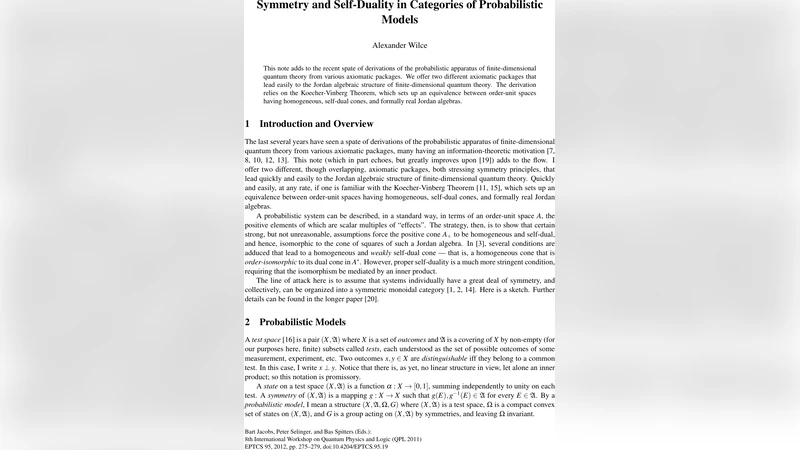
This note adds to the recent spate of derivations of the probabilistic apparatus of finite-dimensional quantum theory from various axiomatic packages. We offer two different axiomatic packages that lead easily to the Jordan algebraic structure of finite-dimensional quantum theory. The derivation relies on the Koecher-Vinberg Theorem, which sets up an equivalence between order-unit spaces having homogeneous, self-dual cones, and formally real Jordan algebras.
💡 Research Summary
The paper investigates the foundations of finite‑dimensional quantum theory by focusing on categories of probabilistic models. It begins by formalizing a probabilistic model as an order‑unit space (V, u) equipped with a positive cone V₊ that encodes states (normalized positive elements) and effects (elements between 0 and u). The central aim is to identify minimal, physically motivated axioms that force V₊ to be both homogeneous (any interior point can be mapped to any other by a symmetry) and self‑dual (the cone coincides with its dual under a suitable inner product).
Two independent axiom packages are presented. The first, called the “symmetry‑self‑duality” package, consists of: (A1) Transitivity – a group G of reversible transformations acts transitively on pure states, guaranteeing homogeneity of the cone; and (A2) Self‑duality – there exists an inner product ⟨·,·⟩ such that V₊ = {x | ⟨x, y⟩ ≥ 0 for all y ∈ V₊}, making the cone self‑dual. The second package, termed “maximal‑normalization”, replaces the explicit inner‑product requirement with two conditions on extreme effects: (E1) every extreme effect e has a unique normalized state ωₑ satisfying ⟨e, ωₑ⟩ = 1, and (E2) the symmetry group can map any extreme effect to any other while simultaneously mapping the associated states, thereby ensuring both homogeneity and an induced self‑duality.
With either package in place, the cone V₊ satisfies the hypotheses of the Koecher‑Vinberg theorem, a deep result in convex geometry stating that an order‑unit space whose cone is homogeneous and self‑dual is isomorphic to a formally real Jordan algebra, with the order unit corresponding to the algebra’s identity. Consequently, the space of effects and states acquires the structure of a Jordan algebra of observables. In finite dimensions, the only such algebras are the self‑adjoint parts of complex, real, or quaternionic matrix algebras, reproducing precisely the algebraic backbone of standard quantum mechanics.
The paper proceeds to sketch proofs that each axiom package indeed yields a homogeneous, self‑dual cone. For the symmetry‑self‑duality package, transitivity directly supplies homogeneity, while the existence of a G‑invariant inner product provides self‑duality. For the maximal‑normalization package, the pairing between extreme effects and their unique normalizing states defines a bilinear form that is shown to be positive‑definite and G‑invariant, thus furnishing the required inner product.
Beyond the technical derivation, the authors discuss the physical significance of the two axioms. Transitivity captures the idea that any pure preparation can be turned into any other by a reversible physical process, reflecting the operational homogeneity of a theory. Self‑duality encodes a symmetry between states and measurement outcomes, suggesting that the geometry of the state space is mirrored by that of the effect space. The paper argues that these concepts are more primitive and experimentally accessible than many information‑theoretic postulates used in other reconstructions (e.g., no‑signalling, purification, or local tomography).
Finally, the authors acknowledge limitations and outline future work. The current results apply strictly to finite‑dimensional systems; extending the framework to infinite dimensions would require careful handling of topological issues and possibly a generalized version of the Koecher‑Vinberg theorem. Moreover, they suggest exploring concrete physical models (e.g., spin systems, optical modes) to illustrate how the symmetry group G emerges in practice and how self‑duality might be tested experimentally.
In summary, the paper demonstrates that imposing only two natural structural principles—symmetry (transitivity) and self‑duality—on categories of probabilistic models suffices to recover the Jordan‑algebraic formulation of finite‑dimensional quantum theory. This provides a conceptually streamlined route to quantum foundations, emphasizing geometric and group‑theoretic properties over more elaborate informational constraints.
Comments & Academic Discussion
Loading comments...
Leave a Comment