Rainbow Connectivity of Sparse Random Graphs
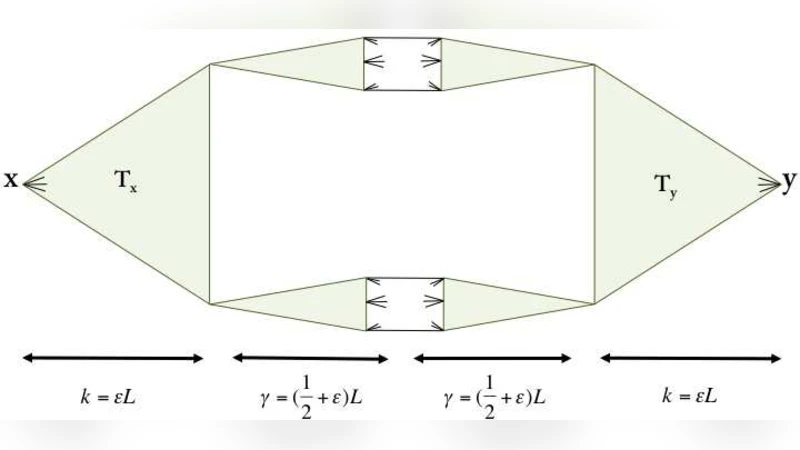
An edge colored graph $G$ is rainbow edge connected if any two vertices are connected by a path whose edges have distinct colors. The rainbow connectivity of a connected graph $G$, denoted by $rc(G)$, is the smallest number of colors that are needed in order to make $G$ rainbow connected. In this work we study the rainbow connectivity of binomial random graphs at the connectivity threshold $p=\frac{\log n+\om}{n}$ where $\om=\om(n)\to\infty$ and ${\om}=o(\log{n})$ and of random $r$-regular graphs where $r \geq 3$ is a fixed integer. Specifically, we prove that the rainbow connectivity $rc(G)$ of $G=G(n,p)$ satisfies $rc(G) \sim \max\set{Z_1,diameter(G)}$ with high probability (\whp). Here $Z_1$ is the number of vertices in $G$ whose degree equals 1 and the diameter of $G$ is asymptotically equal to $\diam$ \whp. Finally, we prove that the rainbow connectivity $rc(G)$ of the random $r$-regular graph $G=G(n,r)$ satisfies $rc(G) =O(\log^2{n})$ \whp.
💡 Research Summary
The paper investigates the rainbow connectivity (rc(G)) of two fundamental random graph models: the binomial random graph (G(n,p)) at the connectivity threshold and the random (r)-regular graph (G(n,r)) with fixed degree (r\ge 3). Rainbow connectivity asks for the minimum number of edge colours needed so that every pair of vertices is linked by a path whose edges all have distinct colours.
Main results for (G(n,p)).
The authors consider the regime (p=\frac{\log n+\omega(n)}{n}) where (\omega(n)\to\infty) but (\omega(n)=o(\log n)). In this range the graph is almost surely connected, yet a non‑negligible number of vertices have degree 1. Let (Z_1) denote the number of degree‑1 vertices and let (\operatorname{diam}(G)) be the graph diameter, which is known to be asymptotically (\Theta!\bigl(\frac{\log n}{\log(np)}\bigr)). The paper proves that, with high probability,
\
Comments & Academic Discussion
Loading comments...
Leave a Comment