No-go theorems for functorial localic spectra of noncommutative rings
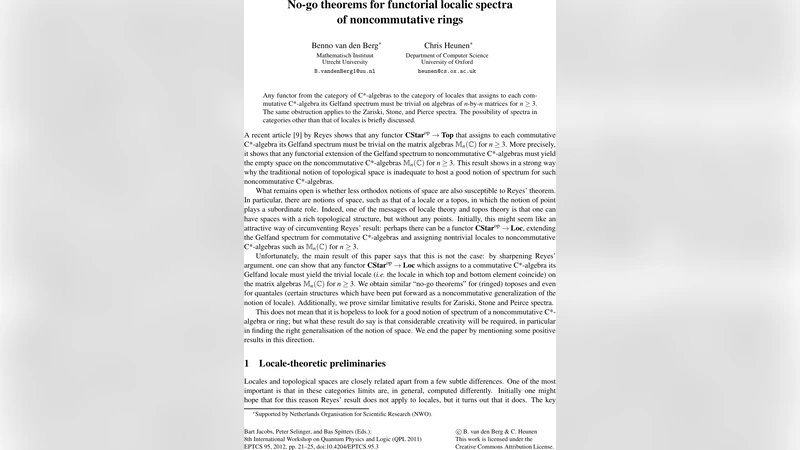
Any functor from the category of C*-algebras to the category of locales that assigns to each commutative C*-algebra its Gelfand spectrum must be trivial on algebras of nxn-matrices for n at least 3. The same obstruction applies to the Zariski, Stone, and Pierce spectra. The possibility of spectra in categories other than that of locales is briefly discussed.
💡 Research Summary
The paper investigates whether one can extend the classical Gelfand spectrum, which assigns to each commutative C*‑algebra a compact Hausdorff space, to a functor that lands in the category of locales (point‑free spaces). The authors require two natural conditions: (1) the functor must be defined on all C*‑algebras, and (2) on commutative algebras it must recover the ordinary Gelfand spectrum (up to homeomorphism of locales). Under these hypotheses they prove a striking no‑go theorem: any such functor must be trivial on matrix algebras Mₙ(ℂ) for n ≥ 3, i.e. the locale assigned to Mₙ(ℂ) is either the empty locale or the one‑point locale.
The proof hinges on the observation that the centre of Mₙ(ℂ) is just ℂ, and that any spectrum‑like construction respecting centres must send the centre to the same locale as the whole algebra. In the locale setting, open sublocales correspond to ideals of the algebra. Since Mₙ(ℂ) has only the trivial ideals {0} and itself, the lattice of opens collapses to a two‑element lattice, forcing the locale to be trivial. The authors formalize this argument using the internal logic of the topos of sheaves on a locale, showing that any functor satisfying the two conditions inevitably yields a degenerate locale for these algebras.
The same reasoning applies to other classical spectra: the Zariski spectrum (prime ideals), the Stone spectrum (ultrafilters of the Boolean algebra of projections), and the Pierce spectrum (maximal ideals of the centre). In each case the paucity of non‑trivial ideals in Mₙ(ℂ) forces the associated locale to be trivial, so any functor that agrees with the usual spectrum on commutative algebras cannot give a meaningful non‑trivial spectrum for non‑commutative matrix algebras of size three or larger.
In the final section the authors discuss possible ways around the obstruction. They note that one could abandon locales altogether and work in richer categorical settings such as higher toposes, algebraic stacks, or non‑commutative spaces defined via derived categories or operator‑algebraic K‑theory. However, they caution that similar centre‑preserving constraints are likely to reappear, suggesting that any successful non‑commutative spectrum must fundamentally differ from the classical point‑free approach.
Overall, the paper establishes a robust barrier to extending the familiar Gelfand, Zariski, Stone, or Pierce spectra to a functorial locale‑valued theory for non‑commutative C*‑algebras, and it points toward the necessity of more radical categorical frameworks for a genuine non‑commutative spectral theory.
Comments & Academic Discussion
Loading comments...
Leave a Comment