Inapproximability of the Tutte polynomial of a planar graph
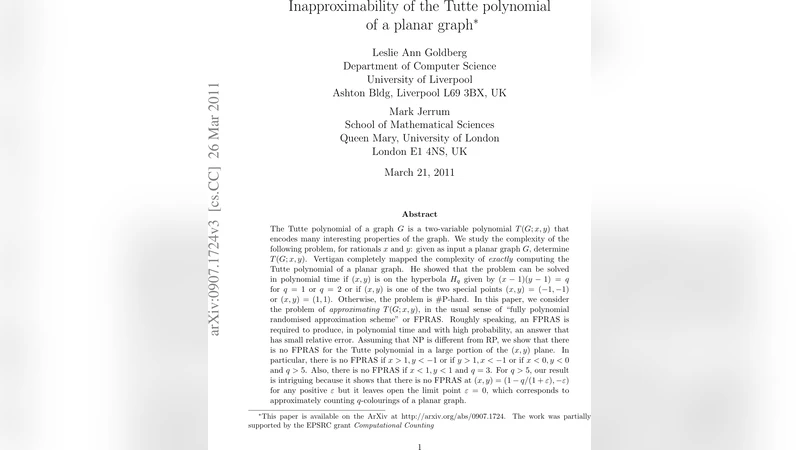
The Tutte polynomial of a graph G is a two-variable polynomial T(G;x,y) that encodes many interesting properties of the graph. We study the complexity of the following problem, for rationals x and y: given as input a planar graph G, determine T(G;x,y). Vertigan completely mapped the complexity of exactly computing the Tutte polynomial of a planar graph. He showed that the problem can be solved in polynomial time if (x,y) is on the hyperbola H_q given by (x-1)(y-1)=q for q=1 or q=2 or if (x,y) is one of the two special points (x,y)=(-1,-1) or (x,y)=(1,1). Otherwise, the problem is #P-hard. In this paper, we consider the problem of approximating T(G;x,y), in the usual sense of “fully polynomial randomised approximation scheme” or FPRAS. Roughly speaking, an FPRAS is required to produce, in polynomial time and with high probability, an answer that has small relative error. Assuming that NP is different from RP, we show that there is no FPRAS for the Tutte polynomial in a large portion of the (x,y) plane. In particular, there is no FPRAS if x>1, y<-1 or if y>1, x<-1 or if x<0, y<0 and q>5. Also, there is no FPRAS if x<1, y<1 and q=3. For q>5, our result is intriguing because it shows that there is no FPRAS at (x,y)=(1-q/(1+epsilon),-epsilon) for any positive epsilon but it leaves open the limit point epsilon=0, which corresponds to approximately counting q-colourings of a planar graph.
💡 Research Summary
The paper investigates the approximability of the Tutte polynomial T(G;x,y) when the input graph G is planar. The Tutte polynomial is a two‑variable invariant that simultaneously encodes many classical graph quantities such as the number of spanning trees, the reliability polynomial, the chromatic polynomial, and the flow polynomial. Vertigan’s classic dichotomy (1998) completely characterises the exact computational complexity for planar graphs: the polynomial can be evaluated in polynomial time only on the hyperbola H_q defined by (x‑1)(y‑1)=q for q=1 or q=2, and at the two isolated points (‑1,‑1) and (1,1). For every other rational pair (x,y) the exact evaluation is #P‑hard.
The present work shifts focus from exact evaluation to approximation, specifically to the existence of a Fully Polynomial‑Randomised Approximation Scheme (FPRAS). An FPRAS must, with high probability, output a value within a factor (1±ε) of the true answer in time polynomial in the size of the graph and in 1/ε. Assuming the standard complexity separation NP ≠ RP, the authors prove that an FPRAS does not exist for a large region of the (x,y)‑plane.
The proof strategy relies on two pillars. First, the authors exploit known hardness results for the q‑state Potts model and for counting q‑colourings, both of which are equivalent to evaluating the Tutte polynomial on points of the hyperbola H_q. In particular, for q≥3 the problem of approximately counting proper q‑colourings of a planar graph is known to be NP‑hard under AP‑reductions. Second, they construct planar‑preserving AP‑reductions from these hard counting problems to the problem of approximating T(G;x,y) at the target points. The reductions use gadgets that simulate edge weights while maintaining planarity, thereby translating hardness from the Potts model to the Tutte evaluation.
The main hardness results are as follows:
- No FPRAS exists when x>1 and y<‑1, or symmetrically when y>1 and x<‑1. These regions lie outside the hyperbola H_q and correspond to “ferromagnetic” and “antiferromagnetic” regimes of the Potts model with opposite sign interactions.
- When x<0, y<0 and q=(x‑1)(y‑1)>5, the Tutte polynomial is also inapproximable. This covers a substantial part of the negative quadrant where the underlying Potts model is highly frustrated.
- For the special case q=3, the authors show that any point with x<1 and y<1 (i.e., the interior of the unit square) is hard to approximate.
- An especially intriguing corollary is that for every q>5 and every positive ε, the point (x,y) = (1‑q/(1+ε),‑ε) lies in the inapproximable region. As ε→0 the point approaches (1‑q,0), which corresponds exactly to counting q‑colourings of a planar graph. The paper leaves open whether an FPRAS exists at this limit point, highlighting a delicate boundary between tractability and hardness.
Beyond the technical theorems, the authors discuss the broader implications. Their results demonstrate that the inapproximability region for planar graphs is strictly larger than the #P‑hard region for exact computation, indicating that randomisation does not substantially enlarge the set of tractable points. Moreover, the techniques showcase how planarity‑preserving gadget constructions can be combined with AP‑reductions to transfer hardness from statistical‑physics models to combinatorial polynomial evaluations. The open problem at ε=0 suggests a potential avenue for future research, possibly requiring new algorithmic ideas or refined complexity assumptions.
In summary, assuming NP ≠ RP, the paper establishes that for a wide swath of rational parameters (x,y) the Tutte polynomial of a planar graph admits no fully polynomial‑time randomised approximation scheme. This significantly deepens our understanding of the computational landscape surrounding one of graph theory’s most unifying invariants.
Comments & Academic Discussion
Loading comments...
Leave a Comment