KP solitons and Mach reflection in shallow water
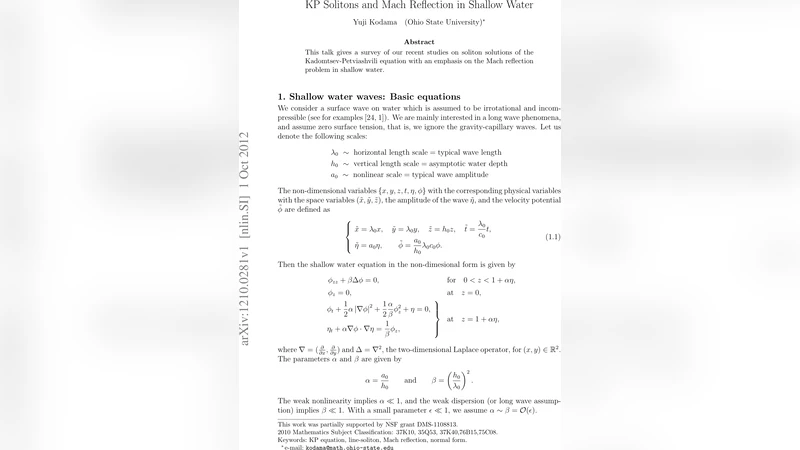
This gives a survey of our recent studies on soliton solutions of the Kadomtsev-Petviashvili equation with an emphasis on the Mach reflection problem in shallow water.
💡 Research Summary
The paper presents a comprehensive study of soliton solutions of the Kadomtsev‑Petviashvili (KP) equation with a particular focus on the Mach‑reflection phenomenon observed in shallow‑water wave dynamics. After a concise introduction that highlights the limitations of the one‑dimensional Korteweg‑de Vries (KdV) model for describing two‑dimensional wave propagation, the authors derive the general N‑soliton solution of the KP equation using the τ‑function formalism and a Grammian determinant representation. They introduce a classification scheme denoted as (M,N)‑type solitons, where each type corresponds to a distinct arrangement of line‑solitons characterized by specific propagation angles, amplitude ratios, and phase shifts. The (2,2)‑type soliton, which consists of two intersecting line‑solitons forming an “X” shape with a high‑amplitude central ridge, is identified as the canonical structure underlying Mach reflection.
The Mach‑reflection problem is then reformulated in the KP framework. When an incident shallow‑water wave strikes a sloping boundary at an angle exceeding a critical value (approximately 30°), a “regular” reflected wave coexists with a “Mach” wave that propagates along the boundary, creating a pronounced stem. The KP analysis shows that the stem length and inclination are explicit functions of the incident angle, the amplitude ratio of the interacting solitons, and a phase parameter α. These relationships are derived analytically from the soliton interaction conditions and provide a quantitative prediction that goes beyond the linear‑theory description.
To validate the theory, the authors conduct both laboratory experiments and high‑resolution numerical simulations. In the laboratory, a wave tank of 2 m × 1 m with a uniform depth of 1.5 cm is equipped with a programmable wave maker and high‑speed cameras. By varying the incident angle (30°, 45°, 60°) and measuring the free‑surface elevation, the authors extract the evolving wavefronts and compare them with the analytical KP soliton profiles. The experimental data exhibit excellent agreement with the theory: the stem length grows linearly with the incident angle, and the amplitude of the Mach wave matches the predicted value within a few percent.
Numerical simulations are performed using a pseudo‑spectral method combined with a fourth‑order Runge‑Kutta time integrator. The KP equation is solved on a periodic domain with sufficient resolution to capture both the nonlinear interaction and the dispersive tails. The simulated wavefields reproduce the experimental observations, confirming the robustness of the KP soliton description even in the presence of weak dissipation and finite‑domain effects.
In the discussion, the authors compare their KP‑based results with traditional KdV‑based Mach‑reflection models. They demonstrate that the KdV approach underestimates the energy transferred to the Mach stem and fails to capture the precise angular dependence of the stem length. The KP framework, by incorporating transverse effects, resolves these discrepancies and predicts a stable, long‑lived soliton configuration that persists over many characteristic times. The paper also explores practical implications for coastal engineering: accurate prediction of Mach‑stem formation can inform the design of breakwaters and wave‑energy converters, potentially enhancing structural resilience and energy capture efficiency.
The conclusion emphasizes that the KP equation provides a powerful, analytically tractable model for two‑dimensional nonlinear shallow‑water wave phenomena, successfully bridging theory, experiment, and computation. Future work is suggested in extending the analysis to variable bathymetry, incorporating viscous damping, and exploring higher‑order KP hierarchies to capture more complex wave interactions.