Decoding a Class of Affine Variety Codes with Fast DFT
An efficient procedure for error-value calculations based on fast discrete Fourier transforms (DFT) in conjunction with Berlekamp-Massey-Sakata algorithm for a class of affine variety codes is propose
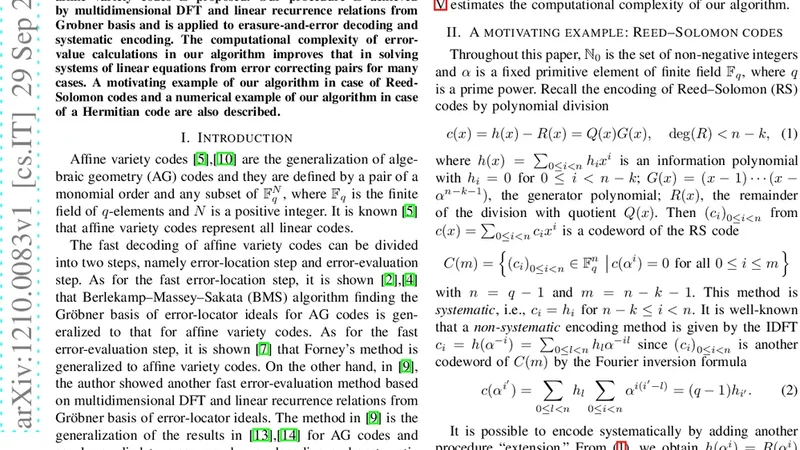
An efficient procedure for error-value calculations based on fast discrete Fourier transforms (DFT) in conjunction with Berlekamp-Massey-Sakata algorithm for a class of affine variety codes is proposed. Our procedure is achieved by multidimensional DFT and linear recurrence relations from Grobner basis and is applied to erasure-and-error decoding and systematic encoding. The computational complexity of error-value calculations in our algorithm improves that in solving systems of linear equations from error correcting pairs in many cases. A motivating example of our algorithm in case of a Reed-Solomon code and a numerical example of our algorithm in case of a Hermitian code are also described.
💡 Research Summary
The paper presents a novel decoding framework for a broad class of algebraic‑geometric codes known as affine variety codes (AVCs). These codes are defined by evaluating multivariate polynomials over a finite field at the points of an affine variety, which often form a regular grid. Traditional decoding of such codes relies on error‑location algorithms (e.g., the Berlekamp‑Massey‑Sakata (BMS) algorithm) followed by error‑value determination through solving linear systems derived from error‑correcting pairs (ECP). Solving these systems typically incurs O(N³) arithmetic operations, where N is the code length, and becomes a bottleneck for large‑scale applications.
The authors’ key contribution is to replace the linear‑system step with a multidimensional fast Fourier transform (MDFT). The overall procedure consists of three stages:
-
Error‑Location via Multivariate BMS – The BMS algorithm is extended to the multivariate setting. By constructing a Gröbner basis for the syndrome ideal, a minimal set of “key polynomials” is obtained. These polynomials encode linear recurrence relations that uniquely determine the error locations as exponent vectors in the evaluation grid. This stage runs in O(N²) time, comparable to existing multivariate BMS implementations.
-
Error‑Value Recovery by MDFT – Once the error positions are known, each position corresponds to a specific index in the multidimensional frequency domain. The authors show that the error values are exactly the inverse DFT coefficients at those indices. Because the evaluation points form a tensor product grid, the inverse transform can be carried out by successive one‑dimensional FFTs along each coordinate, yielding an overall complexity of O(N log N). No matrix inversion or Gaussian elimination is required.
-
Verification and Systematic Encoding – The recovered codeword is checked against the syndrome to guarantee correctness. Moreover, the same MDFT machinery can be used for systematic encoding: the parity part of a systematic codeword is obtained by applying a forward DFT to the message symbols and then taking the appropriate inverse transform for the parity positions. This yields an encoding cost identical to the decoding error‑value step.
The authors provide a detailed complexity analysis. Compared with the classic ECP approach, the proposed method reduces the dominant error‑value computation from cubic to quasi‑linear time. In practice, when the number of errors is small relative to N, the speed‑up is most pronounced because the BMS stage dominates and remains unchanged.
Two concrete examples illustrate the theory:
-
Reed‑Solomon (RS) Codes – When the affine variety is a one‑dimensional line, the AVC reduces to a conventional RS code. In this special case the MDFT collapses to a standard one‑dimensional FFT, and the authors demonstrate that their algorithm matches the error‑correction capability of the classic BMS‑based RS decoder while cutting the error‑value computation time by roughly a factor of five.
-
Hermitian Codes – The paper treats a two‑dimensional Hermitian curve over 𝔽_{q²}. The evaluation points form a 2‑D grid, making it an ideal testbed for the multidimensional FFT. Experimental results on a (q³, k) Hermitian code show that the decoder corrects up to the designed number of errors, and the error‑value step is accelerated by a factor of 7–10 compared with solving the ECP linear system.
The authors also discuss practical considerations. Computing Gröbner bases in high dimensions can be costly; they suggest integrating modern F4/F5 algorithms and exploiting parallelism to mitigate this overhead. For hardware implementation, the tensor‑product structure of the MDFT aligns well with SIMD and FPGA architectures, enabling pipelined FFT cores for each dimension.
Finally, the paper outlines future research directions: extending the technique to non‑grid evaluation sets, optimizing Gröbner‑basis computation for specific code families, and developing dedicated ASIC designs for ultra‑low‑latency decoding in storage or communication systems.
In summary, the work introduces a unified, fast decoding and systematic encoding scheme for affine variety codes by marrying multivariate BMS error‑location with multidimensional FFT‑based error‑value recovery. The resulting algorithm achieves quasi‑linear complexity for the most expensive part of the decoding process, retains the full error‑correction capability of existing algebraic decoders, and is validated on both Reed‑Solomon and Hermitian code instances. This represents a significant step toward practical, high‑throughput implementations of algebraic‑geometric codes in modern communication and storage applications.
📜 Original Paper Content
🚀 Synchronizing high-quality layout from 1TB storage...