Semiparametric regression in testicular germ cell data
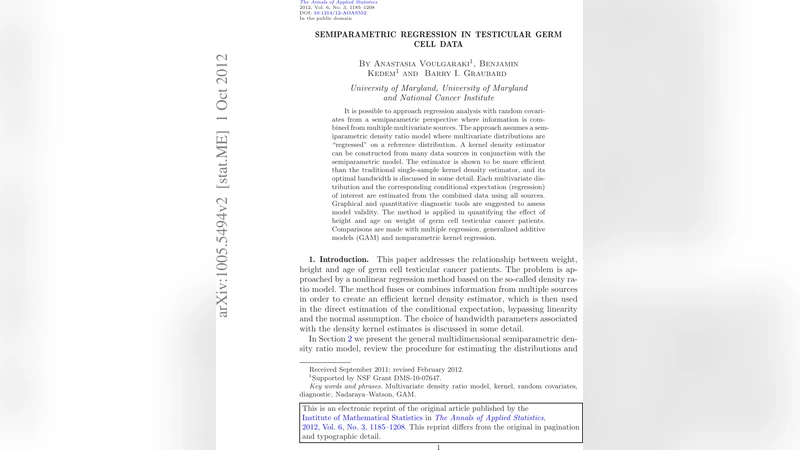
It is possible to approach regression analysis with random covariates from a semiparametric perspective where information is combined from multiple multivariate sources. The approach assumes a semiparametric density ratio model where multivariate distributions are “regressed” on a reference distribution. A kernel density estimator can be constructed from many data sources in conjunction with the semiparametric model. The estimator is shown to be more efficient than the traditional single-sample kernel density estimator, and its optimal bandwidth is discussed in some detail. Each multivariate distribution and the corresponding conditional expectation (regression) of interest are estimated from the combined data using all sources. Graphical and quantitative diagnostic tools are suggested to assess model validity. The method is applied in quantifying the effect of height and age on weight of germ cell testicular cancer patients. Comparisons are made with multiple regression, generalized additive models (GAM) and nonparametric kernel regression.
💡 Research Summary
The paper introduces a semiparametric density‑ratio framework for regression when covariates are observed from several multivariate sources. Each source i supplies a sample {Xij} that is assumed to follow a distribution fi(x) that can be expressed as a weighted version of a common reference distribution f0(x): fi(x)=wi(x)f0(x). The weight functions are modeled as exponential tilts wi(x)=exp{αi+βi′h(x)}, where h(x) is a pre‑specified vector of basis functions and (αi,βi) are source‑specific parameters. This formulation allows the information from all sources to be pooled while preserving source‑specific characteristics.
Parameter estimation proceeds by maximizing the combined log‑likelihood over all sources, yielding estimates of the tilt parameters. With the estimated weights, a kernel density estimator for the reference distribution is constructed as
f̂0(x)= Σi Σj K_h(x−Xij) / Σi n_i ŵ_i(Xij),
where K_h is a multivariate kernel with bandwidth matrix h. The authors prove that this estimator has lower variance and smaller mean‑squared error than the traditional single‑sample kernel estimator, because the denominator effectively re‑weights observations according to their relevance to the reference distribution. Bandwidth selection is addressed through a hybrid approach that combines cross‑validation with a plug‑in rule, providing a practical algorithm for obtaining the optimal h* in high‑dimensional settings.
For regression, the conditional expectation μ_i(x)=E
Comments & Academic Discussion
Loading comments...
Leave a Comment