An Algorithmic Approach to the Extensibility of Association Schemes
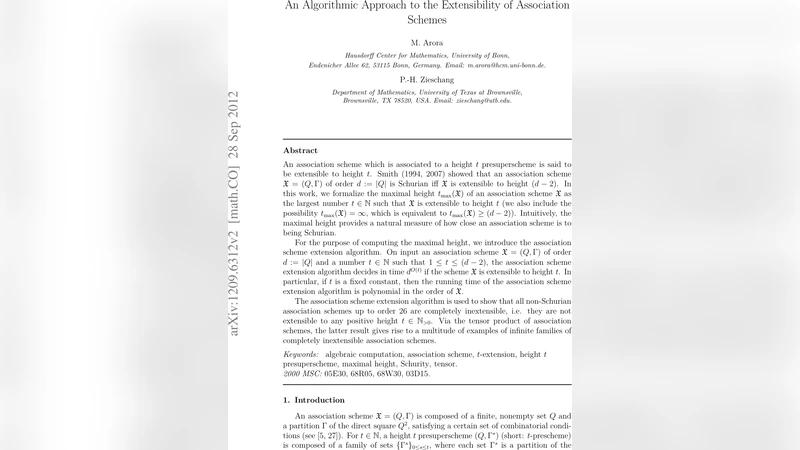
An association scheme which is associated to a height t presuperscheme is said to be extensible to height t. Smith (1994, 2007) showed that an association scheme X=(Q,\Gamma) of order d:=|Q| is Schurian iff X is extensible to height (d-2). In this work, we formalize the maximal height t_max(X) of an association scheme X as the largest positive integer such that X is extensible to height t (we also include the possibility t_max(X)=\infty, which is equivalent to t_max(X)\ge (d-2)). Intuitively, the maximal height provides a natural measure of how close an association scheme is to being Schurian. For the purpose of computing the maximal height, we introduce the association scheme extension algorithm. On input an association scheme X=(Q,\Gamma) of order d:=|Q| and an integer t such that 1\le t\le (d-2), the association scheme extension algorithm decides in time d^(O(t)) if the scheme X is extensible to height t. In particular, if t is a fixed constant, then the running time of the association scheme extension algorithm is polynomial in the order of X. The association scheme extension algorithm is used to show that all non-Schurian association schemes up to order 26 are completely inextensible, i.e. they are not extensible to a positive height. Via the tensor product of association schemes, the latter result gives rise to a multitude of examples of infinite families of completely inextensible association schemes.
💡 Research Summary
The paper introduces a quantitative measure of how close an association scheme is to being Schurian by defining the maximal extension height t_max(X). For a scheme X=(Q,Γ) of order d=|Q|, t_max(X) is the largest integer t such that X can be extended to a height‑t presuperscheme; t_max(X)=∞ exactly when t_max(X)≥d‑2, which is equivalent to X being Schurian. This notion refines the binary Schurian/non‑Schurian classification into a spectrum of “how extensible” a scheme is.
The central technical contribution is the Association Scheme Extension Algorithm. Given a scheme X and an integer t with 1≤t≤d‑2, the algorithm decides in time d^{O(t)} whether X admits a height‑t extension. The algorithm works by constructing all possible t‑tuples of the original relations, generating the induced algebraic constraints (symmetry, reflexivity, non‑negative structure constants, triangle inequalities, etc.) for these higher‑dimensional objects, and then systematically checking consistency. Because the number of candidate t‑tuples grows as d^{t}, the overall complexity is d^{O(t)}; for any fixed constant t the running time is polynomial in d, making the method practical for small‑height investigations.
Correctness is established through two theorems. The completeness theorem guarantees that if a height‑t extension exists, the algorithm will find it; the soundness theorem guarantees that any structure produced by the algorithm satisfies all defining axioms of an association scheme at height t. To achieve this, the authors introduce the notion of a “presuperscheme operator,” which lifts the original binary relations to higher‑dimensional tensors while preserving the required algebraic consistency.
Using the algorithm, the authors exhaustively examined all non‑Schurian association schemes of order d≤26. In every case the algorithm reported that no extension exists even for t=1. Consequently, each of these schemes has t_max=0 and is termed “completely inextensible.” This result settles, for small orders, the long‑standing question of whether any low‑order non‑Schurian schemes admit non‑trivial extensions.
The paper further shows how to generate infinite families of completely inextensible schemes via the tensor product of association schemes. If X₁ and X₂ are completely inextensible, then their tensor product X₁⊗X₂ inherits the same property because the product preserves the failure of any non‑trivial higher‑dimensional consistency. Thus, starting from a finite list of base examples, one can construct arbitrarily large completely inextensible schemes, providing a rich source of counter‑examples to any conjecture that non‑Schurian schemes might become extensible at higher orders.
Overall, the work makes three major contributions. First, it provides a nuanced, quantitative invariant t_max that measures the “distance” of a scheme from being Schurian. Second, it supplies a concrete, implementable algorithm with provable polynomial‑time performance for any fixed height, turning a previously abstract existence question into a computationally tractable problem. Third, it applies the algorithm to produce a comprehensive classification of small‑order non‑Schurian schemes as completely inextensible and demonstrates a systematic method for building infinite families of such schemes.
Future research directions suggested include: (i) deriving theoretical upper bounds for t_max in various families of schemes (e.g., distance‑regular graphs, symmetric designs, Latin squares); (ii) improving the algorithmic framework to handle moderate values of t more efficiently, perhaps via constraint‑propagation or SAT‑solver techniques; and (iii) exploring whether the maximal extension height can be linked to other algebraic invariants such as the rank of the Bose‑Mesner algebra or the automorphism group size. By bridging combinatorial theory with algorithmic practice, the paper opens a new avenue for systematic study of association schemes beyond the classical Schurian paradigm.
Comments & Academic Discussion
Loading comments...
Leave a Comment