Morphisms of A-infinity Bialgebras and Applications
We define the notion of a relative matrad and realize the free relative matrad as a free H_\infty-bimodule structure on cellular chains of bimultiplihedra JJ={JJ_{n,m} = JJ_{m,n}}. We define a morphism G:A => B of A_\infty-bialgebras as a bimodule ov…
Authors: Samson Saneblidze, Ronald Umble
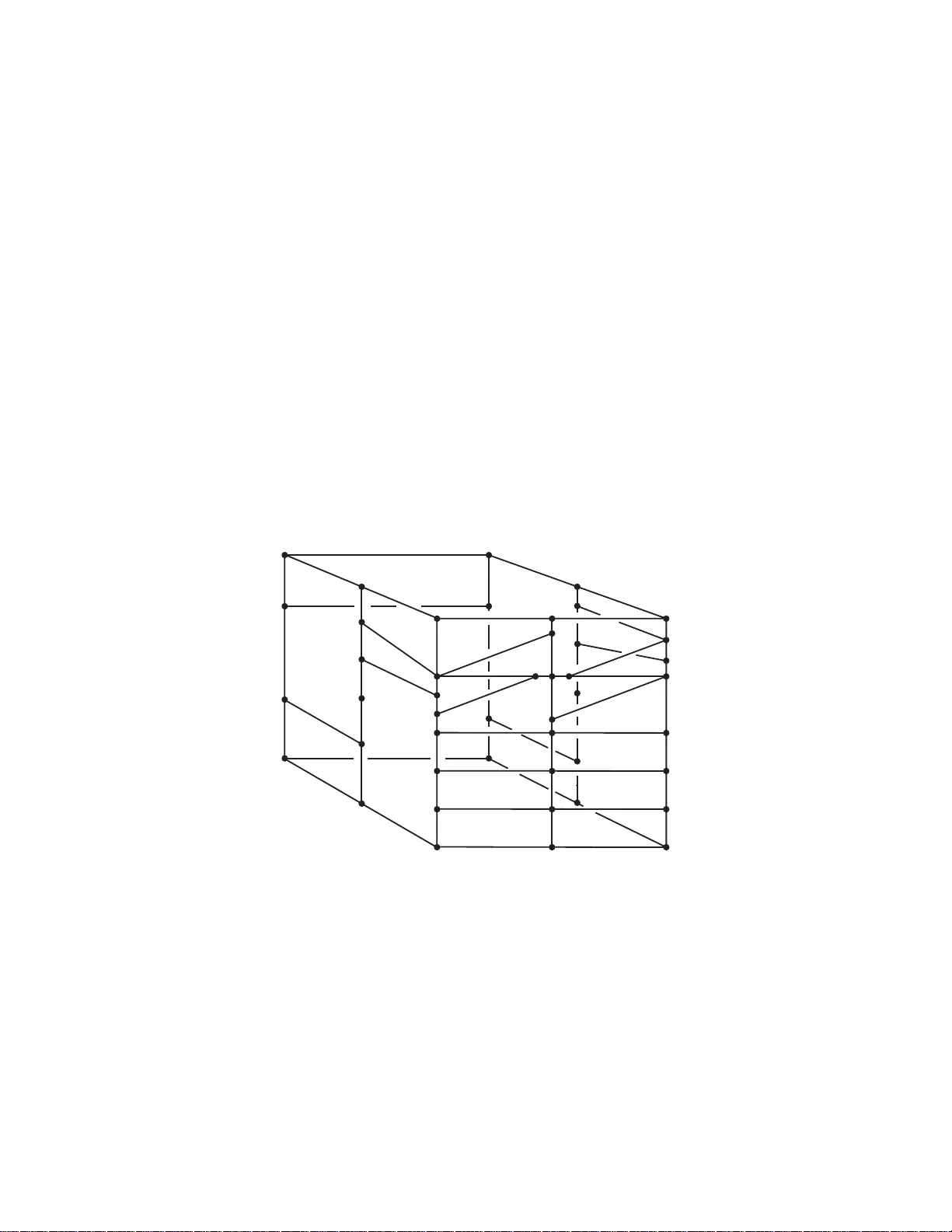
MORPHISMS OF A ∞ -BIALGEBRAS AND APPLICA TIONS SAMSON SANEBLIDZE 1 AND RONALD UMBLE 2 Abstract. W e define th e not ion of a r ela tive matr ad and realize the f ree rela- tiv e m atrad r H ∞ as a fr ee H ∞ -bimo dule structure on cell ular cha ins of bimul- tiplihe d r a J J = { J J n,m = J J m,n } m,n ≥ 1 . W e define a morphism G : A ⇒ B of A ∞ -bialgebras as a bimo dule o ver H ∞ . W e prov e that the homology of ev ery A ∞ -bialgebra ov er a commutativ e ring with unit y admits an i nduced A ∞ -bialgebra structure. W e extend the Bott-Samelson i somorphism to an isomorphism of A ∞ -bialgebras and iden tify the A ∞ -bialgebra structure o f H ∗ (ΩΣ X ; Q ). F or eac h n ≥ 2, we co nstruct a space X n and iden tify an induced non tri vi al A ∞ -bialgebra op eration ω n 2 : H ∗ (Ω X n ; Z 2 ) ⊗ 2 → H ∗ (Ω X n ; Z 2 ) ⊗ n . 1. Introduction This paper assumes familiarit y with our prequels [25] a nd [26], in whic h we defined the ob jects in the catego r y o f A ∞ -bialgebra s; in this paper we define th e morphisms. Let R be a (graded or ungraded) commutativ e ring with unity , let H be a graded R -mo dule, let M = { M n,m = H om ( H ⊗ m , H ⊗ n ) } , and consider the (non-bilinear) pr o duct ⊚ : M × M d × d → M × M Υ → M pro j → M , where M ⊂ T T M (the double tenso r mo dule of M ) is the bisequence submo dule, d : M → M is the bideriv ative, and Υ : M × M → M is the canonical pro duct. A family of maps ω = { ω n m ∈ M n,m | | ω n m | = m + n − 3 } m,n ≥ 1 defines an A ∞ -bialgebra structure on H whenever ω ⊚ ω = 0; the structure r e- lations are the bihomoge ne o us components of this equation. The structure of an A ∞ -bialgebra is con trolled by a family of con tra c tible p o lytop es K K = { K K n,m = K K m,n } called biasso ciahedra , of which K K n,m is ( m + n − 3 )-dimensional with a single to p dimensional cell; in particular, K K 1 ,n is the asso ciahedron K n . The cellular chains C ∗ ( K K ) rea lize the fr ee matrad H ∞ , and there is a canonical ma- trad structure on H om ( T H, T H ). Thus ( H, ω ) is an A ∞ -bialgebra whenever there is a map of matrads C ∗ ( K K ) → H om ( T H , T H ) whose restriction to top dimen- sional cells has imag e ω . When this o ccurs w e say that ( H , ω ) is an alg ebra o ver H ∞ . Date : September 27, 2012. Key wor ds and phr ases. A ∞ -bialgebra, biasso ciahedron, bimultiplihedron, lo op space, m atrad, operad, p ermutahedron, relative m atrad . 1 The research describ ed in this publi cation w as made p ossible in part by Aw ar d No. GM1- 2083 of the U.S. Civi l ian Research and Dev elopment F oundation for the Indep endent States of the F ormer So vi et Union (CRDF) and b y Aw ar d No. 99-00817 of INT AS. 2 This researc h w as f unded i n part by a M illersvil le Universit y faculty research grant. 1 2 SAMSON S ANEBLIDZE 1 AND RONALD UMBLE 2 The structure of an A ∞ -bialgebra morphism is controlled by a family o f con- tractible po lytop es J J = { J J n,m = J J m,n } m,n ≥ 1 called bimultiplihe dr a, of which J J n,m is a s ubdivis ion of K K n,m × I with a single top dimensional cell; in par - ticular, J J 1 ,n is the multiplihedron J n . The A ∞ -bimo dule s tructure on cellula r chains C ∗ ( J ) extends to an H ∞ -bimo dule structure on C ∗ ( J J ) and re alizes the free r elative matr ad r H ∞ . Given A ∞ -bialgebra s A a nd B , there is a canonical E nd T B - E nd T A -bimo dule str ucture on H om ( T A, T B ) , which is also a canonical rel- ative ma trad structure. Thus a family of maps G = g n m ∈ H om A ⊗ m , B ⊗ n | | g n m | = m + n − 2 defines an A ∞ - bialgebr a morphism A ⇒ B whenever there is a map of r elative matrads C ∗ ( J J ) → H om ( T A, T B ) who se r estriction to top dimensional cells has image G . When this o cc ur s we say that ( A, B , G ) is a bimo dule ov er H ∞ . Given an A ∞ -bialgebra B who se homolog y H ∗ ( B ) is a free R -mo dule, and a homology isomor phism g : H ∗ ( B ) → B , we prov e that the A ∞ -bialgebra structure on B pulls back alo ng g to an A ∞ -bialgebra structure on H ∗ ( B ), and any tw o such structures so obtained are isomor phic. This is a sp ecial cas e of our main result: Theorem 2 . L et B b e an A ∞ -bialgebr a with homolo gy H = H ∗ ( B ) , let ( R H, d ) b e a fr e e R -m o dule r esolution of H, and let h b e a p erturb ation of d such that g : ( R H , d + h ) → ( B , d B ) is a homo lo gy isomorphism. Then (i) (Existence) g induc es an A ∞ -bialgebr a structur e ω RH on RH and ext ends to a ma p G : R H ⇒ B of A ∞ -bialgebr as. (ii) (Uniqueness) ( ω RH , G ) is u nique up t o isomorp hism. Whereas an A ∞ -coalge br a is an A ∞ -bialgebra whose nontrivial oper ations are exclusively A ∞ -coalge br a op erations, Theorem 2 achiev es the sa me result a s the Coalgebr a Perturbation Lemma (CPL) whenever it applies (see [1 1], [13], [19]). How ever, Theorem 2 applies to a g eneral A ∞ -bialgebra B , and our pro o f, which follows a geo metrical construction, do es not assume that the map g has a r ight- homotopy in verse (without which the CPL cannot b e formulated). Indeed, if A is a free R -mo dule, B is an A ∞ -structure, a nd g : A → B is a homology isomor phism, Theorem 2 tr a nsfers the A ∞ -structure from B to A along g whenever ( 1) the A ∞ -structure on B is co n trolled by a family P of co ntractible p olytop es, each having a single top dimens io nal ce ll, and (2 ) the morphisms of A ∞ -structures a re controlled by an appr opriate subdiv is ion o f P × I . F or some remar ks on the histo ry of p ertur bation theory see [12] and [13]. W e only note that, in the particular ca s e of the de Rham complex, K .T. Chen [6] constructed the requisite p erturbation b y hand (also see [10]). Several a pplications of Theo rem 2 app ea r in Section 7. Given a top ologica l spa c e X and a field F , the bialgebra structure of simplicial singular c ha ins S ∗ (Ω X ; F ) of Mo ore ba se p o inted lo ops induces an A ∞ -bialgebra structure on H ∗ (Ω X ; F ) and the A ∞ -(co)algebr a substructures are exactly the o nes o bserved earlier by Gugenheim [9] and K adeishvili [15]. F ur thermore, the A ∞ -coalge br a structure on H ∗ ( X ; F ) extends to an A ∞ -bialgebra s tructure on the tensor algebr a T a ˜ H ∗ ( X ; F ), which is trivial if and only if the A ∞ -coalge br a s tructure on H ∗ ( X ; F ) is triv ia l. The Bott- Samelson isomor phis m t ∗ : T a ˜ H ∗ ( X ; F ) ≈ → H ∗ (ΩΣ X ; F ) ex tends to an is omorphism of A ∞ -bialgebra s (Theorem 4). Indeed, the A ∞ -bialgebra structure o f H ∗ (ΩΣ X ; Q ) provides the first no nt r ivial r ational homolo gy inv a riant for ΩΣ X (Corollary 2). MORPHISMS OF A ∞ -BIALGEBRAS AND APPLICA TIONS 3 Finally , fo r each n ≥ 2 , w e construct a space X n and identif y a nontrivial A ∞ - bialgebra op era tio n ω n 2 : H ∗ (Ω X n ; Z 2 ) ⊗ 2 → H ∗ (Ω X n ; Z 2 ) ⊗ n defined in terms of the actio n of the Steenro d algebra A 2 on H ∗ ( X n ; Z 2 ) . The pap er is organize d as follows: Section 2 r eviews the theor y o f matra ds a nd the related notation used th roughout the pap er; see [26] for details. W e construct relative matra ds in Section 3 and the bimultiplih edra in Section 4. W e define morphisms of A ∞ -bialgebra s in Section 5 . W e prove our main result (Theo rem 2) in Section 6 and conclude with v ario us applications a nd exa mples in Section 7. 2. Ma trads Let M = { M n,m } m,n ≥ 1 be a bigr aded mo dule ov er a (gra ded or ungraded) commutativ e ring R with unit y 1 R . Ea ch pair of matrices X = [ x ij ] , Y = [ y ij ] ∈ N q × p , p, q ≥ 1 , uniquely determines a submo dule M Y ,X = M y 11 ,x 11 ⊗ · · · ⊗ M y 1 p ,x 1 p ⊗ · · · ⊗ M y q 1 ,x q 1 ⊗ · · · ⊗ M y qp ,x qp ⊂ T T M . Fix a set of bihomo geneous mo dule genera tors G ⊂ M . A monomial in T M is an element of G ⊗ p , a nd a monomial in T T M is an element of ( G ⊗ p ) ⊗ q . Thus A ∈ ( G ⊗ p ) ⊗ q is naturally repres e n ted by the q × p ma trix A = α y 1 , 1 x 1 , 1 · · · α y 1 ,p x 1 ,p . . . . . . α y q, 1 x q, 1 · · · α y q,p x q,p with entries in G , and rows iden tified with elements of G ⊗ p . W e refer to A as a q × p monomial , and to the submo dules M = M X,Y ∈ N q × p p,q ≥ 1 M Y ,X and V = M X,Y ∈ N 1 × p ∪ N q × 1 p,q ≥ 1 M Y ,X as the matrix and ve ctor submo dules o f T T M , resp ectively . The matrix tra nsp ose A 7→ A T induces the canonical p er m uta tio n of tensor factor s σ p,q : ( M ⊗ p ) ⊗ q ≈ → ( M ⊗ q ) ⊗ p given b y α y 1 , 1 x 1 , 1 ⊗ · · · ⊗ α y 1 ,p x 1 ,p ⊗ · · · ⊗ α y q, 1 x q, 1 ⊗ · · · ⊗ α y q,p x q,p 7→ α y 1 , 1 x 1 , 1 ⊗ · · · ⊗ α y q, 1 x q, 1 ⊗ · · · ⊗ α y 1 ,p x 1 ,p ⊗ · · · ⊗ α y q,p x q,p . Let ¯ X ∈ N q × p be a matrix with co nstant co lumns ( x i ) T ; let ¯ Y ∈ N q × p be a matrix with constant rows ( y j ). Given q × p mo nomials A = α y 1 , 1 x 1 · · · α y 1 ,p x p . . . . . . α y q, 1 x 1 · · · α y q,p x p ∈ M Y , ¯ X and B = β y 1 x 1 , 1 · · · β y 1 x 1 ,p . . . . . . β y q x q, 1 · · · β y q x q,p ∈ M ¯ Y ,X , define the r ow le af se quenc e of A to b e the p -tuple rls ( A ) = ( x 1 , . . . , x p ); define the c olumn le af se qu enc e of B to be the q -tuple cls ( B ) = ( y 1 , . . . , y q ) T . Let M row := M ¯ X ,Y ∈ N q × p ; p,q ≥ 1 M Y , ¯ X and M col := M X, ¯ Y ∈ N q × p ; p,q ≥ 1 M ¯ Y ,X ; then M = M row ∩ M col 4 SAMSON S ANEBLIDZE 1 AND RONALD UMBLE 2 is the bise qu en c e submo dule of T T M , and a q × p mo nomial A ∈ M is represented as a bise qu enc e matrix A = α y 1 x 1 · · · α y 1 x p . . . . . . α y q x 1 · · · α y q x p . Unless otherwis e s tated, we sha ll a ssume that x × y ∈ ( x 1 , . . . , x p ) × ( y 1 , . . . , y q ) T ∈ N 1 × p × N q × 1 , p, q ≥ 1; we will o ften expres s y as a row vector. Let M y x = h A ∈ M | x = rls ( A ) and y = cls ( A ) i ; then M = M x × y M y x . F o r ex ample, g iven a graded R -mo dule H , set M n,m = H om ( H ⊗ m , H ⊗ n ), a nd think of α n m ∈ M n,m as a comp ositio n o f multilinear indeco mpo sable op eratio ns θ j i : H ⊗ i → H ⊗ j pictured as an upw ard-dir ected g raph with m inputs a nd n outputs; then a q × p monomial A ∈ M y x is a q × p matrix of such graphs. By ident ifying ( H ⊗ q ) ⊗ p ≈ ( H ⊗ p ) ⊗ q with ( q , p ) ∈ N 2 , we think of a q × p mo no mial A ∈ M y x as a n op er a tor on the p ositive integer lattice N 2 , pictured as an arrow ( | x | , q ) 7→ ( p, | y | ) , where | u | = Σ u i ; but unfortunately , this representation is not faithful. The bise quenc e ve ctor submo dule is the intersection V = V ∩ M = M s,t ∈ N M y s ⊕ M t x . A submo dule W = M ⊕ M x , y / ∈ N ; s,t ∈ N W y s ⊕ W t x ⊆ V is telesc oping if for a ll x , y , s, t (i) W y s ⊆ M y s and W t x ⊆ M t x ; (ii) α y 1 s ⊗ · · · ⊗ α y q s ∈ W y s implies α y 1 s ⊗ · · · ⊗ α y j s ∈ W y 1 ··· y j s for all j < q ; (iii) β t x 1 ⊗ · · · ⊗ β t x p ∈ W t x implies β t x 1 ⊗ · · · ⊗ β t x i ∈ W t x 1 ··· x i for all i < p. Thu s the truncatio n maps τ : W y 1 ··· y j s → W y 1 ··· y j − 1 s and τ : W t x 1 ··· x i → W t x 1 ··· x i − 1 determine the following “telescoping” se quences of s ubmo dules : τ ( W y s ) ⊆ τ 2 ( W y s ) ⊆ · · · ⊆ τ q − 1 ( W y s ) = W y 1 s τ W t x ⊆ τ 2 W t x ⊆ · · · ⊆ τ p − 1 W t x = W t x 1 . In genera l, W t x is an additive s ubmo dule of M t x 1 ⊗ · · · ⊗ M t x p , which do es not necessarily deco mp os e as B 1 ⊗ · · · ⊗ B p with B i ⊆ M t x i . The telesc opic extension of a teles coping submo dule W ⊆ V is the submo dule of matrices W ⊆ M with the following pro pe rties: If A = α y i,j x i,j is a q × p monomial in W , and ( i) α y i,j x i,j · · · α y i,j + m x i,j + m is a string in the i th row of A such that y i,j = · · · = y i,j + m = t, then α t x i,j ⊗ · · · ⊗ α t x i,j + m ∈ W t x i,j ,...,x i,j + m . (ii) α y i,j x i,j · · · α y i + r,j x i + r,j T is a string in the j th column of A such that x i,j = · · · = x i + r , j = s, then α y i,j s ⊗ · · · ⊗ α y i + r,j s ∈ W y i,j ,...,y i + r,j s . Thu s if A ∈ M y x ∩ W , the i th row of A lies in W y i x , and the j th column of A lies in W y x j . MORPHISMS OF A ∞ -BIALGEBRAS AND APPLICA TIONS 5 Definition 1. A p air of ( q × s, t × p ) monomials A ⊗ B = α y kl v kl ⊗ β u ij x ij ∈ M ⊗ M is a (i) T r ansverse Pair (TP) if s = t = 1 , u 1 ,j = q , and v k, 1 = p for a l l j and k , i.e., setting x j = x 1 ,j and y k = y k, 1 gives A ⊗ B = α y 1 p . . . α y q p ⊗ β q x 1 · · · β q x p ∈ M y p ⊗ M q x . (ii) Blo ck T r ansverse Pair (BTP) if t her e exist t × s blo ck de c omp ositions A = h A ′ k ′ ,l i and B = B ′ i,j ′ such that A ′ il ⊗ B ′ il is a TP fo r al l i and l . A pair A ⊗ B ∈ M y v ⊗ M u x is a BTP if and only if x × y ∈ N 1 ×| v | × N | u |× 1 if and only if the initial p oint o f arrow A coincides with the terminal p oint o f arrow B as op erators on N 2 . Given a family o f maps ¯ γ = { M ⊗ q ⊗ M ⊗ p → M } p,q ≥ 1 , let γ = { γ y x : M y p ⊗ M q x → M | y | | x | } . Then γ induces a global pro duct Υ : M ⊗ M → M defined by (2.1) Υ ( A ⊗ B ) = γ A ′ ij ⊗ B ′ ij , A ⊗ B is a BTP 0 , otherwise, where A ′ ij ⊗ B ′ ij is the ( i, j ) th TP in the BTP decomp osition of A ⊗ B . Obviously Υ is close d in b o th M row and M col , and consequently in M . W e denote the Υ-pro duct by “ · ” or juxtap ositio n; when A ⊗ B = α y j p T ⊗ β q x i is a TP , we write AB = γ ( α y 1 p , . . . , α y q p ; β q x 1 , . . . , β q x p ) . When pictured as an a rrow in N 2 , AB “tra nsgresse s” from the horizo n ta l axis y = 1 to the vertical a xis x = 1 in N 2 . Recall that the Υ -pro duct acts asso ciatively on M (see [26]). How ever, if A 1 · · · A n is a matrix string in M , as s o ciativity f a ils whenever one a sso ciation of A 1 · · · A n pro duces a sequence o f BTPs while so me other do es not. F or exa mple, in AB C = θ 1 2 θ 1 2 θ 1 2 1 1 θ 1 2 θ 2 1 θ 2 1 θ 2 1 , { A ⊗ B , AB ⊗ C } is a seq uence of BTP s but { B ⊗ C , A ⊗ B C } is not; thus ( AB ) C 6 = 0 while A ( B C ) = 0. Let 1 1 × p = (1 , . . . , 1 ) ∈ N 1 × p , and 1 q × 1 = (1 , . . . , 1 ) T ∈ N q × 1 ; we often suppress the exp onents when the context is clear . Definition 2. A pr ematr ad ( M , γ , η ) is a bigr ade d R -mo dule M = { M n,m } m,n ≥ 1 to gether wi t h a family of structur e maps γ = { γ y x : M y p ⊗ M q x → M | y | | x | } and a un it η : R → M 1 1 such that (i) Υ (Υ ( A ; B ) ; C ) = Υ ( A ; Υ ( B ; C )) whenever A ⊗ B and B ⊗ C ar e BTPs in M ⊗ M ; (ii) the fol lowing c omp ositions ar e t he c anonic al isomorphisms: R ⊗ b ⊗ M b a η ⊗ b ⊗ Id − → M 1 b × 1 1 ⊗ M b a γ 1 b × 1 a − → M b a ; M b a ⊗ R ⊗ a Id ⊗ η ⊗ a − → M b a ⊗ M 1 1 1 × a γ b 1 1 × a − → M b a . 6 SAMSON S ANEBLIDZE 1 AND RONALD UMBLE 2 We denote t he element η (1 R ) by 1 M . A morphism of pr ematr ads ( M , γ ) and ( M ′ , γ ′ ) is a map f : M → M ′ such that f γ y x = γ ′ y x ( f ⊗ q ⊗ f ⊗ p ) for al l x × y . Note that if A 1 · · · A n is a matrix string in a pr ematrad, Axio m (i) implies that asso ciativity holds whenever every a sso ciation of A 1 · · · A n pro duces a sequence of BTPs. Definition 3. L et ( M , γ , η ) b e a pr ematr ad. A st ring of m atric es A s · · · A 1 is b asic in M n m if (i) A 1 ∈ M b x , | x | = m, (ii) A i ∈ M r { 1 q × p | p, q ∈ N } for al l i, (iii) A s ∈ M y a , | y | = n, a nd (iv) some asso ciation o f A s · · · A 1 defines a se quenc e of BTPs and non-zer o Υ - pr o duct s. Definition 4 constructs a big r aded set G pre = G pre ∗ , ∗ , where G pre n,m is defined in terms of G [ n,m ] = [ i ≤ m, j ≤ n, i + j < m + n G pre j,i . W e denote the sets of matrices over G [ n,m ] and G pre by G [ n,m ] and G , resp ectively; G denotes the s ubset of bisequence matr ic e s in G . Definition 4. L et Θ = θ n m | θ 1 1 = 1 m,n ≥ 1 b e a fr e e bigr ade d R -mo dule gener ate d by singletons θ n m , and set G pre 1 , 1 = 1 . Inductively, if m + n ≥ 3 and G pre j,i has b e en c onstructe d for i ≤ m, j ≤ n, and i + j < m + n, d efine G pre n,m = θ n m ∪ { b asic strings A s · · · A 1 in G n m with s ≥ 2 } . L et ∼ b e the e quivalenc e re lation on G pre = G pre ∗ , ∗ gener ate d by [ A ij B ij ] ∼ [ A ij ] [ B ij ] if and only if [ A ij ] × [ B ij ] ∈ G × G is a BTP, and let F pre (Θ) = h G pre ∼i . The fr e e pr ematr ad gener ate d by Θ is the pr ematr ad ( F pre (Θ) , γ , η ) , wher e γ is juxtap osition and η : R → F pre 1 , 1 (Θ) is given by η (1 R ) = 1 . Let W b e the tele s copic extension of a teles coping submo dule W . If A ⊗ B is a BTP in W ⊗ W , each TP A ′ ⊗ B ′ in A ⊗ B lie s in W y p ⊗ W q x for some x , y , p, q . Consequently , γ W extends to a g lobal pro duct Υ : W ⊗ W → W as in (2 .1). In fact, W is the smallest matr ix submo dule containing W on which Υ is well-defined. Definition 5. L et W b e a telesc oping submo dule of T T M , and let W b e its tele- sc opic ext ension. L et γ W = n γ y x : W y p ⊗ W q x → W | y | | x | o b e a stru ctur e map, and let η : R → M . The triple ( M , γ W , η ) is a lo c al pr ematr ad (with domain W ) if the fol lowing axioms ar e s atisfi e d: (i) W 1 x = M 1 x and W y 1 = M y 1 for al l x , y ; (ii) Υ (Υ ( A ; B ) ; C ) = Υ ( A ; Υ ( B ; C )) whenever A ⊗ B and B ⊗ C ar e BTPs in W ⊗ W ; (iii) the pr ematr ad unit axiom holds fo r γ W . The “configur ation mo dule” of a lo cal prema trad is defined in ter ms o f the combinatorics of per m uta he dr a. Recall that each co dimensio n k fa c e of the p ermu- tahedron P m is identified with a pair o f planar r o oted trees with levels (PL Ts)– one MORPHISMS OF A ∞ -BIALGEBRAS AND APPLICA TIONS 7 up-ro oted with m + 1 leav es and k +1 levels, and the other its down-ro oted mirro r im- age (see [18], [24 ]). Define the ( m, 1) -r ow desc ent se quenc e of the m -leaf up-ro oted corolla f m to b e m = ( m ) . Giv en an up-rooted P L T T with k ≥ 2 levels, succes- sively remov e the lev els o f T a nd obtain a s e quence o f s ubtrees T = T k , T k − 1 , ..., T 1 , in whic h T i − T i − 1 is the sequence of corolla s f m i, 1 · · · f m i,r i . Recov er T inductiv ely by attaching f m i,j to the j th leaf of T i − 1 . Define the i th le af se qu en c e of T to b e the row ma tr ix m i = ( m i, 1 , . . . , m i,r i ), and the ( m, k ) - ro w desc ent se quenc e of T to b e the k -tuple of row ma trices ( m 1 , . . . , m k ) . Dually , define the ( n, 1) -c olumn desc ent se quenc e of the n -leaf down-roo ted corolla g n to b e n = ( n ) . Define the ( n, 1) -c olumn desc ent se quenc e of the n -lea f down-ro oted coro lla g n to b e n = ( n ) . Given a down-ro oted PL T T with l ≥ 2 levels, s uccessively r emov e the levels of T , and obtain a sequence of s ubtrees T = T l , T l − 1 , ..., T 1 , in which T i − T i − 1 is the sequence of corolla s g n i, 1 · · · g n i,s i . Recover T inductiv ely by attach ing g n i,j to the j th leaf of T i − 1 for e a ch i. Define the i th le af se qu en c e of T to b e the column matrix n i = ( n i, 1 , . . . , n i,s i ) T , and the ( n, l )- c olumn desc ent se quenc e of T to b e the l -tuple o f column matrices ( n l , . . . , n 1 ). Let W row = W ∩ M row , and W col = W ∩ M col . Definition 6. Given a lo c al pr ematr ad ( M , γ W ) with domain W , let ζ ∈ M ∗ ,m and ξ ∈ M n, ∗ b e elements with m, n ≥ 2 . (i) A r ow factorizati on of ζ with r esp e ct to W is a Υ -factorization A 1 · · · A k = ζ su ch that A j ∈ W row and rls( A j ) 6 = 1 for al l j . The se quenc e α = (rls( A 1 ) , ..., rls( A k )) is t he r elate d ( m, k ) -r ow desc ent se quenc e of ζ . ( ii) A c olumn factorization of ξ with r esp e ct to W is a Υ -factorization B l · · · B 1 = ξ such t hat B i ∈ W col and cls( B i ) 6 = 1 for al l i . The se quenc e β = ( cls( B l ) , ..., cls( B 1 )) is the r elate d ( n, l ) - c olumn desc ent se quenc e of ξ . Given a lo cal prematrad ( M , γ W ), and elemen ts A ∈ M ∗ ,s and B ∈ M t, ∗ with s, t ≥ 2, choos e a row fa c torization A 1 · · · A k of A with resp ect to W having ( s, k )- row desce nt sequenc e α, a nd a column fa c torization B l · · · B 1 of B with res p ect to W having ( t, l )-column descent s equence β . Then α identifies A with an up-ro oted s -leaf, k -level PL T and a co dimension k − 1 face ∧ e A of P s − 1 , and β identifies B with a down-ro oted t -lea f, l -level PL T and a co dimension l − 1 face ∨ e B of P t − 1 . Extending to Cartesia n pro ducts, identify the mono mia ls A = A 1 ⊗ · · · ⊗ A q ∈ ( M ∗ ,s ) ⊗ q and B = B 1 ⊗ · · · ⊗ B p ∈ ( M t, ∗ ) ⊗ p with the pro duct cells ∧ e A = ∧ e A 1 × · · · × ∧ e A q ⊂ P × q s − 1 and ∨ e B = ∨ e B 1 × · · · × ∨ e B p ⊂ P × p t − 1 . Now consider the S-U dia gonal ∆ P (see [24]), and recall that there is a k - sub div ision P ( k ) r of P r and a c e llular inclusio n P ( k ) r ֒ → ∆ ( k ) ( P r ) ⊂ P × k +1 r for each k and r (see [26]). Thus fo r each q ≥ 2, the pro duct cell ∧ e A either is o r is not a sub- complex of ∆ ( q − 1) ( P s − 1 ) ⊂ P × q s − 1 , and dually for ∨ e B . Let x p m,i = (1 , . . . , m, . . . , 1) ∈ N 1 × p with m in the i th po sition, and let y n,j q = (1 , . . . , n , . . . , 1) T ∈ N q × 1 with n in the j th po sition. Definition 7 . The (left) c onfigu r ati on mo dule of a lo c al pr ematr ad ( M , γ W ) is the R -mo dule 8 SAMSON S ANEBLIDZE 1 AND RONALD UMBLE 2 Γ( M , γ W ) = M ⊕ M x , y / ∈ N ; s,t ≥ 1 Γ y s ( M ) ⊕ Γ t x ( M ) , wher e Γ y s ( M ) = M y 1 , s = 1 ; y = y n,j q for some n, j, q D A ∈ M y s | ∧ e A ⊂ ∆ ( q − 1) ( P s − 1 ) E , s ≥ 2 0 , otherwise, Γ t x ( M ) = M 1 x , t = 1; x = x p m,i for some m, i, p D B ∈ M t x | ∨ e B ⊂ ∆ ( p − 1) ( P t − 1 ) E , t ≥ 2 0 , otherwise. Thu s Γ t x ( M ) is g enerated by those tensor mo nomials B = β t x 1 ⊗ · · · ⊗ β t x p ∈ M t,x 1 ⊗ · · · ⊗ M t,x p whose tensor factor β t x i is ide ntified with some factor of a pro duct cell in ∆ ( p − 1) ( P t − 1 ) corres po nding to some column factorization β t x i = B i,l · · · B i, 1 with resp ect to W , and dually for Γ y s ( M ) . Definition 8. A lo c al pr ematr ad ( M , γ W , η ) is a (left) matr ad if Γ y p ( M , γ W ) ⊗ Γ q x ( M , γ W ) = W y p ⊗ W q x for al l p, q ≥ 2 . A morphism of matr ads is a map of underlying lo c al pr ematr ads. The doma in of the free prematra d ( M = F pre (Θ) , γ , η ) ge ner ated by Θ = h θ n m i m,n ≥ 1 is V = M ⊕ L x , y / ∈ N ; s,t ∈ N M y s ⊕ M t x , who se submo dules M , M 1 x , and M y 1 are contained in the co nfiguration mo dule Γ ( M ). As ab ov e, the symbol “ · ” denotes the γ pro duct. Definition 9. L et ( M = F pre (Θ) , γ , η ) b e the fr e e pr ematr ad gener ate d by Θ = h θ n m i m,n ≥ 1 , let F (Θ) = Γ ( M ) · Γ( M ) , and let γ F (Θ) = γ | Γ( M ) ⊗ Γ( M ) . The fr e e matr ad gener ate d by Θ is the triple F (Θ) , γ F (Θ) , η . There is a chain map that identifies mo dule gener a tors of F n,m (Θ) with cells of the biassocia hedron K K n,m . W e denote the differen tial ob ject ( F (Θ ) , ∂ ) by H ∞ , and define an A ∞ -infinit y bialgebr a as an alg e bra o ver H ∞ . 3. Rela tive Ma trads Let ( M , γ M , η M ) and ( N , γ N , η N ) b e R -pr ematrads, a nd let E = { E n,m } m,n ≥ 1 be a bigraded R - mo dule. Left a nd righ t ac tio ns λ = { λ y x : M y p ⊗ E q x → E | y | | x | } a nd ρ = { ρ y x : E y p ⊗ N q x → E | y | | x | } induce left and right globa l pro ducts Υ λ : M ⊗ E → E and Υ ρ : E ⊗ N → E in the same wa y that γ M = { γ y x : M y p ⊗ M q x → M | y | | x | } induces Υ M : M ⊗ M → M (see [2 6] and fo r mula (2 .1)). Definition 10. A t uple ( M , E , N , λ, ρ ) is a r elati ve pr ematr ad if (i) Asso ciativity hol ds: (a) Υ ρ (Υ λ ⊗ 1 ) = Υ λ ( 1 ⊗ Υ ρ ); (b) Υ λ (Υ M ⊗ 1 ) = Υ λ ( 1 ⊗ Υ λ ); (c) Υ ρ (Υ ρ ⊗ 1 ) = Υ ρ ( 1 ⊗ Υ N ) . MORPHISMS OF A ∞ -BIALGEBRAS AND APPLICA TIONS 9 (ii) The units η M and η N induc e the fo l lowing c anonic al isomorphisms for al l a, b ∈ N : R ⊗ b ⊗ E b a η ⊗ b M ⊗ 1 − → M 1 b × 1 1 ⊗ E b a λ 1 b × 1 a − → E b a ; E b a ⊗ R ⊗ a 1 ⊗ η ⊗ a N − → E b a ⊗ N 1 1 1 × a ρ b 1 1 × a − → E b a . We re fer to E as an M - N - bimo dule; when M = N we r efer to E as an M - bimo dul e . Definition 11 . A morphism f : ( M , E , N , λ, ρ ) → ( M ′ , E ′ , N ′ , λ ′ , ρ ′ ) of r elative pr ematr ads is a triple ( f M : M → M ′ , f E : E → E ′ , f N : N → N ′ ) such that (i) f M and f N ar e maps of pr ematr ads; (ii) f E c ommutes wi t h left and right actions, i.e., f E ◦ λ y x = λ ′ y x ◦ ( f ⊗ q M ⊗ f ⊗ p E ) and f E ◦ ρ y x = ρ ′ y x ◦ ( f ⊗ q E ⊗ f ⊗ p N ) for all x × y ∈ N p × 1 × N 1 × q . T ree representations of λ x 1 and ρ x 1 are related to those of λ 1 x and ρ 1 x by a reflection in some horizontal axis. Although ρ 1 x agrees with Markl, Shnider , and Stas heff ’s right mo dule action over an oper ad [20], λ 1 x differs fundamentally from their left mo dule action, and our definition of an “op era dic bimo dule” is consistent with their definition o f an op era dic ideal. Given graded R - mo dules A a nd B , let U A = E nd T A = { N s,p = H om ( A ⊗ p , A ⊗ s ) } p,s ≥ 1 U A,B = H om ( T A, T B ) = { E t,q = H om ( A ⊗ q , B ⊗ t ) } q,t ≥ 1 U B = E nd T B = { M u,r = H om ( B ⊗ r , B ⊗ u ) } r,u ≥ 1 , and define left and rig ht actions λ and ρ in terms o f the horizo nt al and vertical op erations × and ◦ analo gous to thos e in the prematrad str uc tur es on U A and U B (see Section 2 a bove and [2 6]). Then the r elative PROP ( U B , U A,B , U A , λ, ρ ) is the universal ex ample of a re lative prematr a d. Definition 12 co nstructs a bigraded set G pre = G pre ∗ , ∗ , where G pre n,m is defined in terms of G [ n,m ] = [ i ≤ m, j ≤ n, i + j < m + n G pre j,i . W e denote the sets o f ma trices ov er G [ n,m ] and G pre by C [ n,m ] and C , resp ectively; C denotes the subset o f bisequence matrices in C . As b efore, G denotes the sets of matrices ov er G pre , and G deno tes the subset o f bisequence matr ices in G . Definition 12. Given a fr e e bigr ade d R -mo dule Θ = θ n m | θ 1 1 = 1 m,n ≥ 1 gener ate d by singletons in e ach bide gr e e, let ( F pre (Θ) , γ , η ) b e the fr e e pr ematr ad gener ate d by Θ . L et F = h f n m i m,n ≥ 1 b e a fr e e bigr ade d R -mo dule gener ate d by singletons in e ach bide gr e e, and set G pre 1 , 1 = f 1 1 . In ductively, if m + n ≥ 3 and C [ n,m ] has b e en c onstructe d, define G pre n,m = f n m ∪ { B 1 · · · B l · C · A k · · · A 1 | k + l ≥ 1; k , l ≥ 0 } , wher e (i) A 1 ∈ G q x and B 1 ∈ G y p for ( | x | , | y | ) = ( m, n ) ; (ii) A i , B j ∈ G [ n,m ] for al l i, j ; 10 SAMSON S ANEBLIDZE 1 AND RONALD UMBLE 2 (iii) C ∈ C [ n,m ] ; and (vii) some asso ciation of B 1 · · · B l · C · A k · · · A 1 defines a se quenc e of BTP s . L et ∼ b e the e quivalenc e r elation on G pre = G pre ∗ , ∗ gener ate d b y [ X ij Y ij ] ∼ [ X ij ] [ Y ij ] iff [ X ij ] × [ Y ij ] ∈ C × G ∪ G × G ∪ G × C is a BT P , and let F pre (Θ , F , Θ) = h G pre ∼ i . The fr e e r elati ve pr ematr ad gener ate d by Θ and F is t he r elative p re matr ad ( F pre (Θ) , F pre (Θ , F , Θ) , F pre (Θ) , λ pre , ρ pre ) , wher e λ pre and ρ pre ar e juxt ap osition. Example 1. The mo dule F pre 2 , 2 (Θ , F , Θ) c ontains 25 mo dule gener ators, namely, the inde c omp osable f 2 2 and the fol lowi ng ( λ pre , ρ pre ) -de c omp osables: Two of t he form B C A : (3.1) θ 2 1 f 1 1 θ 1 2 and " θ 1 2 θ 1 2 # " f 1 1 f 1 1 f 1 1 f 1 1 # θ 2 1 θ 2 1 . Eleven of t he form C A k · · · A 1 : f 2 1 θ 1 2 , " f 1 1 f 1 1 # θ 2 2 , " f 1 1 f 1 1 # θ 2 1 θ 1 2 , " f 1 1 f 1 1 # " θ 1 2 θ 1 2 # θ 2 1 θ 2 1 , " f 1 2 f 1 2 # θ 2 1 θ 2 1 , " f 1 2 f 1 1 θ 1 2 # θ 2 1 θ 2 1 , " f 1 1 θ 1 2 f 1 2 # θ 2 1 θ 2 1 , " θ 1 2 f 1 1 f 1 1 f 1 1 θ 1 2 # θ 2 1 θ 2 1 , " f 1 1 θ 1 2 θ 1 2 f 1 1 f 1 1 # θ 2 1 θ 2 1 , " θ 1 2 f 1 1 f 1 1 f 1 2 # θ 2 1 θ 2 1 , " f 1 2 θ 1 2 f 1 1 f 1 1 # θ 2 1 θ 2 1 . And eleven r esp e ctive duals of t he form B 1 · · · B k C. Example 2. Re c al l t hat the bialg ebr a pr ematr ad H pre has two pr ematr ad gener a- tors c 1 , 2 and c 2 , 1 , and a single mo dule gener ator c n,m in bide gr e e ( m, n ) (se e [26] ). Conse qu ently, t he H pre -bimo dule J J pre has a single bi m o dule gener ator f of bide- gr e e (1 , 1) , and a single mo dule gener ator in e ach bide gr e e satisfying the struct ur e r elations λ ( c n,m ; f , . . . , f | {z } m ) = ρ ( f , . . . , f | {z } n ; c n,m ) . Mor e pr e cisely, if Θ = θ 1 1 = 1 , θ 1 2 , θ 2 1 and F = f = f 1 1 , then J J pre = F pre (Θ , F , Θ) / ∼ , wher e u ∼ u ′ if and only if bideg( u ) = bideg ( u ′ ) . A bialgebr a morphi sm f : A → B is the i m age of f under a map J J pre → U A,B of r elative pr ematra ds. MORPHISMS OF A ∞ -BIALGEBRAS AND APPLICA TIONS 11 Example 3. Wher e as F pre 1 , ∗ (Θ) and F pre ∗ , 1 (Θ) c an b e identifie d with the A ∞ -op er ad A ∞ ( se e [26]) , F 1 , ∗ (Θ , F , Θ) and F ∗ , 1 (Θ , F , Θ) c an b e identifie d with the A ∞ -bimo dule J ∞ whose bimo dule gener ators ar e in 1-1 c orr esp ondenc e with { f 1 m } m ≥ 1 and { f n 1 } n ≥ 1 , r esp e ctively. Thus an A ∞ -(c o)algebr a morphism f : A → B is the image of the A ∞ - bimo dule gener ators under a map J ∞ → H om ( T A, B ) ( or J ∞ → H om ( A, T B ) ) of r elative pr ematra ds. When Θ = θ n m 6 = 0 | θ 1 1 = 1 m,n ≥ 1 , and F = h f n m 6 = 0 i m,n ≥ 1 , the canonical pro - jections pre Θ : F pre (Θ) → H pre and pre : F pre (Θ , F , Θ) → J J pre give a ma p ( pre Θ , pre , pre Θ ) o f relative pr e matrads. If ∂ pre is a differential on F pre (Θ , F , Θ) such that pre is a free resolution in the catego ry of r e lative prematrads, the in- duced isomor phism pre : H ∗ ( F pre (Θ , F , Θ) , ∂ pre ) ≈ J J pre implies ∂ pre ( f 1 1 ) = 0 ∂ pre ( f 1 2 ) = ρ ( f 1 1 ; θ 1 2 ) − λ ( θ 1 2 ; f 1 1 , f 1 1 ) ∂ pre ( f 2 1 ) = ρ ( f 1 1 , f 1 1 ; θ 2 1 ) − λ ( θ 2 1 ; f 1 1 ) . This gives rise to the standard is o morphisms F pre 1 , 2 (Θ , F , Θ) = θ 1 2 f 1 1 f 1 1 , f 1 2 , f 1 1 θ 1 2 ≈ l l l l C ∗ ( J 2 ) = h 1 | 2 , 12 , 2 | 1 i ≈ l l l l F pre 2 , 1 (Θ , F , Θ) = θ 2 1 f 1 1 , f 2 1 , " f 1 1 f 1 1 # θ 2 1 (see Figure 3). A simila r applicatio n of ∂ pre to f n 1 and f 1 m gives the isomo rphisms (3.2) F pre n, 1 (Θ , F , Θ) ≈ − → J ∞ ( n ) = C ∗ ( J n ) and (3.3) F pre 1 ,m (Θ , F , Θ) ≈ − → J ∞ ( m ) = C ∗ ( J m ) (see [2 7], [28], [24]). As in the absolute case, there is a differ en tial ∂ on a ca nonical prop er submo dule J J ∞ ⊂ F pre (Θ , F , Θ) such that the canonical pro jection : J J ∞ → J J pre is a free r esolution in the category of “relative matrads.” Definition 1 3 . Given lo c al pr ematr ads ( M , γ W M , η M ) and ( N , γ W N , η N ) , a bi- gr ade d R -mo dule E = { E n,m } m,n ≥ 1 , a telesc oping submo dule W E ⊆ V E , and ac- tions λ = { λ y x : ( W M ) y p ⊗ ( W E ) q x → ( W E ) | y | | x | } and ρ = { ρ y x : ( W E ) y p ⊗ ( W N ) q x → ( W E ) | y | | x | } , t he tu ple ( M , E , N , λ, ρ ) is a r elative lo c al pr ematr ad with domain ( W M , W E , W N ) if (i) ( W E ) 1 x = E 1 x and ( W E ) y 1 = E y 1 for al l x , y ; (ii) Υ M , Υ N , Υ λ , Υ ρ inter act asso ciatively on W E ∩ E ; (iii) the r elative pr ematr ad unit axiom holds for λ and ρ . Let E row = M ¯ X ,Y ∈ N q × p ; p,q ≥ 1 E Y , ¯ X and E col = M X, ¯ Y ∈ N q × p ; p,q ≥ 1 E ¯ Y ,X , 12 SAMSON S ANEBLIDZE 1 AND RONALD UMBLE 2 where ¯ X ha s constant columns and ¯ Y has consta nt rows. If A is a q × p monomial in E Y , ¯ X , w e refer to a r ow x of ¯ X as the ro w le af se qu enc e of A , a nd write rls( A ) = x ; if B is a q × p mono mial in E ¯ Y ,X , we refer to a column y of ¯ Y as the c olumn le af se quenc e o f B , a nd write c ls ( B ) = y . Given a telescoping submo dule W ⊆ V E and its telescopic extension W E , let ( W E ) row = W E ∩ E row and ( W E ) col = W E ∩ E col . Definition 14. L et ( M , E , N , λ, ρ ) b e a r elative lo c al pr ematra d with domain ( W M , W E , W N ) , let m, n ≥ 1 , let f ∈ E ∗ ,m , and let g ∈ E n, ∗ . (i) A r ow factorizati on of f with r esp e ct to ( W M , W E , W N ) is an (Υ λ , Υ ρ ) - factorization A 1 · · · A s · C · A ′ s +1 · · · A ′ k = f such that A i ∈ ( W M ) row , C ∈ ( W E ) row , A ′ j ∈ ( W N ) row and rls( A i ) , rls( A ′ j ) 6 = 1 for al l i, j. The ( m + 1 , k + 1) - r ow desc ent se quenc e of f is the ( k + 1) - tuple of r ow ve ctors m =(rls ( A 1 ) , ..., rls( A s ) , (1 , 0 , ..., 0) + rls( C ) , 1 , rls( A ′ s +1 ) , ..., (1 , rls( A ′ k ))) . (ii) A c olumn factorization of g with r esp e ct to ( W M , W E , W N ) is an (Υ λ , Υ ρ ) -factorization B ′ l · · · B ′ t +1 · D · B t · · · B 1 = g such that B ′ i ∈ ( W M ) col , D ∈ ( W E ) col , B j ∈ ( W N ) col and cls( B ′ i ) , cls( B j ) 6 = 1 for al l i, j. The ( n + 1 , l + 1) - c olumn desc ent se qu enc e of g is t he ( l + 1) -t uple of c olumn ve ctors n = ((cls( B ′ l ) , 1) T ,..., (cls( B ′ t +1 ) , 1) T , cls( D ) + (0 ,..., 0 , 1) T , cls( B t ) ,..., cls( B 1 )) . Column and row facto rizations ar e not unique. Note that f ∈ E n,m alwa ys has trivial r ow and co lumn factor izations as a 1 × 1 ma tr ix C = [ f ]. Given elements f ∈ E ∗ ,m and g ∈ E n, ∗ with m, n ≥ 1 , cho ose a r ow factoriz ation A 1 · · · A s · C · A ′ s +1 · · · A ′ k of f , and a column factorization B ′ l · · · B ′ t +1 · D · B t · · · B 1 of g . The rela ted ro w descen t sequence m iden tifies f with an up-ro oted ( m + 1)- leaf, ( k + 1)-lev e l PL T, a nd hence with a co dimension k face ∧ e f of P m . Dually , the related column desce nt seq uence n identifies g with a down-ro oted ( n + 1)- leaf, ( l + 1)-level PL T, and hence with a co dimension l face ∨ e g of P n . Extending to Cartesian pro ducts, ident ify the monomials F = f 1 ⊗ · · · ⊗ f q ∈ ( E ∗ ,m ) ⊗ q and G = g 1 ⊗ · · · ⊗ g p ∈ ( E n, ∗ ) ⊗ p with the pro duct cells ∧ e F = ∧ e f 1 × · · · × ∧ e f q ⊂ P × q m and ∨ e G = ∨ e g 1 × · · · × ∨ e g p ⊂ P × p n . As in the absolute cas e r eviewed in Section 2, the pro duct cell ∧ e F either is or is not a sub complex of ∆ ( q − 1) ( P m ) ⊂ P × q m , and dually fo r ∨ e G . Recall that x × y ∈ N 1 × p × N q × 1 , and let r Γ( E ) = E ⊕ M x , y / ∈ N ; s,t ≥ 1 r Γ y s ( E ) ⊕ r Γ t x ( E ) , where r Γ y s ( E ) = D F ∈ E y s | ∧ e F ⊂ ∆ ( q − 1) ( P s ) E , r Γ t x ( E ) = D G ∈ E t x | ∨ e G ⊂ ∆ ( p − 1) ( P t ) E . MORPHISMS OF A ∞ -BIALGEBRAS AND APPLICA TIONS 13 Definition 15. The (left) c onfigur ation mo dule of a r elative lo c al pr ematr ad ( M , E , N , λ, ρ ) with domain ( W M , W E , W N ) is t he triple Γ( M , γ w M ) , r Γ( E ) , Γ( N , γ W N ) . When s = t = 1, the arguments in the absolute case carr y o ver v erba tim and give M x r Γ 1 x ( E ) = T + ( E 1 , ∗ ) and M y r Γ y 1 ( E ) = T + ( E ∗ , 1 ) . Definition 1 6. L et ( M , γ w M ) and ( N , γ w N ) b e (left) matr ads. A r elative lo c al pr e- matr ad ( M , E , N , λ, ρ ) with do m ain ( W M , W E , W N ) is a r elati ve (left) matr ad if r Γ( E ) = W E . Whe n M = N we r efer to r Γ( E ) as a Γ( M ) -bimo dule . A mor- phism of r elative matr ads is a map of underlying r elative lo c al pr ematr ads. A rela tiv e prematra d ( M , E , N , ρ, λ ) with do main ( W M , W E , W N ) restr icts to a rela tive matrad structure with domain (Γ( M ) , r Γ( E ) , Γ( N )) . Example 4. The Bi algebr a Morphism Matr ad J J . The H pre -bimo dule J J pre discusse d in Ex ample 2 s atisfies r Γ y p ( E ) ⊗ Γ q x ( M ) = E y p ⊗ M q x and Γ v s ( M ) ⊗ r Γ t u ( E ) = M v s ⊗ E t u . Conse qu ently, J J pre is also a r elative matra d, c al le d the bi al gebr a morphi sm matr ad , a nd is h en c eforth d enote d by J J . Definition 1 7. L et Θ = θ n m | θ 1 1 = 1 m,n ≥ 1 and F = h f n m i m,n ≥ 1 . L et F pre = F pre (Θ) , and c onsider the fr e e F pre -bimo dule E pre = F pre (Θ , F , Θ) . The fr e e r el- ative matr ad gener ate d by (Θ , F ) with domain ( W F (Θ) , W E , W F (Θ) ) is the tuple ( F (Θ) , F (Θ , F , Θ) , F (Θ) , λ, ρ ) , wher e F (Θ , F , Θ) = λ pre Γ y p ( F pre ); r Γ q x ( E pre ) ⊕ ρ pre r Γ y p ( E pre ); Γ q x ( F pre ) , λ = λ pre | W F (Θ) ⊗ W E , ρ = ρ pre | W E ⊗ W F (Θ) , and W E = M p,q ∈ N ; x , y / ∈ N F q,p (Θ , F , Θ) ⊕ Γ y p ( E pre ) ⊕ Γ q x ( E pre ) . F o r example, the mono mials in (3.1) ar e tw o o f the 17 mo dule genera tors in F 2 , 2 (Θ , F , Θ) identified with the faces o f the o ctago n J J 2 , 2 (see Fig ure 4). In general, F 1 ,m (Θ , F , Θ) = F pre 1 ,m (Θ , F , Θ), and F n, 1 (Θ , F , Θ) = F pre n, 1 (Θ , F , Θ) for all m, n ≥ 1 . Example 5. The A ∞ -bialgebr a Morphism Matr ad. L et Θ = θ n m | θ 1 1 = 1 m,n ≥ 1 , and F = h f n m i m,n ≥ 1 , wher e | f n m | = m + n − 2 . F ol lowing the c onstru ct ion in the absolute c ase, let r C b e the set indexing the mo dule gener ators F (Θ , F , Θ ) , and let AR m,n ⊂ C m,n × r C m,n and QB m,n ⊂ r C m,n × C m,n b e the s u bsets of r C that index t he c o dimension 1 elements of F n,m (Θ , F , Θ) of the form λ ( − ; − ) and ρ ( − ; − ) , r esp e ctively. L et ( A y p ) α and { ( B q x ) β } b e the b ases define d in Example 19 of [26] , and let { ( Q v s ) ν } ν ∈Q v s and { ( R t u ) µ } µ ∈R t u b e t he analo gous b ases for r Γ v s ( E ) and r Γ t u ( E ) in d imensions | v | + s − t and | u | + t − s ; then e ach ∧ e Q ν is a sub c omplex of ∆ ( t − 1) ( P s ) with asso ciate d sign ( − 1) ǫ ν and e ach ∨ e R µ is a sub c omplex of ∆ ( s − 1) ( P t ) with asso ciate d sign ( − 1) ǫ µ . Now c onsider c o dimension 1 fac e e ( y , x ) = C | D ⊂ P m + n − 2 define d as fol lows: If | x | = m > p ≥ 2 , let A x | B x b e the c o dimension 1 fac e of P m − 1 with le af se quenc e x ; dual ly, if | y | = n > q ≥ 2 , let A y | B y b e the 14 SAMSON S ANEBLIDZE 1 AND RONALD UMBLE 2 c o dimension 1 fac e of P n − 1 with le af se quenc e y . If A = { a 1 , . . . , a r } ⊂ Z and z ∈ Z , define − A = {− a 1 , . . . , − a n } and A + z = { a 1 + z , . . . , a r + z } ; t hen set A 1 = m − 1 , if x = 1 m , m ≥ 1 ∅ , if x = m ≥ 2 − B x + m, otherwise, A 2 = ∅ , if y = 1 n , n ≥ 1 n − 1 , if y = n ≥ 2 A y , otherwise, B 1 = ∅ , if x = 1 m , m ≥ 1 m − 1 , if x = m ≥ 2 − A x + m, otherwise, B 2 = n − 1 , if y = 1 n , n ≥ 1 ∅ , if y = n ≥ 2 B y , otherwise, and define (3.4) e ( y , x ) = A 1 ∪ ( A 2 + m − 1) | B 1 ∪ ( B 2 + m − 1 ) (this c orr e cts the analo gous formula in line (13) of [26] in which the symb ols A x and B x ar e r everse d). D efine a differ ential ∂ : F (Θ , F , Θ) → F (Θ , F , Θ) of de gr e e − 1 on gener ators by (3.5) ∂ ( f n m ) = P ( α,µ ) ∈AR m,n ( − 1) ǫ 1 + ǫ α + ǫ µ λ ( A y p ) α ; ( R q x ) µ + P ( ν,β ) ∈QB m,n ( − 1) ǫ 2 + ǫ ν + ǫ β ρ ( Q y p ) ν ; ( B q x ) β , wher e ( − 1) ǫ 1 is the sign asso ciate d with e ( y , x ) , and ǫ 2 = # D + ǫ 1 + 1 . Exten d ∂ as a derivation of ρ and λ ; t hen ∂ 2 = 0 fol lows fr om t he asso ciativity of ρ and λ . The A ∞ - bialgebr a morphi sm matr ad is the DG H ∞ -bimo dule J J ∞ = ( F (Θ , F , Θ) , ∂ ) . W e realize the A ∞ -bialgebra mor phism matra d by the cellular chains of a new family of polytop es J J = ⊔ m,n ≥ 1 J J n,m , called bimultiplihe dr a , to b e constr ucted in the next section. The standa rd is omorphisms (3.2) a nd (3.3) e x tend to isomor - phisms (3.6) ( J J ∞ ) n,m ≈ − → C ∗ ( J J n,m ) , and one r ecov er s J ∞ by restricting the differential ∂ to ( J J ∞ ) 1 , ∗ or ( J J ∞ ) ∗ , 1 . 4. Bimul tiplihedra In this sec tio n we constr uct the bim ultiplihedron J J n,m as a sub division o f the cylinder K K n,m × I . Whereas our construction o f K K n +1 ,m +1 uses the combina- torics of P m + n , our construction of J J n +1 ,m +1 uses the combinatorics of P m + n +1 thought of as a sub division of P m + n × I (see [24]), or equiv alently , as the com bi- natorial jo in P m + n +1 = P m + n ∗ c P 1 , whic h corresp o nds algebraically to adjoining the parameter f 1 1 to the 0-dimensiona l elements of the free matrad H ∞ (recall that dim P m + n +1 = dim( P m + n ∗ c P 1 ) = dim P m + n + 1; se e [26]). Indee d, our construc- tion of J J n +1 ,m +1 as the geometric realizatio n of a p oset r P P n,m ∼ resembles our constr uction of K K n +1 ,m +1 = |P P n,m ∼ | in [26], but with so me technical differences. Recall that faces of the permutahedron P n are indexed by up-ro oted (or down- ro oted) PL Ts. In particula r, the vertices of P n are indexed by the set ∧ n ( ∨ n ) of all up-rooted (down-ro oted) pla na r binary trees with n + 1 leav es and n levels. MORPHISMS OF A ∞ -BIALGEBRAS AND APPLICA TIONS 15 Since vertices o f P n are identified with p ermutations o f n = { 1 , 2 , . . . , n } , the Bruhat par tial or dering, generated by a 1 | · · · | a n < a 1 | · · · | a i +1 | a i | · · · | a n if and only if a i < a i +1 , induces natural p os et structures on ∧ n and ∨ n . In [26] we in tro duced the subp o set X n m ⊆ ∧ × n m , which indexes the vertices of the sub complex ∆ ( n − 1) ( P m ) ⊆ P × n m ; an element x ∈ X n m is expres s ed as a column matrix x = [ ˆ T 1 · · · ˆ T n ] T of n up-ro oted binary trees with m + 1 le aves a nd m levels. Let f ( g ) denote the up-r o oted (down-ro oted) 2-lea f cor o lla. Now if a ∈ ∧ n , there exists a unique B TP Υ-factoriza tion a = a 1 · · · a n such that a j is a 1 × j r ow ma trix ov er { 1 , f } containing the entry f exactly once. Th us by factoring e ach ˆ T i , we obtain the B TP Υ- fa ctorization x = x 1 · · · x m in which x j is an n × j matrix . Below we distinguish tw o matrices x α and x β that co rresp ond to the first a nd last matrices of a 0 -dimensional element of J J ∞ containing the entry f 1 1 as follows. Let ( x, i ) b e the lowest level of ˆ T i in which a branch is attached o n the ex treme left. Given p ositive integers α ≤ β , consider the s et of bitrunc ate d elements X n m ( α, β ) = { α x β = x α · · · x β | x = x 1 · · · x α · · · x β · · · x m ∈ X n m , α = min 1 ≤ i ≤ n ( x, i ) and β = max 1 ≤ i ≤ n ( x, i ) } . Define α x β < α ′ x ′ β ′ if and only if x < x ′ for some x = x 1 · · · x α · · · x β · · · x m and x ′ = x ′ 1 · · · x ′ α ′ · · · x ′ β ′ · · · x ′ m in X n m ; then X n m ( α, β ) is the p oset of bitrunc ate d elements . Now r eplace the entries 1 and f in each x j with the integers 1 and 2 , r esp ectively . Then the ( m + 1 , m )-r ow descent sequence C i = ( x i, 1 = (2) , x i, 2 , . . . , x i,m ) of ˆ T i app ears as the i th rows of x 1 , . . . , x m , and = ( x, i ) is the larges t in teger such that x i, = (2 , 1 , ..., 1) . Intro duce the decora tions ˚ x i, = ( ˚ 2 , ˚ 1 , ..., ˚ 1) and ˙ x i,j = ˙ 1 , 1 , . . . , 2 , 1 , . . . for j > , a nd obtain the cor resp onding ( m + 1 , m )- marke d r ow desc ent se quenc e ˆ C i = ( x i, 1 , . . . , x i, − 1 , ˚ x i, , ˙ x i, +1 , . . . , ˙ x i,m ) . The term ˚ x i, represents the constant 1 × matrix f 1 1 · · · f 1 1 . Let ˚ x denote the matrix string x = x 1 · · · x m with decora ted integer ent ries; then the po set of marke d bitrunc ate d elements is ˚ X n m ( α, β ) = { α ˚ x β | α x β ∈ X n m ( α, β ) } . Note that ( x, i ) is cons ta nt for all i if a nd only if α = β , in which ca se ˚ X n m ( α, α ) is a s ingleton set containing the n × α matrix α ˚ x α = ˚ x 1 ,α . . . ˚ x n,α = ˚ 2 ˚ 1 · · · ˚ 1 . . . . . . . . . ˚ 2 ˚ 1 · · · ˚ 1 , which re pr esents the constant matrix f 1 1 n × α . Given α ˚ x β ∈ ˚ X n m ( α, β ) , consider the mar ked sequence of i th rows ( x i,α , . . . , x i, − 1 , ˚ x i, , ˙ x i, +1 , . . . , ˙ x i,β ) . Let x ′ i,k denote the vector obtained from ˙ x i,k by deleting the marked en tr y ˙ 1 , and form the (unmarked) row-descen t sequence ( x ′′ i,α , ..., x ′′ i,β − 1 ) = ( x i,α , ..., x i, − 1 , x ′ i, +1 , ..., x ′ i,β ) . Then α x ′′ β − 1 denotes the bitruncated element whose i th rows are x ′′ i,α , ..., x ′′ i,β − 1 . 16 SAMSON S ANEBLIDZE 1 AND RONALD UMBLE 2 Example 6. Consider the fol lowing element x ∈ X 2 6 and its B TP factorization: x = = f f f 1 f 1 1 f 1 1 f 1 f 1 1 1 1 1 f 1 1 f 1 1 1 1 f 1 1 1 , wher e the dotte d lines indic ate the lowest lev els in which br anches ar e attache d on the extre m e left ( α = ( x, 2) = 2 , and β = ( x, 1) = 4 ). Then ˚ x = 2 2 2 1 ˚ 2 ˚ 1 1 2 1 ˙ 1 2 1 ˚ 2 ˚ 1 ˚ 1 ˚ 1 ˙ 1 1 2 1 ˙ 1 2 1 1 1 ˙ 1 2 1 1 1 ∈ ˚ X 2 6 and 2 ˚ x 4 = 2 1 ˚ 2 ˚ 1 1 2 1 ˙ 1 2 1 ˚ 2 ˚ 1 ˚ 1 ˚ 1 ˙ 1 1 2 1 ∈ ˚ X 2 6 (2 , 4) . The pr oje ctions (2 , 1) , (1 , 2 , 1) , ˚ 2 , ˚ 1 , ˚ 1 , ˚ 1 7→ (( 2 , 1) , (1 , 2 , 1)) and ˚ 2 , ˚ 1 , ˙ 1 , 2 , 1 , ˙ 1 , 1 , 2 , 1 7→ ((2 , 1 ) , (1 , 2 , 1)) send 2 ˚ x 4 to 2 x ′′ 3 = 2 1 2 1 1 2 1 1 2 1 . Dually , there is the subp oset Y m n ⊆ ∨ × m n , which indexes the vertices of the sub c omplex ∆ ( m − 1) ( P n ) ⊆ P × m n ; an element y ∈ Y m n is expres s ed as a row matrix y = [ ˇ T 1 · · · ˇ T m ] o f m down-ro oted binary trees with n + 1 leaves and n levels. Now if b ∈ ∨ n , ther e exists a unique B TP Υ-factor iz ation b = b n · · · b 1 such that b i is a i × 1 column matrix ov er { 1 , g } containing the entry g exactly o nce. Thus by factoring each ˇ T j , we obtain the (unique) BTP Υ -factorizatio n y = y n · · · y 1 in which y i is a n i × m matrix. Let κ ( y , j ) b e the highest level of ˇ T j in whic h a bra nch is attached on the extreme right. Given p ositive in tegers ǫ ≥ δ, consider the set of bitru nc ate d elements Y m n ( ǫ, δ ) = { ǫ y δ = y ǫ · · · y δ | y = y n · · · y ǫ · · · y δ · · · y 1 ∈ Y m n , ǫ = max 1 ≤ j ≤ m κ ( y , j ) and δ = min 1 ≤ j ≤ m κ ( y , j ) } . Define ǫ y δ < ǫ ′ y ′ δ ′ if and only if y < y ′ for some y = y n · · · y ǫ · · · y δ · · · y 1 and y ′ = y ′ n · · · y ′ ǫ ′ · · · y ′ δ ′ · · · y ′ 1 in Y m n ; then Y m n ( ǫ, δ ) is the p oset of bitrunc ate d elements. Now r eplace the sym b ols 1 and g in each y i with the in teger s 1 and 2 , resp ec- tively . Then the ( n + 1 , n )-column des c e n t sequence D j = ( y n,j , . . . , y 2 ,j , y 1 ,j = (2)) of ˇ T j app ears as the j th columns of y n , . . . , y 1 , a nd κ = κ ( y , j ) is the larges t integer such that y κ ,j = (1 , ..., 1 , 2) . Int ro duce the decor ations ˚ y κ ,j = ( ˚ 1 , ..., ˚ 1 , ˚ 2) T and ˙ y i,j = . . . , 1 , 2 , . . . , 1 , ˙ 1 T for i > κ , and o btain the corres po nding ( n + 1 , n )- marke d c olumn desc ent se quenc e ˇ D j = ( ˙ y n,j , . . . , ˙ y κ +1 ,j , ˚ y κ ,j , y κ − 1 ,j , . . . , y 1 ,j ) . MORPHISMS OF A ∞ -BIALGEBRAS AND APPLICA TIONS 17 The term ˚ y κ ,j represents the constan t κ × 1 matrix f 1 1 · · · f 1 1 T . Let ˚ y denote the matrix string y = y n · · · y 1 with decorated integer entries; then the p oset of marke d bitrunc ate d elements is ˚ Y m n ( ǫ, δ ) = { ǫ ˚ y δ | ǫ y δ ∈ Y m n ( ǫ, δ ) } . Note that κ ( y , j ) is constant for all j if and only if δ = ǫ, in which case Y m n ( δ, δ ) is a singleto n set containing the δ × m matr ix δ ˚ y δ = [ ˚ y δ, 1 · · · ˚ y δ,m ] = ˚ 1 · · · ˚ 1 . . . . . . ˚ 1 · · · ˚ 1 ˚ 2 · · · ˚ 2 , which re pr esents the constant matrix f 1 1 δ × m . Given ǫ ˚ y δ ∈ ˚ Y m n ( ǫ, δ ) , consider the marked sequence of j th columns ( ˙ y ǫ,j , . . . , ˙ y κ +1 ,j , ˚ y κ ,j , y κ − 1 ,j , . . . , y κ ,j ) . Let y ′ k,j denote the vector obtained fro m ˙ y k,j by deleting the marked en tr y ˙ 1 , and form the (unmarked) column-descent s e quence y ′′ ǫ − 1 ,j , ..., y ′′ δ,j = y ′ ǫ − 1 ,j , . . . , y ′ κ +1 ,j , y κ − 1 ,j , . . . , y κ ,j . Then ǫ − 1 y ′′ δ denotes the bitruncated element whose j th columns are y ′′ ǫ − 1 ,j , ..., y ′′ δ,j . Example 7. Consider the fol lowing element y ∈ Y 2 6 and its B TP factorization: y = = 1 1 gg 1 1 1 1 1 1 1 1 g 1 1 1 1 g 1 1 gg 1 1 1 1 gg [ gg ] , wher e the dotte d li n es indic ate the highest levels in which br anches ar e a ttache d on the extre m e right ( ǫ = κ ( y, 1 ) = 4 , and δ = κ ( y , 2 ) = 2 ). Then ˚ y = 1 1 2 2 1 1 1 1 ˙ 1 ˙ 1 1 ˚ 1 2 ˚ 1 1 ˚ 1 ˙ 1 ˚ 2 1 1 2 2 ˙ 1 1 ˚ 1 1 ˚ 2 2 2 2 ∈ ˚ Y 2 6 and 4 ˚ y 2 = 1 ˚ 1 2 ˚ 1 1 ˚ 1 ˙ 1 ˚ 2 1 1 2 2 ˙ 1 1 ˚ 1 1 ˚ 2 2 ∈ ˚ Y 2 6 (4 , 2) . The pr oje ctions 1 2 1 ˙ 1 , 1 2 ˙ 1 , ˚ 1 ˚ 2 7→ 1 2 1 , 1 2 18 SAMSON S ANEBLIDZE 1 AND RONALD UMBLE 2 and ˚ 1 ˚ 1 ˚ 1 ˚ 2 , 1 2 1 , 1 2 7→ 1 2 1 , 1 2 send 4 ˚ y 2 to 3 y ′′ 2 = 1 1 2 2 1 1 1 1 2 2 . Now extend the p oset structures o n these sets of bitrunca ted elements to ˚ X j m ( α, β ) ∪ ˚ Y i m ( ǫ, δ ) in the following wa y : Given α ˚ x β ∈ ˚ X j m ( α, β ) and ǫ ˚ y δ ∈ ˚ Y i m ( ǫ, δ ) , define α ˚ x β ≤ ǫ ˚ y δ if α ≥ i and j ≤ δ, and ǫ ˚ y δ ≤ α ˚ x β if α ≤ i and j ≥ δ. Then α = i a nd j = β implies α = β and ǫ = δ, in which ca se α ˚ x α = δ ˚ y δ . This equality reflects the cor resp ondence ˚ 2 ˚ 1 · · · ˚ 1 . . . . . . . . . ˚ 2 ˚ 1 · · · ˚ 1 δ × α ↔ f 1 1 · · · f 1 1 . . . . . . f 1 1 · · · f 1 1 δ × α ↔ ˚ 1 · · · ˚ 1 . . . . . . ˚ 1 · · · ˚ 1 ˚ 2 · · · ˚ 2 δ × α . Let A = [ a ij ] b e an ( n + 1) × m matrix ov er { 1 , f } , each row o f which co n tains the entry f exactly once, a nd let B = [ b ij ] b e an n × ( m + 1) matrix over { 1 , g } , each co lumn of which contains the entry g exa ctly once. Rec all that a BTP ( A, B ) is a n ( i, j ) -e dge p air if a ij = a i +1 ,j = f and b ij = b i,j +1 = g . Note that ( x m , y n ) is the only p otential e dg e pair in a matrix s tr ing x 1 · · · x m y n · · · y 1 ∈ X n +1 m × Y m +1 n . Given a n ( i, j )-edge pair ( A, B ) , let A i ∗ and B ∗ j denote the matrices obtained by deleting the i th row of A and the j th column of B . If c = C 1 · · · C k C k +1 · · · C r is a ma trix string in which ( C k , C k +1 ) is an ( i , j )-edge pa ir, the ( i, j ) -tr ansp osition of c in p osition k is the matrix str ing T k ij ( c ) = C 1 · · · C ∗ j k +1 C i ∗ k · · · C r . If ( x m , y n ) is an ( i, j )-edge pair in u = x 1 · · · x m y n · · · y 1 ∈ X n +1 m × Y m +1 n , then ( x m − 1 , y ∗ j n ) and ( x i ∗ m , y n − 1 ) are the p otential edge pairs in T m ij ( u ) . If ( x m − 1 , y ∗ j n ) is a ( k , l )-edge pair , then ( x m − 2 , y ∗ j ∗ l n ) is a p otential edge pairs in T m − 1 kl T m ij ( u ) = x 1 · · · x m − 2 y ∗ j ∗ l n x k ∗ m − 1 x i ∗ m y n − 1 · · · y 1 , and so on. Clearly , T k t i t j t · · · T k 1 i 1 j 1 ( u ) uniquely determines a s h uffle p ermutation σ ∈ Σ m,n . On the other hand, ( A, B ) can b e an ( i, j )-edge pair for multiple v alues of i and j, in which case distinctly differen t comp ositions T k t i t j t · · · T k 1 i 1 j 1 act on u and determine the same σ. Thus we define T Id := Id and T σ ( u ) := n T k t i t j t · · · T k 1 i 1 j 1 ( u ) | T k t i t j t · · · T k 1 i 1 j 1 determines σ ∈ Σ m,n o . Recall that P P n,m = X n +1 m × Y m +1 n ∪ Z n,m , where Z n,m = T σ ( u ) | u ∈ X n +1 m × Y m +1 n and σ ∈ Σ m,n r { Id } . MORPHISMS OF A ∞ -BIALGEBRAS AND APPLICA TIONS 19 The p oset r P P n,m is built up on P P n,m . Giv en u = x 1 · · · x m y n · · · y 1 and a = T σ ( u ) , let x # i and y # j denote either x i , y j or their resp ective transp ositions in a. Let X n,m = X ′ n,m ∪ X ′′ n,m , m + n > 0 , m, n ≥ 0 , where X ′ n,m = ( a, α ˚ x α ) ∈ [ 1 ≤ α ≤ m +1 1 ≤ i ≤ n +1 P P n,m × ˚ X i m +1 ( α, α ) x # α has i rows , and X ′′ n,m = ( a, α ˚ x β ) ∈ [ 1 ≤ α<β ≤ m +1 1 ≤ i ≤ n +1 P P n,m × ˚ X i m +1 ( α, β ) α x ′′ β − 1 is a substring of a . Dually , let Y n,m = Y ′ n,m ∪ Y ′′ n,m , m + n > 0 , m, n ≥ 0 , where Y ′ n,m = ( a, δ ˚ y δ ) ∈ [ 1 ≤ δ ≤ n +1 1 ≤ j ≤ m +1 P P n,m × ˚ Y j n +1 ( δ, δ ) y # δ has j columns , and Y ′′ n,m = ( a, ǫ ˚ y δ ) ∈ [ 1 ≤ δ< ǫ ≤ n +1 1 ≤ j ≤ m +1 P P n,m × ˚ Y j n +1 ( ǫ, δ ) ǫ − 1 y ′′ δ is a substring of a . Define r P P n,m = X n,m ∪ Y n,m with the p oset structur e genera ted by ( a, b ) ≤ ( a ′ , b ′ ) for • a = a ′ and b ≤ b ′ ; • a ≤ a ′ and b = b ′ such that u ′ = ( ν x × ν y ) u for ν x ∈ S × n +1 α − 1 × S × n +1 β − α × S × n +1 m − β +1 ⊂ S × n +1 m , ν y ∈ S × m +1 i − 1 × S × m +1 n − i +1 ⊂ S × m +1 n , b ∈ ˚ X i m +1 ( α, β ) , 1 ≤ α ≤ β ≤ m + 1 , or ν x ∈ S × n +1 j − 1 × S × n +1 m − j +1 ⊂ S × n +1 m , ν y ∈ S × m +1 δ − 1 × S × m +1 ǫ − δ × S × m +1 n − ǫ +1 ⊂ S × m +1 n , b ∈ ˚ Y j n +1 ( ǫ, δ ) , 1 ≤ δ ≤ ǫ ≤ n + 1 with con ven tion that S 0 × S k = S k × S 0 = S k , k ≥ 1 . Note that for m, n ≥ 1 , a ∈ X n +1 m × Y m +1 n ⊂ P P n,m whenever α = m + 1 in X ′ n,m or δ = n + 1 in Y ′ n,m . Hence, the po set s tructure identifies the subset X 0 n,m := X n +1 m × Y m +1 n × ˚ X n +1 m +1 ( m + 1 , m + 1) ⊂ X n,m with the subset Y 0 n,m := X n +1 m × Y m +1 n × ˚ Y m +1 n +1 ( n + 1 , n + 1) ⊂ Y n,m . Note also that X ′ m, 0 = X ′′ m, 0 = X ′′ 0 ,m = Y ′ 0 ,n = X ′′ 0 ,n = Y ′′ n, 0 = ∅ ; th us r P P 0 ,m = X ′ 0 ,m and r P P n, 0 = Y ′ n, 0 . 20 SAMSON S ANEBLIDZE 1 AND RONALD UMBLE 2 The p oset J J n +1 ,m +1 is the image of the q uotient map r P P n,m → r P P n,m ∼ given by r estricting the ma p P P ∗ , ∗ → KK ∗ +1 , ∗ +1 to le ft-ha nd factors, a nd J J n +1 ,m +1 is the geometric realization |J J n +1 ,m +1 | . The p oset structure o f r P P corre s po nds to the “cylindr ical p oset” K K × I in the following wa y . Given a ∈ KK n,m and t ≥ m + n + 1 , consider a par tition ( a, b 1 ) < · · · < ( a, b t ) of the interv al a × I , wher e ( a, b 1 ) = a × 0 and ( a, b t ) = a × 1 . If a indexes a vertex a 1 | · · · | a n + m ∈ P n + m , and b t α denotes the single element of ˚ X j m ( α, α ) , then ( a, b t α ) indexes the vertex a 1 | · · · | a n + α − j | m + n + 1 | a n +1+ α − j | · · · | a m + n ∈ P m + n +1 ; and in particular, ( a, b 1 ) ↔ a 1 | · · · | a m + n | m + n + 1 and ( a, b t ) ↔ m + n + 1 | a 1 | · · · | a m + n . Note that this corres p ondenc e agr ees with the com bina torial representation of P m + n +1 as a sub division of the cy linder P m + n × P 2 = P m + n × I (s e e [24]), or equiv a lently , with the combinatorial join P m + n +1 = P m + n ∗ c P 1 (see [2 6]). If in addition, b s ∈ ˚ X j m +1 ( α, β ) with β = α + 1 , then ( a, b s ) sub divides the interv al [( a, b t α +1 ) , ( a, b t α )] (reca ll that b t α +1 < b t α ). In the o ctagon J J 2 , 2 in Figure 4 and Example 8 b elow, w e hav e (1 | 2 , b 1 ) < (1 | 2 , b 2 ) < (1 | 2 , b 3 ) < (1 | 2 , b 4 ) < (1 | 2 , b 5 ) = 1 | 2 | 3 < v 1 < 1 | 3 | 2 < v 2 < 3 | 1 | 2 , where v 1 ↔ b 2 ∈ ˚ Y 2 2 (1 , 2) and v 2 ↔ b 4 ∈ ˚ X 2 2 (1 , 2); on the other hand, (2 | 1 , b 1 ) < (2 | 1 , b 2 ) < (2 | 1 , b 3 ) = 2 | 1 | 3 < 2 | 3 | 1 < 3 | 2 | 1 . Now consider an element ( a, b ) ∈ P P n,m × ˚ X j m +1 ( α, β ) ⊂ r P P n,m , and r ecall that a = a 1 · · · a n + m is repres ent e d by a piecewise linear path in N 2 with m + n directed comp onents. The element ( a, b ) is represented by a piecewise linear pa th in N 3 of the form B C A with m + n + 1 + α − β directed comp onents from ( m + 1 , 1 , 0) ∈ N 2 × 0 to (1 , n + 1 , 1) ∈ N 2 × 1. T he co mpone nt A is represe nted by the pa th from ( m + 1 , 1 , 0) to ( β , j, 0 ) in N 2 × 0 c orresp onding to a n + β − j · · · a n + m ; the comp onent C is represented by the ar row ( β , j, 0) → ( α, j, 1); and the comp onent B is represented by the pa th from ( α, j, 1) to (1 , n + 1 , 1) in N 2 × 1 corresp onding to a 1 · · · a n + α − j (see Figure 1). Note that the a rrow repres e n ting C is per pendicula r to b oth integer lattices if and only if α = β , in which ca se the path has m + n + 1 directed comp onents. The cas e of ( a, b ) ∈ Y n,m is a nalogous with the ar row repr esenting C lying in a vertical plane. F or example, for m = n = 1 , the singleton ( a, b ) ∈ X 0 1 , 1 (= Y 0 1 , 1 ) is expres sed b y D C ′ B in Figure 1 b elow. MORPHISMS OF A ∞ -BIALGEBRAS AND APPLICA TIONS 21 r r r 1 2 3 ✻ ✛ ✛ ✛ ✻ r r r r 1 2 ✻ ✛ ✛ ✻ ✻ ❩ ❩ ❩ ❩ ❩ ⑥ ❩ ❩ ❩ ❩ ❩ ⑥ ❩ ❩ ❩ ❩ ❩ ⑥ s s s ◗ ◗ ◗ ✛ ✛ ✛ s 3 C ′ C C ′′′ C ′′ A B A ′ B ′ D E E ′ D ′ s ✻ ❩ ❩ ⑥ Figure 1. D E C < D C ′ B < C ′′′ AB < C ′′′ B ′ A ′ . Now suppo se w ∈ J J n +1 ,m +1 is the pr o jection of ˜ w = ( a, b ) ∈ r P P n,m . T rans- form w into a 0- dimensional elemen t of the A ∞ -bialgebra morphism matrad J J ∞ in th e following w ay (see Example 8 b elow): If ˜ w ∈ X 0 n,m and a = u × v , replace a by u · b · v ; if ˜ w ∈ X ′ n,m , repla ce a = · · · x # α · · · by · · · α ˚ x α · x # α · · · ; if ˜ w ∈ X ′′ n,m and a = · · · α ˚ x ′′ β − 1 · · · , replace α x ′′ β − 1 by α ˚ x β = x α · · · x β , if ˜ w ∈ Y ′ n,m , replac e a = · · · y # δ · · · by · · · y # δ · δ ˚ y δ · · · ; if ˜ w ∈ Y ′′ n,m and a = · · · ǫ − 1 ˚ y ′′ δ · · · , replace ǫ − 1 y ′′ δ by ǫ ˚ y δ = y ǫ · · · y δ . Now replace eac h r ow ( ˚ 2 , ˚ 1 , ..., ˚ 1) by ( f 1 1 , f 1 1 , ..., f 1 1 ), a nd each col- umn ( ˚ 1 , ..., ˚ 1 , ˚ 2) T by ( f 1 1 , ..., f 1 1 , f 1 1 ) T ; delete 1’s; repla ce e a ch 1 by 1 , re pla ce each 2 in x # i by θ 1 2 , and repla ce each 2 in y # j by θ 2 1 . This transforma tio n induces the bijectio n in (3.6) as in the absolute ca se. Example 8. The lab els v 1 and v 2 ar e t he midp oints of the e dges 1 | 23 and 13 | 2 of P 3 , r esp e ctively (se e Fig u r e 4). 1 | 2 | 3 ↔ D E C = " θ 1 2 θ 1 2 # θ 2 1 θ 2 1 f 1 1 f 1 1 1 | 3 | 2 ↔ D C ′ B = " θ 1 2 θ 1 2 # " f 1 1 f 1 1 f 1 1 f 1 1 # θ 2 1 θ 2 1 3 | 1 | 2 ↔ C ′′′ AB = " f 1 1 f 1 1 # " θ 1 2 θ 1 2 # θ 2 1 θ 2 1 2 | 1 | 3 ↔ E ′ D ′ C = θ 2 1 θ 1 2 f 1 1 f 1 1 2 | 3 | 1 ↔ E ′ C ′′ A ′ = θ 2 1 f 1 1 θ 1 2 3 | 2 | 1 ↔ C ′′′ B ′ A ′ = " f 1 1 f 1 1 # θ 2 1 θ 1 2 v 1 ↔ " θ 1 2 θ 1 2 # " θ 2 1 f 1 1 " f 1 1 f 1 1 # θ 2 1 # v 2 ↔ " θ 1 2 f 1 1 f 1 1 f 1 1 θ 1 2 # θ 2 1 θ 2 1 . 22 SAMSON S ANEBLIDZE 1 AND RONALD UMBLE 2 The bijection in (3.6) can be descr ib e d on the co dimension 1 level in the following wa y: The comp onents θ n +1 m +1 f 1 1 · · · f 1 1 and f 1 1 · · · f 1 1 θ n +1 m +1 of ( J J ∞ ) n +1 ,m +1 are assigned to the c ells K K n +1 ,m +1 × 0 and K K n +1 ,m +1 × 1 , which are the resp ective pro jections of n + m | n + m + 1 and n + m + 1 | n + m in P m + n +1 , and labele d b y the leaf sequences n +1 z }| { 1 · · · 1 ˚ 1 · · · ˚ 1 | {z } m +1 and n +1 z }| { ˚ 1 · · · ˚ 1 1 · · · 1 | {z } m +1 resp ectively . The o ther co mpo nen ts A y p R q x and Q y p B q x of ( J J ∞ ) n +1 ,m +1 are as - signed to the cells e 1 and e 2 of J J n +1 ,m +1 obtained b y sub dividing K n +1 ,m +1 × I in the following ways: Let e ( y , x ) = C | D b e the co dimension 1 cell of P m + n defined in line (3.4). Then C | ( D ∪ { m + n + 1 } ) ∪ ( C ∪ { m + n + 1 } ) | D = C | D × I ⊂ P m + n × I ≈ P m + n +1 , e 1 = ( ϑ n,m × 1)( C | D ∪ { m + n + 1 } ) , a nd e 2 = ( ϑ n,m × 1) ( C ∪ { m + n + 1 } | D ) . The leaf sequences y ˚ x and ˚ y x lab el e 1 and e 2 , r e spe ctively (see Figures 2-5 b elow). • 1 ˚ 1 ˚ 1 Figure 2. The p oint J J 1 , 1 . s s 1 | 2 2 ˚ 1 2 | 1 ˚ 1 ˚ 1 1 s s 1 | 2 1 ˚ 1 ˚ 1 2 | 1 ˚ 1 2 Figure 3. The interv als J J 2 , 1 and J J 1 , 2 . s s s s s s 13 | 2 ˚ 1 ˚ 1 11 1 | 23 11 ˚ 1 ˚ 1 12 | 3 2 ˚ 1 ˚ 1 3 | 12 ˚ 1 ˚ 1 2 2 | 13 2 ˚ 2 23 | 1 ˚ 2 2 q q MORPHISMS OF A ∞ -BIALGEBRAS AND APPLICA TIONS 23 Figure 4. The o ctagon J J 2 , 2 as a sub division of P 3 . Combinatorial data fo r J J 2 , 3 : 123 | 4 ↔ 2 ˚ 1 ˚ 1 ˚ 1 = θ 2 3 / f 1 1 f 1 1 f 1 1 1 | 234 ↔ 11 ˚ 2 ˚ 1 = θ 1 2 θ 1 2 / f 2 2 f 1 1 f 1 1 /θ 2 1 4 | 123 ↔ ˚ 1 ˚ 1 3 = f 1 1 f 1 1 /θ 2 3 14 | 23 ↔ ˚ 1 ˚ 1 21 = [( f 1 1 /θ 1 2 ) f 1 2 + f 1 2 θ 1 2 / f 1 1 f 1 1 ] /θ 2 2 θ 2 1 13 | 24 ↔ 2 ˚ 2 ˚ 1 = θ 2 2 / f 1 2 f 1 1 2 | 134 ↔ 11 ˚ 1 ˚ 2 = θ 1 2 θ 1 2 / ( θ 2 1 / f 1 1 ) f 2 2 134 | 2 ↔ ˚ 2 21 = f 2 2 /θ 1 2 θ 1 1 24 | 13 ↔ ˚ 1 ˚ 1 12 = [( f 1 1 /θ 1 2 ) f 1 2 + f 1 2 θ 1 2 / f 1 1 f 1 1 ] /θ 2 1 θ 2 2 3 | 124 ↔ 2 ˚ 3 = θ 2 1 / f 1 3 23 | 14 ↔ 2 ˚ 1 ˚ 2 = θ 2 2 / f 1 1 f 1 2 34 | 12 ↔ ˚ 2 3 = f 2 1 /θ 1 3 234 | 1 ↔ ˚ 2 12 = f 2 2 /θ 1 1 θ 1 2 12 | 34 ↔ 11 ˚ 1 ˚ 1 ˚ 1 = [ θ 1 2 /θ 1 2 θ 1 1 θ 1 3 + θ 1 3 θ 1 2 /θ 1 1 θ 1 2 ] / [( θ 2 1 / f 1 1 )( θ 2 1 / f 1 1 ) f 2 1 + ( θ 2 1 / f 1 1 ) f 2 1 ( f 1 1 f 1 1 /θ 2 1 ) + f 2 1 ( f 1 1 f 1 1 /θ 2 1 )( f 1 1 f 1 1 /θ 2 1 )] 124 | 3 ↔ ˚ 1 ˚ 1 111 = [( θ 1 2 /θ 1 2 θ 1 1 / f 1 1 f 1 1 f 1 1 ) f 1 3 + f 1 3 ( f 1 1 /θ 1 2 /θ 1 1 θ 1 2 ) + ( θ 1 3 / f 1 1 f 1 1 f 1 1 )( θ 1 2 / f 1 1 f 1 2 ) +( θ 1 3 / f 1 1 f 1 1 f 1 1 )( f 1 2 /θ 1 1 θ 1 2 ) + ( θ 1 2 / f 1 1 f 1 2 )( f 1 2 /θ 1 1 θ 1 2 ) − ( θ 1 2 / f 1 2 f 1 1 )( f 1 2 /θ 1 2 θ 1 1 ) − ( θ 1 2 / f 1 2 f 1 1 )( f 1 1 /θ 1 3 ) − ( f 1 2 /θ 1 2 θ 1 1 )( f 1 1 /θ 1 3 )] / θ 2 1 θ 2 1 θ 2 1 Figure 5. The bimult iplihedr on J J 2 , 3 as a sub division of P 4 . Unlik e the 3-dimensional biass o ciahedra, certain 2 -cells of the 3-dimensiona l bi- m ultiplihedra a re defined in terms of ∆ P . When constructing J J 2 , 3 , for example, we use ∆ P ( P 3 ) to sub divide the cell 1 24 | 3, and la be l the faces in a manner s imilar to the lab eling on K K 2 , 3 (see [26], Figure 19). F urther more, it is co nv enient to think of J J 2 , 3 as a s ubdivis ion of the cylinder K K 2 , 3 × I ; then 2-faces o f ( J J ∞ ) 2 , 3 are represe nted b y a path (3 , 1 , 0) → ( s, t, ǫ ) → (1 , 2 , 1 ) in N 3 with ǫ = 0 , 1. F o r example, the paths (3 , 1 , 0) → (2 , 2 , 1) → (1 , 2 , 1) and (3 , 1 , 0) → (2 , 2 , 0 ) → (1 , 2 , 1) represent the 2-faces e 1 = 1 | 23 4 a nd e 2 = 14 | 2 3, respectively . Finally , we remar k that a general co dimension 1 face of ( J J ∞ ) n,m is detected by the pair of leaf sequences ( x , y ) a nd the c orresp onding pa th. 24 SAMSON S ANEBLIDZE 1 AND RONALD UMBLE 2 While J J 1 ,n and J J n, 1 are combinatorially isomorphic to the m ultiplihedro n J n , their distinct combinatorial repres e ntations ar e related by the cellular isomorphism J J 1 ,n → J J n, 1 induced by the reversing map τ : a 1 | · · · | a n 7→ a n | · · · | a 1 on P n . Let π 1 : P n → J n and π 2 : P n → J n be the res p ective cellular pro jections P n = | r P P 0 ,n − 1 | → J J 1 ,n and P n = | r P P n − 1 , 0 | → J J n, 1 , n ≥ 2; then π 1 = π 2 ◦ τ . Example 9. The bije ction (3.6) is r epr esente d on the vert ic es of J 4 in π 1 (2 | 134 ∪ 24 | 13) as fol lows: θ 1 2 1 θ 1 2 θ 1 2 1 1 f 1 1 f 1 1 f 1 1 f 1 1 ∼ θ 1 2 θ 1 2 1 1 1 θ 1 2 f 1 1 f 1 1 f 1 1 f 1 1 l l (2) , ( 12) , (211) , ˚ 2 ˚ 1 ˚ 1 ˚ 1 ∼ (2) , (21) , (112) , ˚ 2 ˚ 1 ˚ 1 ˚ 1 l l 2 | 1 | 3 | 4 π 1 ∼ 2 | 3 | 1 | 4 θ 1 2 1 θ 1 2 f 1 1 f 1 1 f 1 1 θ 1 2 1 1 θ 1 2 θ 1 2 1 f 1 1 f 1 1 f 1 1 1 1 θ 1 2 l l (2) , (12) , ˚ 2 ˚ 1 ˚ 1 , ˙ 1211 (2) , (21) , ˚ 2 ˚ 1 ˚ 1 , ˙ 1112 l l 2 | 1 | 4 | 3 2 | 3 | 4 | 1 θ 1 2 f 1 1 f 1 1 1 θ 1 2 θ 1 2 1 1 ∼ θ 1 2 f 1 1 f 1 1 θ 1 2 1 1 1 θ 1 2 l l (2) , ˚ 2 ˚ 1 , ˙ 112 , ˙ 1211 ∼ (2) , ˚ 2 ˚ 1 , ˙ 121 , ˙ 1112 l l 2 | 4 | 1 | 3 π 1 ∼ 2 | 4 | 3 | 1 f 1 1 θ 1 2 1 θ 1 2 θ 1 2 1 1 ∼ f 1 1 θ 1 2 θ 1 2 1 1 1 θ 1 2 l l ˚ 2 , ˙ 12 , ˙ 112 , ˙ 1211 ∼ ˚ 2 , ˙ 12 , ˙ 121 , ˙ 1112 l l 4 | 2 | 1 | 3 π 1 ∼ 4 | 2 | 3 | 1 . Note that the 2-c el l 24 | 1 3 and the e dge 2 | 1 3 | 4 of P 4 de gener ate u nder π 1 , wher e as the 2-c el l 13 | 2 4 and the e dge 4 | 13 | 2 of P 4 de gener ate under π 2 . F or c omp arison, the c el lular map π : P n → J n define d in [24] differs fr om b oth π 1 and π 2 : The 2-c el l 24 | 13 and t he e dge 1 | 2 4 | 3 of P 4 de gener ate under π . 5. Morphisms Define d In this section we define the morphis ms of A ∞ -bialgebra s. But b efore we b egin, we mention three settings in which A ∞ -bialgebra s naturally app ear: (1) Let X b e a space. The cobar construction Ω S ∗ ( X ) on the s implicial singular chain complex of X is a DG bialgebr a with co asso ciative copro duct [1], [5], [16], but whether or not Ω 2 S ∗ ( X ) admits a coass o ciative co pr o duct is unknown. How ever, there is a n A ∞ -coalge br a structure on Ω 2 S ∗ ( X ) , which is compatible with the pro duct, and Ω 2 S ∗ ( X ) is an A ∞ -bialgebra . (2) Let H b e a grade d bialgebra with nontrivial pro duct and co pro duct, and let ρ : RH − → H b e a (bigr aded) multiplicative reso lution. Since R H cannot b e free MORPHISMS OF A ∞ -BIALGEBRAS AND APPLICA TIONS 25 and cofree, it is difficult to intro duce a coasso c ia tive copr o duct on RH so that ρ is a bialgebra map. Howev er, there is always an A ∞ -bialgebra structure on RH such that ρ is a morphism o f A ∞ -bialgebra s. (3) If A is an A ∞ -bialgebra ov er a field, and g : H ( A ) → A is a c ycle-selecting homomorphism, there is an A ∞ -bialgebra structure o n H ( A ) , w hich is unique up to isomor phism, a nd a morphism G : H ( A ) ⇒ A of A ∞ -bialgebra s extending g (see Theorem 2). Recall the following equiv alent definitions of an A ∞ -bialgebra : Definition 18. A gr ade d R -mo dule A to gether with an element ω = { ω n m ∈ H om m + n − 3 ( A ⊗ m , A ⊗ n ) } m,n ≥ 1 ∈ U A is an A ∞ -bialgebr a if either (i) ω ⊚ ω = 0 or (ii) the map θ n m 7→ ω n m extends t o a map H ∞ → U A of matr ads. There is an o per ation ⊖ : U B × U A,B × U A → U A,B analogo us to ⊚ , which allows us to define a morphis m of A ∞ -bialgebra s in tw o equiv a len t w ays. Given DG R - mo dules (DGMs) ( A, d A ) and ( B , d B ) , let d A : T A → T A a nd d B : T B → T B b e the free linear extensions o f d A and d B , a nd let ∇ b e the induced Ho m differential on U A,B , i.e., for f ∈ U A,B define ∇ f = d B ◦ f − ( − 1) | f | f ◦ d A . Giv en ( ζ , f , η ) ∈ U B × U A,B × U A and m, n ≥ 1 , obtain X n,m + Y n,m ∈ ( U A,B ) n,m by re pla cing ( θ, f , θ ) in the right-hand side o f formula (3.5) with ( ζ , f , η ). Then define ⊖ ( ζ , f , η ) = { X n,m } m,n ≥ 1 + { Y n,m } m,n ≥ 1 − ∇ f . Definition 19. L et ( A , ω A ) and ( B , ω B ) b e A ∞ -bialgebr as. An element G = { g n m ∈ H om m + n − 2 ( A ⊗ m , B ⊗ n ) } m,n ≥ 1 ∈ U A,B is an A ∞ - bialgebr a morphism fr om A to B if either (i) ⊖ ( ω B , G, ω A ) = 0 o r (ii) the map f n m 7→ g n m extends t o a map J J ∞ → U A,B of r elative matr ads. The symb ol G : A ⇒ B denotes an A ∞ -bialgebr a m orphism G fr om A t o B . An A ∞ - bialgebr a morphism Φ = { φ n m } m,n ≥ 1 : A ⇒ B is an isomorphism if φ 1 1 : A → B is an isomorphism of underlying mo dules. 6. Transfer of A ∞ -Struct ure If A is a free DGM, B is an A ∞ -coalge br a, and g : A → B is a homolog y isomorphism (w eak equiv ale nce ) with a rig ht -homotopy inverse, the Coalgebr a Per- turbation Lemma transfers the A ∞ -coalge br a s tructure fro m B to A (see [13], [19]). When B is an A ∞ -bialgebra , Theorem 1 generalizes the CPL in tw o dir ections: (1) The A ∞ -bialgebra structure transfers from B to A. (2) Neither freenes s nor a existence of a right-homotopy inv erse is requir ed. Note that (2) formulates the tra nsfer o f A ∞ -algebra structure in maximal g enerality (see Remark 2). Prop ositio n 1. L et A and B b e DGMs. If g : A → B is a chain map and u ∈ H om ( A ⊗ m , A ⊗ n ) , t he induc e d map ˜ g : U A → U A,B define d by ˜ g ( u ) = g ⊗ n u is a c o chain map. F urt hermor e, if g is also a homolo gy isomorphism, ˜ g is a c ohomolo gy isomorphi sm if either 26 SAMSON S ANEBLIDZE 1 AND RONALD UMBLE 2 (i) A is fr e e as an R -mo dule or (ii) for e ach n ≥ 1 , ther e is a DGM X ( n ) and a s plitting B ⊗ n = A ⊗ n ⊕ X ( n ) as a cha in c omplex such that H ∗ H om A ⊗ k , X ( n ) = 0 for al l k ≥ 1 . The pr o of is left to the re a der. Theorem 1 ( The T ransfer ) . L et ( A, d A ) b e a DGM, let ( B , d B , ω B ) b e an A ∞ - bialgebr a, and let g : A → B b e a chain map/homo lo gy isomorphism. If ˜ g is a c ohomolo gy isomorph ism, then (i) (Existenc e) g induc es an A ∞ -bialgebr a structu r e ω A = { ω n,m A } on A , and extends t o a map G = { g n m | g 1 1 = g } : A ⇒ B of A ∞ -bialgebr as. (ii) (Uniqueness) ( ω A , G ) is un ique up t o isomorphism, i.e., if ( ω A , G ) and ¯ ω A , ¯ G ar e induc e d by chain homotopic maps g and ¯ g , t her e is an iso- morphism of A ∞ -bialgebr as Φ : ( A, ¯ ω A ) ⇒ ( A, ω A ) and a chain homo topy T : ¯ G ≃ G ◦ Φ . Pr o of. W e obta in the desired str uctures b y sim ulta neously constructing a map of matrads α A : C ∗ ( K K ) → U A and a map of rela tive matrads β : C ∗ ( J J ) → U A,B . Thinking o f J J n,m as a sub divisio n of the cylinder K K n,m × I , identify the top dimensional cells of K K n,m and J J n,m with θ n m and f n m , and the faces K K n,m × 0 and K K n,m × 1 of J J n,m with θ n m f 1 1 ⊗ m and f 1 1 ⊗ n θ n m , res pec tively . By h yp othesis, there is a ma p of ma trads α B : C ∗ ( K K ) → U B such that α B ( θ n m ) = ω n,m B . T o initialize the induction, define β : C ∗ ( J J 1 , 1 ) → H om 0 ( A, B ) b y β f 1 1 = g 1 1 = g , a nd extend β to C ∗ ( J J 1 , 2 ) → H om 1 A ⊗ 2 , B and C ∗ ( J J 2 , 1 ) → H om 1 A, B ⊗ 2 in the follo wing way: O n the vertices θ 1 2 f 1 1 ⊗ f 1 1 ∈ J J 1 , 2 and θ 2 1 f 1 1 ∈ J J 2 , 1 , define β θ 1 2 f 1 1 ⊗ f 1 1 = ω 1 , 2 B ( g ⊗ g ) and β θ 2 1 f 1 1 = ω 2 , 1 B g . Since ω 1 , 2 B ( g ⊗ g ) and ω 2 , 1 B g a re ∇ -co cycles, and ˜ g ∗ is an isomor phis m, there exist co cycles ω 1 , 2 A and ω 2 , 1 A in U A such that ˜ g ∗ [ ω 1 , 2 A ] = [ ω 1 , 2 B ( g ⊗ g )] and ˜ g ∗ [ ω 2 , 1 A ] = [ ω 2 , 1 B g ] . Thu s h ω 1 , 2 B ( g ⊗ g ) − g ω 1 , 2 A i = h ω 2 , 1 B g − ( g ⊗ g ) ω 2 , 1 A i = 0 , and there e x ist cochains g 1 2 and g 2 1 in U A,B such that ∇ g 1 2 = ω 1 , 2 B ( g ⊗ g ) − g ω 1 , 2 A and ∇ g 2 1 = ω 2 , 1 B g − ( g ⊗ g ) ω 2 , 1 A . F o r m = 1 , 2 and n = 3 − m, define α A : C ∗ ( K K n,m ) → H om ( A ⊗ m , A ⊗ n ) by α A ( θ n m ) = ω n,m A , and define β : C ∗ ( J J n,m ) → H om ( A ⊗ m , B ⊗ n ) by β ( f n m ) = g n m β ( f 1 1 θ 1 2 ) = g ω 1 , 2 A ( m = 2) β (( f 1 1 ⊗ f 1 1 ) θ 2 1 ) = ( g ⊗ g ) ω 2 , 1 A ( m = 1) . Inductively , given ( m, n ) , m + n ≥ 4 , assume that for i + j < m + n ther e exists a map of matrads α A : C ∗ ( K K j,i ) → H om A ⊗ i , A ⊗ j and a map of relative matrads β : C ∗ ( J J j,i ) → H om A ⊗ i , B ⊗ j such that α A ( θ j i ) = ω j,i A and β ( f j i ) = g j i . Th us we a re g iven c ha in maps α A : C ∗ ( ∂ K K n,m ) → H om ( A ⊗ m , A ⊗ n ) and β : C ∗ ( ∂ J J n,m r in t K K n,m × 1) → H om ( A ⊗ m , B ⊗ n ) ; we wish to extend α A to the top cell θ n m of K K n,m , and β to the co dimensio n 1 cell f 1 1 ⊗ n θ n m and the top cell f n m of J J n,m . Since α A is a map of matra ds , the comp onents of the co cycle z = α A ( C ∗ ( ∂ K K n,m )) ∈ H om m + n − 4 A ⊗ m , A ⊗ n MORPHISMS OF A ∞ -BIALGEBRAS AND APPLICA TIONS 27 are expresse d in terms of ω j,i A with i + j < m + n ; s imilarly , since β is a map of relative matr ads, the comp onents of the co c hain ϕ = β ( C ∗ ( ∂ J J n,m r in t K K n,m × 1)) ∈ H om m + n − 3 A ⊗ m , B ⊗ n are expressed in terms of ω B , ω j,i A and g j i with i + j < m + n. Clea rly ˜ g ( z ) = ∇ ϕ ; and [ z ] = [0] since ˜ g is a homo logy isomor phism. Now choose a co chain b ∈ H om m + n − 3 ( A ⊗ m , A ⊗ n ) such that ∇ b = z . Then ∇ ( ˜ g ( b ) − ϕ ) = ∇ ˜ g ( b ) − ˜ g ( z ) = 0 . Cho ose a class repr esentativ e u ∈ ˜ g − 1 ∗ [ ˜ g ( b ) − ϕ ] , set ω n,m A = b − u, and define α A ( θ n m ) = ω n,m A . Then [ ˜ g ( ω n,m A ) − ϕ ] = [ ˜ g ( b − u ) − ϕ ] = [ ˜ g ( b ) − ϕ ] − [ ˜ g ( u )] = [0] . Cho ose a co chain g n m ∈ H om m + n − 2 ( A ⊗ m , B ⊗ n ) such that ∇ g n m = g ⊗ n ω n,m A − ϕ, and define β ( f n m ) = g n m . T o extend β as a map of re la tive ma tr ads, define β f 1 1 ⊗ n θ n m = g ⊗ n ω n,m A . Passing to the limit we obtain the desir ed maps α A and β . F ur thermore, if c hain maps ¯ α A and ¯ β are defined in terms of different c hoices, beg inning with a chain map ¯ g c ha in ho motopic to g , let ¯ ω A = Im ¯ α A and ¯ G = Im ¯ β . There is an inductively defined isomo rphism Φ = P φ n m : ( A, ¯ ω A ) ⇒ ( A, ω A ) with φ 1 1 = 1 , and a chain homotopy T : ˜ G ≃ G ◦ Φ . T o initializ e the induction, set φ 1 1 = 1 , and note that ∇ g 1 2 = g ω 1 , 2 A − ω 1 , 2 B ( g ⊗ g ) and ∇ ¯ g 1 2 = ¯ g ¯ ω 1 , 2 A − ω 1 , 2 B ( ¯ g ⊗ ¯ g ) . Let s : ¯ g ≃ g ; then c 1 2 = ω 1 , 2 B ( s ⊗ g + ¯ g ⊗ s ) satisfies ∇ c 1 2 = ω 1 , 2 B ( g ⊗ g ) − ω 1 , 2 B ( ¯ g ⊗ ¯ g ) . Hence ∇ ( g 1 2 − ¯ g 1 2 + c 1 2 ) = g ω 1 , 2 A − ¯ g ¯ ω 1 , 2 A and ¯ g ( ω 1 , 2 A − ¯ ω 1 , 2 A ) = ∇ ( g 1 2 − ¯ g 1 2 + c 1 2 − s ω 1 , 2 A ) . Consequently , there is φ 1 2 : A ⊗ 2 → A s uc h that ∇ φ 1 2 = ω 1 , 2 A − ¯ ω 1 , 2 A ; and, as a bove, φ 1 2 may b e chosen so that ¯ g φ 1 2 − ( g 1 2 − ¯ g 1 2 + c 1 2 − s ω 1 , 2 A ) is coho mologous to zero. Thus there is a co mpo nent t 1 2 of T such that ∇ ( t 1 2 ) = ¯ g φ 1 2 − ( g 1 2 − g 1 2 + c 1 2 + s ω 1 , 2 A ) . W e sha ll r efer to the algo rithm in the pro of of the T rans fer Theor em as the T r ansfer Algorithm . Since ˜ g is a homolo gy isomor phism whenever A is free (cf. Prop ositio n 1) we have: Corollary 1. L et ( A, d A ) b e a fr e e DGM, let ( B , d B , ω B ) b e an A ∞ -bialgebr a, and let g : A → B b e a chain map/h omolo gy isomorphism. Then (i) (Existenc e) g induc es an A ∞ -bialgebr a s t ructur e ω A on A , and ext ends to a map G : A ⇒ B of A ∞ -bialgebr as. (ii) (Uniqueness) ( ω A , G ) is u nique up t o isomorp hism. 28 SAMSON S ANEBLIDZE 1 AND RONALD UMBLE 2 Given a chain co mplex B o f (not necess arily fre e) R -mo dules, there is alw ays a chain complex of free R -mo dules ( A, d A ), and a ho mology is omorphism g : A → B . T o see this, let RH : · · · → R 1 H → R 0 H ρ → H , d be a free R -mo dule resolution of H = H ∗ ( B ) . Since R 0 H is pro jective, there is a cycle-selec ting homomorphism g ′ 0 : R 0 H → Z ( B ) lifting ρ through the pro jection Z ( B ) → H , and extending to a chain map g 0 : ( R H, 0 ) → ( B , d B ) . If RH : 0 → R 1 H → R 0 H → H is a short R -mo dule resolution of H , then g 0 extends to a homolo gy is omorphism g : ( RH , d + h ) → ( B , d B ) with ( A, d A ) = ( R H, d ) . Otherwis e , there is a p erturbation h of d such that g : ( RH , d + h ) → ( B , d B ) is a homolog y isomor phism with ( A, d A ) = ( RH , d + h ) (see [3], [21]). Thus an A ∞ -structure on B always transfers to an A ∞ -structure on ( RH , d + h ) via Corollar y 1, and we obtain our main result concerning the transfer of A ∞ -structure to homolog y: Theorem 2. L et B b e an A ∞ -bialgebr a with homolo gy H = H ∗ ( B ) , let ( RH , d ) b e a fr e e R - mo dule r esolution of H , and let h b e a p ert u rb ation of d such that g : ( R H , d + h ) → ( B , d B ) is a homo lo gy isomorphism. Then (i) (Existenc e) g induc es an A ∞ -bialgebr a structur e ω RH on RH , and extends to a ma p G : RH ⇒ B of A ∞ -bialgebr as. (ii) (Uniqueness) ( ω RH , G ) is u nique up t o isomorp hism. Remark 1. Note that A ∞ -bialgebr a structur es induc e d by the T r ansfer Algo rithm ar e isomorph ic for al l choic es of the m ap g : ( R H, d + h ) → ( B , d B ) , and we obtain an isomorphism class of A ∞ -bialgebr a structur es on R H . Remark 2. W hen H = H ∗ ( B ) is a fr e e mo dule, we r e c over the classic al r esult s of Kadeishvi li [15] , Markl [19] , and others, which t r ansfer a D G (c o)algebr a structur e to an A ∞ -(c o)algebr a stru ct ur e on homolo gy, by setting R H = H . F urt hermor e, any p air of A ∞ -(c o)algebr a stru ct ur es n ω n, 1 H o n ≥ 1 and n ω 1 ,m H o m ≥ 1 on H induc e d by t he same cycle-sele cting map g : H → B extend to an A ∞ -bialgebr a structu r e ( H, ω n,m H ) , by t he pr o of of The or em 2. F or an example of a D GA B whose c o- homolo gy H ( B ) is n ot fr e e, and who se DGA structur e tr ansfers to an A ∞ -algebr a structur e on H ( B ) via The or em 2 along a map g : H ( B ) → B having no right- homotopy inverse, se e [30] . 7. Applica tions and Examples The applica tions and ex amples in this s ection apply the T ransfer Alg orithm given by the pro of o f Theo rem 1. Three kinds of sp ecializ ed A ∞ -bialgebra s ( A, { ω n m } ) are relev ant here: (1) ω 1 m = 0 for m ≥ 3 (the A ∞ -algebra substructure is trivial). (2) ω n m = 0 for m, n ≥ 2 (all higher o rder structure is co ncentrated in the A ∞ -algebra and A ∞ -coalge br a s ubstructures). (3) Co nditions (1 ) and (2 ) hold simult aneously . Of these, A ∞ -bialgebra s o f the firs t and third kind app ear in the applications. Structure relations defining A ∞ -bialgebra s of the se cond a nd third kind ar e ex- pressed in terms o f the S-U dia g onal on ass o ciahedra ∆ K [24] and hav e esp ecially nice form. Structure relatio ns of the seco nd kind w er e derived in [29]. Structure relations in an A ∞ -bialgebra ( A, ω ) of the third kind with ω 1 1 = 0, µ = ω 1 2 and MORPHISMS OF A ∞ -BIALGEBRAS AND APPLICA TIONS 29 ψ n = ω n 1 are a sp ecial ca se of thos e der ived in [29], and are g iven by the for mula (7.1) ψ n µ = µ ⊗ n Ψ n n ≥ 2 , where the n -ar y A ∞ -coalge br a o pe ration Ψ n = ( σ n, 2 ) ∗ ι ( ξ ⊗ ξ ) ∆ K e n − 2 : A ⊗ A → ( A ⊗ A ) ⊗ n is defined in ter ms of • a map ξ : C ∗ ( K ) → H om ( A, T A ) of op erads sending the top dimensional cell e n − 2 ⊆ K n to ψ n , • the cano nical isomo rphism ι : H om A, A ⊗ n ⊗ 2 → H om A ⊗ 2 , A ⊗ n ⊗ 2 , • and the induced isomorphism ( σ n, 2 ) ∗ : H om A ⊗ 2 , A ⊗ n ⊗ 2 → H om A ⊗ 2 , A ⊗ 2 ⊗ n . Structure rela tions defining a morphism G = { g n } : ( A, ω A ) ⇒ ( B , ω B ) b etw een A ∞ -bialgebra s of the third kind are expressed in terms of the S-U dia gonal on m ultiplihedra ∆ J [24] by the for mu la (7.2) g n µ A = µ ⊗ n B g n n ≥ 1 , where g n = ( σ n, 2 ) ∗ ι ( υ ⊗ υ )∆ J ( e n − 1 ) : A ⊗ A → ( B ⊗ B ) ⊗ n , and υ : C ∗ ( J ) → H om ( A, T B ) is a map of r elative prematrads sending the top di- mensional cell e n − 1 ⊆ J n to g n (the maps { g n } define the tensor pro duct mo rphism G ⊗ G : ( A ⊗ A, Ψ A ⊗ A ) ⇒ ( B ⊗ B , Ψ B ⊗ B )). Given a simply connected top ologic al space X, cons ider the Mo ore lo op spac e Ω X a nd the simplicial sing ular co chain complex S ∗ (Ω X ; R ). Under the hypotheses of the T ransfer Theorem, the DG bialgebra structure of S ∗ (Ω X ; R ) tr ansfers to an A ∞ -bialgebra structure on H ∗ (Ω X ; R ). Our next tw o theorems apply this prin- ciple, and ident ify some importa n t A ∞ -bialgebra s o f the third kind on lo o p spa c e (co)homology . Theorem 3. If X is simply c onne cte d, H ∗ (Ω X ; Q ) admits an induc e d A ∞ -bialgebr a structur e of t he thir d ki nd. Pr o of. Let A X be a free DG commutativ e algebr a co chain mo del fo r X over Q (e.g., Sulliv an’s minimal or Halp e rin-Stasheff ’s filtered mo del); then H ∗ ( A X ) ≈ H ∗ ( X ; Q ) . The bar construction ( B = B A X , d B , ∆ B ) with shuffle pro duct is a cofree DG commutativ e Ho pf algebra co chain model for Ω X , and H = H ∗ ( B , d B ) is a Ho pf algebra with induce d copro duct ψ 2 = ω 2 1 and free graded commutativ e pro d- uct µ = ω 1 2 (b y a theor em of Hopf ). Since H is a free commutativ e algebra, there is a m ultiplicative cocycle- selecting map g 1 1 : H → B . Consequently , we may set ω 1 n = 0 for all n ≥ 3 a nd g 1 n = 0 for a ll n ≥ 2, and obtain a triv ia l A ∞ -algebra struc- ture ( H , µ ) induced by g 1 1 . Ther e is an induced A ∞ -coalge br a s tructure ( H, ψ n ) n ≥ 2 , and an A ∞ -coalge br a map G = g n | g 1 = g 1 1 n ≥ 1 : H ⇒ B constr ucted as follows: F o r n ≥ 2 , assume ψ n and g n − 1 hav e be e n co nstructed, and a pply the T ransfer Algorithm to obtain candidates ω n +1 1 and g n 1 . Restr ict ω n +1 1 to gener a tors, and let ψ n +1 be the free extension of ω n +1 1 to a ll of H using F ormula 7.1. Similarly , restr ict 30 SAMSON S ANEBLIDZE 1 AND RONALD UMBLE 2 g n 1 to genera tors, a nd let g n be the fre e extension o f g n 1 to all of H using F ormula 7.2. T o co mplete the pro of, we show that all other A ∞ -bialgebra o pe r ations may b e trivially chosen. Refer to the T ransfer Algorithm, and note that the Hopf relation ψ 2 µ = ( µ ⊗ µ ) σ 2 , 2 ψ 2 ⊗ ψ 2 implies β ( ∂ f 2 2 ) | C 1 ( J J 2 , 2 \ int( K K 2 , 2 × 1)) = 0 . Thus we may choos e ω 2 2 = g 2 2 = 0 so that β ( ∂ f 2 2 ) = β ( f 2 2 ) = 0 . Inductively , ass ume tha t ω n − 1 2 = g n − 1 2 = 0 for n ≥ 3 . Then β ( ∂ f n 2 ) | C n − 1 ( J J n, 2 \ int( K K n, 2 × 1)) = 0, a nd we may choose ω n 2 = 0 a nd g n 2 = 0 s o that β ( ∂ f n 2 ) = β ( f n 2 ) = 0 . Finally , for m ≥ 3 set ω n m = 0 a nd g n m = 0 . Then ( H , µ, ψ n ) n ≥ 2 as an A ∞ -bialgebra of the third kind with structure relations given by F ormula 7.1, and G is a map of A ∞ -bialgebra s satisfying F or mula 7.2. Note that the comp onents of the A ∞ -bialgebra ma p G in the pro of of Theorem 3 are exactly the components of a ma p of underlying A ∞ -coalge br as given by the T ransfer Algorithm. Let R b e a PID, and let X b e a connected space such that H ∗ ( X ; R ) is tor sion free. Then the Bott-Samelson Theo rem [4] asse r ts that H ∗ (ΩΣ X ; R ) is isomor phic as an algebr a to the tenso r algebra T a ˜ H ∗ ( X ; R ) g enerated b y the reduced homolo gy of X , and the adjo int i : X → ΩΣ X of the identit y 1 : Σ X → Σ X induces the canonica l inclusion i ∗ : ˜ H ∗ ( X ; R ) ֒ → T a ˜ H ∗ ( X ; R ) ≈ H ∗ (ΩΣ X ; R ). Thus if { ψ n } n ≥ 2 is an A ∞ -coalge br a structur e o n H ∗ ( X ; R ) , the tensor a lgebra T a ˜ H ∗ ( X ; R ) admits a cano nical A ∞ -bialgebra structure o f the third kind with res p ect to the free extension of each ψ n via F ormula 7.1. F ur thermore, the ca nonical inclusion t : X ֒ → ΩΣ X induces a DG coa lgebra map of simplicial s ingular chains t # : S ∗ ( X ; R ) → S ∗ (ΩΣ X ; R ), which extends to a homolog y isomo rphism t # : T a ˜ S ∗ ( X ; R ) ≈ S ∗ (ΩΣ X ; R ) of DG Hopf a lgebras. Thu s the induced B ott-Samelson Isomorphism t ∗ : T a ˜ H ∗ ( X ; R ) ≈ H ∗ (ΩΣ X ; R ) is an isomor phism of Hopf a lgebras ([14], [16]), and T a ˜ S ∗ ( X ; R ) is a free DG Hopf algebra chain mode l for ΩΣ X . Theorem 4. L et R b e a PID, and let X b e a c onne ct e d sp ac e su ch t hat H ∗ ( X ; R ) is torsion fr e e. (i) Then T a ˜ H ∗ ( X ; R ) admits an A ∞ -bialgebr a structu re of the thir d kind, which is trivial if and only if t he A ∞ -c o algebr a stru ct ur e of H ∗ ( X ; R ) is trivial. (ii) The Bott-Samelson Isomorph ism t ∗ : T a ˜ H ∗ ( X ; R ) ≈ H ∗ (ΩΣ X ; R ) ex tends to an iso morphism of A ∞ -bialgebr as. Pr o of. Since H ∗ ( X ; R ) is free as an R -mo dule, we may cho o se a cy c le -selecting map ¯ g = ¯ g 1 1 : H ∗ ( X, R ) → S ∗ ( X ; R ) and apply the T ransfer Algorithm to ob- tain an induced A ∞ -coalge br a str uc tur e ¯ ω = { ¯ ω n 1 } n ≥ 2 on H ∗ ( X, R ) and a cor- resp onding ma p of A ∞ -coalge br as ¯ G = { ¯ g n 1 } n ≥ 1 : H ∗ ( X ; R ) ⇒ S ∗ ( X ; R ) . Let H = T a ˜ H ∗ ( X ; R ) , let B = T a ˜ S ∗ ( X ; R ) , and consider the free (multiplicativ e) ex- tension g = T ( ¯ g ) : H → B . As in the pro of of Theorem 3, us e for mulas 7 .1 a nd 7.2 to freely extend ¯ ω and ¯ G to families ω = { ω n 1 } and G = { g n 1 | g 1 1 = g } n ≥ 1 defined o n H , a nd choose a ll other A ∞ -bialgebra op era tions to b e zero . Then ¯ ω lifts to an A ∞ - bialgebra structure ( H , ω , µ ) of the third kind with free pro duct µ , and ¯ G lifts to a map G : H ⇒ B of A ∞ -bialgebra s. F urthermore, r estricting ω to the multiplica- tive genera tors H ∗ ( X ; R ) r ecov er s the A ∞ -coalge br a op era tions on H ∗ ( X ; R ). Thus MORPHISMS OF A ∞ -BIALGEBRAS AND APPLICA TIONS 31 A ∞ -bialgebra structure of H is trivia l if and only if the A ∞ -coalge br a structur e of H ∗ ( X ; R ) is trivial. Finally , since B is a free DG Hopf alg ebra chain mo del for ΩΣ X , the Bott-Samelson Isomorphism t ∗ extends to an isomor phism of A ∞ -bialgebra s, and identifies the A ∞ -bialgebra s tructure of H ∗ (ΩΣ X ; R ) with ( H , ω , µ ). It is imp or tant to no te that prior to this work, all known r ational ho mology inv ariants of ΩΣ X are triv ial for a n y space X . How ever, w e now hav e the following: Corollary 2 . A n ont rivial A ∞ -c o algebr a stru ct ur e on H ∗ ( X ; Q ) induc es a non- trivial A ∞ -bialgebr a stru ct ur e on H ∗ (ΩΣ X ; Q ) . Thus the A ∞ -bialgebr a structur e of H ∗ (ΩΣ X ; Q ) is a n ontrivial r ational ho molo gy invaria nt. Pr o of. First, H = H ∗ (ΩΣ X ; Q ) admits an induced A ∞ -bialgebra structure of the third kind b y Theor em 4, which is trivial if and o nly if the A ∞ -coalge br a structur e of H ∗ ( X ; Q ) is trivia l. Second, the dual version o f Theorem 3 imp oses an induced A ∞ - bialgebra structur e on H whos e A ∞ -coalge br a substructure is trivial, a nd whose A ∞ -algebra substructur e is trivial if and only if the A ∞ -coalge br a structure of H ∗ ( X ; Q ) is trivial. The tw o A ∞ -bialgebra s identified in t he pro o f of Cor ollary 2 – one with triv ial A ∞ -coalge br a s ubstructure and the other with tr ivial A ∞ -algebra substructure – are in fact iso mo rphic, and repres ent the same isomor phism class of A ∞ -bialgebra structures o n H ∗ (ΩΣ X ; Q ) (cf. Remar k 1). Indeed, choo s e a pair o f iso morphisms for the t wo A ∞ -(co)algebr a substr uctur es (their comp onent in bideg ree (1 , 1 ) is 1 : H → H ). Since ω j i = 0 for i, j ≥ 2 , these isomor phisms clearly determine an isomorphism of A ∞ -bialgebra s. Our next ex ample exhibits an A ∞ -bialgebra o f the first but not the second k ind. Given a 1 -co nnected DGA ( A, d A ) , the bar construction of A , denoted by B A, is the cofr ee DGC T c ↓ A whose different ial d and copro duct ∆ are defined as follows: Let ⌊ x 1 | · · · | x n ⌋ denote the element ↓ x 1 | · · · |↓ x n ∈ B A , a nd let e denote the unit ⌊ ⌋ . Then d ⌊ x 1 | · · · | x n ⌋ = n X i =1 ± ⌊ x 1 | · · · | d A x i | · · · | x n ⌋ + n − 1 X i =1 ± ⌊ x 1 | · · · | x i x i +1 | · · · | x n ⌋ ; ∆ ⌊ x 1 | · · · | x n ⌋ = e ⊗ ⌊ x 1 | · · · | x n ⌋ + ⌊ x 1 | · · · | x n ⌋ ⊗ e + n − 1 X i =1 ⌊ x 1 | · · · | x i ⌋ ⊗ ⌊ x i | · · · | x n ⌋ . Given an A ∞ -coalge br a ( C, ∆ n ) n ≥ 1 , the tilde-cobar construction of C , deno ted by ˜ Ω C, is the fre e DGA T a ↑ C with differen tial d ˜ Ω A given by extending P i ≥ 1 ∆ n as a deriv ation. Le t ⌈ x 1 | · · · | x n ⌉ denote ↑ x 1 | · · · |↑ x n ∈ ˜ Ω H. Example 10. Consider the D GA A = Z 2 [ a, b ] / a 4 , ab with | a | = 3 , | b | = 5 and trivia l differ ential. Define a homotopy Gerstenhab er algebr a ( HGA ) stru ctur e { E p,q : A ⊗ p ⊗ A ⊗ q → A } p,q ≥ 0; p + q > 0 with E p,q acting trivial ly ex c ept E 1 , 0 = E 0 , 1 = 1 and E 1 , 1 ( b ; b ) = a 3 ( cf. [8] , [16]) . F orm the t en sor c o algebr a B A ⊗ B A with c opr o duct ψ = σ 2 , 2 (∆ ⊗ ∆) , and c onsider the induc e d map φ = E ′ 1 , 0 + E ′ 0 , 1 + E ′ 1 , 1 : B A ⊗ B A → A of de gr e e +1 , which acts trivial ly exc ept for E ′ 1 , 0 ( ⌊ x ⌋ ⊗ e ) = E ′ 0 , 1 ( e ⊗ ⌊ x ⌋ ) = x for al l x ∈ A, and E ′ 1 , 1 ( ⌊ b ⌋ ⊗ ⌊ b ⌋ ) = a 3 . Sinc e E p,q is an HGA structur e, φ is a twisting 32 SAMSON S ANEBLIDZE 1 AND RONALD UMBLE 2 c o chain, whi ch lifts to a chain map of DG c o algebr as µ : B A ⊗ B A → B A d efine d by µ = ∞ X k =0 ↓ ⊗ k +1 φ ⊗ k +1 ¯ ψ ( k ) , wher e ¯ ψ (0) = 1 , ¯ ψ ( k ) = ¯ ψ ⊗ 1 ⊗ k − 1 · · · ¯ ψ ⊗ 1 ¯ ψ for k > 0 , and ¯ ψ is the r e duc e d c opr o duct on B A ⊗ B A. Then, for example, µ ( ⌊ b ⌋ ⊗ ⌊ b ⌋ ) = a 3 and µ ( ⌊ b ⌋ ⊗ ⌊ a | b ⌋ ) = a | a 3 + ⌊ b | a | b ⌋ . It fol lows that ( B A, d, ∆ , µ ) is a DG Hopf algebr a. L et µ H and ∆ H b e the pr o duct and c opr o duct on H = H ∗ ( B A ) induc e d by µ and ∆; then ( H, ∆ H , µ H ) is a gr ade d bialgebr a. L et α = c ls ⌊ a ⌋ and z = cls a | a 3 in H , and note that a 3 = d a | a 2 . L et g : H → B A b e a cycle-sele cting map su ch that g (cls ⌊ x 1 | · · · | x n ⌋ ) = ⌊ x 1 | · · · | x n ⌋ . Then ¯ ∆ H ( z ) = cls ¯ ∆ a | a 3 = cls ⌊ a ⌋ ⊗ a 3 = 0 so that { ∆ g + ( g ⊗ g ) ∆ H } ( z ) = ⌊ a ⌋ ⊗ a 3 . By the T r ansfer The or em, we may cho ose a map g 2 : H → B A ⊗ B A such that g 2 ( z ) = ⌊ a ⌋ ⊗ a | a 2 ; then ∇ g 2 ( z ) = { ∆ g + ( g ⊗ g ) ∆ H } ( z ) . F urthermor e, note t hat g 2 ⊗ g + g ⊗ g 2 ∆ H + (∆ ⊗ 1 + 1 ⊗ ∆) g 2 ( z ) = ⌊ a ⌋ ⊗ ⌊ a ⌋ ⊗ a 2 . Sinc e a 2 = d ⌊ a | a ⌋ , ther e is an A ∞ -c o algebr a op er ation ∆ 3 H : H → H ⊗ 3 , and a map g 3 : H → ( B A ) ⊗ 3 satisfying the gener al r elation on J 3 such that ∆ 3 H ( z ) = 0 and g 3 ( z ) = ⌊ a ⌋ ⊗ ⌊ a ⌋ ⊗ ⌊ a | a ⌋ . In fact, we may cho ose ∆ 3 H to b e identic al ly zer o on H so that ∇ g 3 = (∆ ⊗ 1 + 1 ⊗ ∆) g 2 + g 2 ⊗ g + g ⊗ g 2 ∆ H . Now the p otential ly non-vanishing terms in the image of J 4 ar e g 3 ⊗ g + g 2 ⊗ g 2 + g ⊗ g 3 ∆ H + (∆ ⊗ 1 ⊗ 1 + 1 ⊗ ∆ ⊗ 1 + 1 ⊗ 1 ⊗ ∆) g 3 , and evaluating at z gives ⌊ a ⌋ ⊗ ⌊ a ⌋ ⊗ ⌊ a ⌋ ⊗ ⌊ a ⌋ . Thus ther e is an A ∞ -c o algebr a op er ation ∆ 4 H and a map g 4 : H → ( B A ) ⊗ 4 satisfying the gener al r elation on J 4 such that ∆ 4 H ( z ) = α ⊗ α ⊗ α ⊗ α and g 4 ( z ) = 0 . Now r e c al l that t he induc e d A ∞ -c o algebr a structur e on H ⊗ H is given by ∆ H ⊗ H = σ 2 , 2 (∆ H ⊗ ∆ H ) ∆ 4 H ⊗ H = σ 4 , 2 [∆ 4 H ⊗ ( 1 ⊗ 2 ⊗ ∆ H )( 1 ⊗ ∆ H )∆ H + (∆ H ⊗ 1 ⊗ 2 )(∆ H ⊗ 1 )∆ H ⊗ ∆ 4 H ] . . . L et β = cls ⌊ b ⌋ , u = cls ⌊ a | b ⌋ , v = cls ⌊ b | a ⌋ , and w = cls ⌊ b | a | b ⌋ in H, and c onsider the induc e d map of tilde -c ob ar c onstructions f µ H = X n ≥ 1 ( ↑ µ H ↓ ) ⊗ n : ˜ Ω( H ⊗ H ) → ˜ Ω H. Then f µ H ⌈ β ⊗ u ⌉ = ⌈ µ H ( β ⊗ u ) ⌉ = ⌈ cls µ ( ⌊ b ⌋ ⊗ ⌊ a | b ⌋ ) ⌉ = ⌈ z + w ⌉ MORPHISMS OF A ∞ -BIALGEBRAS AND APPLICA TIONS 33 so that d ˜ Ω H f µ H ⌈ β ⊗ u ⌉ = d ˜ Ω H ⌈ z + w ⌉ = ⌈ α | α | α | α ⌉ + ⌈ β | u ⌉ + ⌈ v | β ⌉ . But on t he other hand, d ˜ Ω( H ⊗ H ) ⌈ β ⊗ u ⌉ = ⌈ ∆ H ⊗ H ( β ⊗ u ) ⌉ = ⌈ e ⊗ u | β ⊗ e ⌉ + ⌈ β ⊗ e | e ⊗ u ⌉ + ⌈ β ⊗ α | e ⊗ β ⌉ + ⌈ e ⊗ α | β ⊗ β ⌉ so that f µ H d ˜ Ω( H ⊗ H ) ⌈ β ⊗ u ⌉ = ⌈ β | u ⌉ + ⌈ v | β ⌉ . Altho u gh f µ H fails to b e a chain map, the T r ansfer The or em implies ther e is a chain map f µ H 2 : ˜ Ω( H ⊗ H ) → ˜ Ω H such that f µ H 2 ⌈ e ⊗ α | β ⊗ β ⌉ = ⌈ α | α | α | α ⌉ , which c an b e r e alize d by defining f µ H 2 = X n ≥ 1 ↑ µ H ↓ + ↑ ⊗ 3 ω 3 2 ↓ ⊗ n , wher e ω 3 2 ( β ⊗ β ) = α ⊗ α ⊗ α. Inde e d, to se e that the r e quir e d e quality holds, note that µ H ( β ⊗ β ) = 0 s inc e a 3 = d a | a 2 . Thus ther e is a map g 2 : H ⊗ H → B A such that g 2 ( β ⊗ β ) = a | a 2 , and ∇ g 2 = g µ H + µ ( g ⊗ g ) . F urthermor e, ther e is the fol lowing gener al r elation on J J 2 , 2 : ∇ g 2 2 = ω 2 , 2 B A ( g ⊗ g ) + ( µ ⊗ µ ) σ 2 , 2 ∆ g ⊗ g 2 + g 2 ⊗ ( g ⊗ g ) ∆ H + g 2 µ H (7.3) + ( µ ( g ⊗ g ) ⊗ g 2 + g 2 ⊗ g µ H ) σ 2 , 2 (∆ H ⊗ ∆ H ) + ∆ g 2 + ( g ⊗ g ) ω 2 2 . The first expr ession on the right-hand side vanishes sinc e B A has trivial higher or der stru ctur e, and t he next t wo expr essions vanish sinc e µ H ( β ⊗ β ) = 0 and g 2 ( β ) = 0 ( β is primitive). However, { ( µ ( g ⊗ g ) ⊗ g 2 + g 2 ⊗ g µ H ) σ 2 , 2 (∆ H ⊗ ∆ H ) + ∆ g 2 } ( β ⊗ β ) = ¯ ∆ g 2 ( β ⊗ β ) = ⌊ a ⌋ ⊗ a 2 . Sinc e d ⌊ a | a ⌋ = a 2 , ther e an op er ation ω 2 2 : H ⊗ 2 → H ⊗ 2 , and a map g 2 2 : H ⊗ 2 → ( B A ) ⊗ 2 satisfying r elation (7.3) such that ω 2 2 ( β ⊗ β ) = 0 and g 2 2 ( β ⊗ β ) = ⌊ a ⌋ ⊗ ⌊ a | a ⌋ . S imilarly, ther e is an op era t ion ω 3 2 : H ⊗ 2 → H ⊗ 3 , and a map g 3 2 : H ⊗ 2 → ( B A ) ⊗ 3 satisfying the gener al r elation on J J 3 , 2 such that ω 3 2 ( β ⊗ β ) = α ⊗ α ⊗ α and g 3 2 ( β ⊗ β ) = 0 . Thus H, µ H , ∆ H , ∆ 4 H , ω 3 2 , ... is an A ∞ -bialgebr a of t he first kind. One can think of the a lgebra A in Example 10 as the s ingular Z 2 -cohomolo gy al- gebra of a space X with the Steenro d alge br a A 2 acting nontrivially via S q 1 b = a 3 (recall tha t S q 1 : H n ( X ; Z 2 ) → H 2 n − 1 ( X ; Z 2 ) is a homomor phism defined by S q 1 [ x ] = [ x ⌣ 1 x ]). Recall that a space X is Z 2 - formal if there exis ts a DGA B and cohomolog y is omorphisms C ∗ ( X ; Z 2 ) ← B → H ∗ ( X ; Z 2 ) . Th us when X is Z 2 -formal, H ∗ ( B A ) ≈ H ∗ (Ω X ; Z 2 ) a s gr a ded coa lgebras. No w consider a Z 2 -formal spa ce X who se cohomolo gy H ∗ ( X ; Z 2 ) is generated multiplicatively by { a 1 , . . . , a n +1 , b } , n ≥ 2 . Then E xample 1 0 s uggests the following co nditions o n X, which if satisfied, give rise to a nontrivial oper ation ω n 2 with n ≥ 2 , on the lo op cohomolog y H ∗ (Ω X ; Z 2 ): (1) a 1 b = 0 ; (2) a 1 · · · a n +1 = 0; (3) a i 1 · · · a i k 6 = 0 whenever k ≤ n and i p 6 = i q for all p 6 = q ; 34 SAMSON S ANEBLIDZE 1 AND RONALD UMBLE 2 (4) S q 1 ( b ) = a 2 · · · a n +1 . T o see this, consider the non-zer o classe s α i = cls ⌊ a i ⌋ , β = cls ⌊ b ⌋ , u = cls ⌊ a 1 | b ⌋ , w = cls ⌊ b | a 1 | b ⌋ , and z = cls ⌊ a 1 | a 2 · · · a n +1 ⌋ in H = H ∗ ( B A ) . Conditions (2) and (3) give rise to an induced A ∞ -coalge br a structure ∆ k H : H → H ⊗ k such that ∆ k H ( z ) = 0 for 3 ≤ k ≤ n , and ∆ n +1 H ( z ) = α 1 ⊗ · · · ⊗ α n +1 with g k ( z ) = ⌊ a 1 ⌋ ⊗ · · · ⊗ ⌊ a k − 1 ⌋ ⊗ ⌊ a k | a k +1 · · · a n +1 ⌋ for 2 ≤ k ≤ n and g n +1 ( z ) = 0 . Next, condition (4) implies β ⌣ u = w + z , and we can define ω k 2 ( β ⊗ β ) = 0 fo r 2 ≤ k < n and ω n 2 ( β ⊗ β ) = α 2 ⊗ · · · ⊗ α n +1 with g 1 2 ( β ⊗ β ) = ⌊ a 2 | a 3 · · · a n +1 ⌋ , g k 2 ( β ⊗ β ) = ⌊ a 2 ⌋ ⊗ · · · ⊗ ⌊ a k ⌋ ⊗ ⌊ a k +1 | a k +2 · · · a n +1 ⌋ for 2 ≤ k ≤ n − 1 and g n 2 ( β ⊗ β ) = 0 . Indeed, the T ra ns fer Theor em implies the existence of an A ∞ - bialgebra structure in which ω n 2 satisfies the r e quired structure rela tion on J J n, 2 . Note that the Z 2 -formality assumption is in fact sup erfluous here, as it is sufficient for α i , β , and u to b e no n-zero. Spaces X with Z 2 -cohomolo gy s atisfying conditio ns (1)-(4) a b o und. Example 11 . Given an inte ger n ≥ 2 , cho ose p ositive inte gers r 1 , . . . , r n +1 and m ≥ 2 such that r 2 + · · · + r n +1 = 4 m − 3 . Consider t he “thick b ouquet” S r 1 ⊻ · · · ⊻ S r n +1 , i.e., S r 1 × · · · × S r n +1 with t op dimensional c el l re m ove d, and gener ators ¯ a i ∈ H r i ( S r i ; Z 2 ) . Also c onsider the susp ension of c omplex pr oje ctive sp ac e Σ C P 2 m − 2 with gener ators ¯ b ∈ H 2 m − 1 (Σ C P 2 m − 2 ; Z 2 ) and S q 1 ¯ b ∈ H 4 m − 3 (Σ C P 2 m − 2 ; Z 2 ) . L et Y n = S r 1 ⊻ · · · ⊻ S r n +1 ∨ Σ C P 2 m − 2 , and cho ose a map f : Y n → K ( Z 2 , 4 m − 3 ) such that f ∗ ( ι 4 m − 3 ) = ¯ a 2 · · · ¯ a n +1 + S q 1 ¯ b. Final ly, c onsider the pul lb ack p : X n → Y n of the fol lowing p ath fibr ation: K ( Z 2 , 4 m − 4) − → X n − → L K ( Z 2 , 4 m − 3) p ↓ ↓ Y n f − → K ( Z 2 , 4 m − 3) ¯ a 2 · · · ¯ a n +1 + S q 1 ¯ b ← − f ∗ ι 4 m − 3 L et a i = p ∗ (¯ a i ) and b = p ∗ ¯ b ; then a 1 , . . . , a n +1 , b ar e mult iplic ative gener ators of H ∗ ( X n ; Z 2 ) satisfyi ng c onditions (1) - (4) ab ove. We r emark that one c an also obtain a sp ac e X ′ 2 with a non- trivial ω 2 2 on its lo op c ohomolo gy by setting Y ′ 2 = S 2 × S 3 ∨ Σ C P 2 in the c onstruction ab ove (se e [30] for detai ls). Finally , we note that the cohomolog y of Eilenberg-Mac Lane space s and Lie groups fa il to sa tis fy all of (1)-(4), and it would no t be sur pr ising to find that the o p- erations ω n 2 v a nish in their lo op cohomolog ies fo r all n ≥ 2 . In the case of Eilenber g- MacLane s pa ces, rece n t work of Be rciano and the second author se e ms to supp ort this conjecture. Indeed, each tensor factor A = E ( v , 2 n + 1) ⊗ Γ( w , 2 np + 2) ⊂ H ∗ ( K ( Z , n ) ; Z p ) , n ≥ 3 , and p an o dd prime, is an A ∞ -bialgebra of the third kind of the form A, ∆ 2 , ∆ p , µ (see [2]). HGAs with no nt r ivial actions of the Steenrod algebra A 2 were first considered by the firs t author in [22] and [23]. In ge neral, the Steenro d ⌣ 1 -co chain op era- tion (together with the other higher co chain op er ations) induces a nontrivial HGA structure o n S ∗ ( X ). Howev er, the failure of the differential to b e a ⌣ 1 -deriv ation preven ts an immediate lifting o f the H GA s tr ucture to cohomology . Nevertheless, such liftings are p ossible in certain situations, as we hav e seen in Exa mple 1 0. Here is another such example. MORPHISMS OF A ∞ -BIALGEBRAS AND APPLICA TIONS 35 Example 12 . L et g : S 2 n − 2 → S n b e a map of spher es, and let Y m,n = S m × e 2 n − 1 ∪ g S n . L et ∗ b e the we dge p oint of S m ∨ S n ⊂ Y m,n , let f : S 2 m − 1 → S m × ∗ , and let X m,n = e 2 m ∪ f Y m,n . Then X m,n is Z 2 -formal for e ach m and n (by a dimensional ar gument ), and we may c onsider A = H ∗ ( X m,n ; Z 2 ) and H = H ∗ ( B A ) ≈ H ∗ (Ω X m,n ; Z 2 ) . Below we pr ove that: (i) The A ∞ -c o algebr a stru ctur e of H is nontrivial if and only if the Hopf in- variant h ( f ) = 1 , in which c ase m = 2 , 4 , 8 . (ii) If h ( f ) = 1 , the A ∞ -c o algebr a structur e on H extends t o a nontrivial A ∞ - bialgebr a structur e on H . F u rthermor e, let a ∈ A n and c ∈ A 2 n − 1 b e mu lti- plic ative gener ators; t hen t her e i s a p ertu rb e d multiplic ation ϕ on H if and only if S q 1 a = c, in which c ase n = 3 , 5 , 9 ; otherwise ϕ is induc e d by the shuffle pr o duct on B A . Pr o of. Suppo se h ( f ) = 1 . Then A is gener ated multiplicativ ely by a ∈ A n , b ∈ A m , and c ∈ A 2 n − 1 sub ject to the relations a 2 = c 2 = ac = ab 2 = b 2 c = b 3 = 0 . Let α = cls ⌊ a ⌋ , β = cls ⌊ b ⌋ , γ = c ls ⌊ c ⌋ , and z = cls b 2 ∈ H = H ∗ ( B A ) . Giv en x i = cls ⌊ u i ⌋ ∈ H with u i u i +1 = 0 , let x 1 | · · · | x n = cls ⌊ u 1 | · · · | u n ⌋ . Note that x = α | z = z | α a nd y = γ | z = z | γ . Let ∆ H denote the co pro duct in H induced by the cofr ee copro duct ∆ in B A. Then x and y are primitive, and ∆ H ( α | z | α ) = e ⊗ α | z | α + x ⊗ α + α ⊗ x + α | z | α ⊗ e. Define g ( x ) = a | b 2 and g 2 ( x ) = ⌊ a ⌋ ⊗ ⌊ b | b ⌋ ; define g ( α | z | α ) = a | b 2 | a and g 2 ( α | z | α ) = ⌊ a ⌋ ⊗ ( ⌊ a | b | b ⌋ + ⌊ b | a | b ⌋ + ⌊ b | b | a ⌋ ) . There is an induced A ∞ -coalge br a o per ation ∆ 3 H : H → H ⊗ 3 , which v anishes except on elements of the form · · · | z | · · · , and may b e defined on the elements x, y , and α | z | α by ∆ 3 H ( x ) = α ⊗ β ⊗ β , ∆ 3 H ( y ) = γ ⊗ β ⊗ β , and ∆ 3 H ( α | z | α ) = α ⊗ ( α | β + β | α ) ⊗ β + α ⊗ β ⊗ ( α | β + β | α ) . Then ∆ H , ∆ 3 H defines a n A ∞ -coalge br a structur e on H . F urthermore, if S q 1 a = c, which ca n only o ccur when n = 3 , 5 , 9 , the induced HGA structure on A is determined by S q 1 , a nd induces a p erturbation of the shuffle pro duct µ : B A ⊗ B A → B A with µ ( ⌊ a ⌋ ⊗ ⌊ a ⌋ ) = ⌊ c ⌋ . The pro duct µ lifts to a p erturb ed pro duct ϕ on H such that ϕ ( α ⊗ α | z ) = α | z | α + γ | z , and the A ∞ -coalge br a structure H, ∆ H , ∆ 3 H extends to an A ∞ -bialgebra structure H, ∆ H , ∆ 3 H , ϕ as in Ex ample 10. O n the other ha nd, if S q 1 a = 0 , then is induced by the shuffle pro duct on B A and ϕ ( α ⊗ α | z ) = α | z | α. Co n versely , if h ( f ) = 0 , then b 2 = 0 so that ∆ k H = 0 , for all k ≥ 3 . W e conclude with an inv es tig ation of the A ∞ -bialgebra s tructure on the double cobar construc tio n. T o this end, we fir st prove a mo re genera l fact, whic h follo ws our next definition: Definition 20. L et ( A, d, ψ , ϕ ) b e a fr e e DG bialgebr a, i.e., fr e e as a DGA. An acyclic c over of A is a c ol le ct ion of acycl ic DG submo dules C ( A ) = { C a ⊆ A | a i s a mono mial of A } such that ψ ( C a ) ⊆ C a ⊗ C a and ϕ C a ⊗ C b ⊆ C ab . 36 SAMSON S ANEBLIDZE 1 AND RONALD UMBLE 2 Prop ositio n 2. L et ( A , d, ψ , ϕ ) b e a fr e e DG bialgebr a with acyclic c over C ( A ) . (i) Then ϕ and ψ extend to an A ∞ -bialgebr a structur e of t he thir d ki nd. (ii) L et ( A ′ , d ′ , ψ ′ , ϕ ′ ) b e a fr e e D G bialgebr a with acycli c c over C ( A ′ ) , and let f : A → A ′ b e a D GA map s uch that f ( C a ) ⊆ C f ( a ) for al l C a ∈ C ( A ) . Then f extends t o a morphism of A ∞ -bialgebr as. Pr o of. Define an A ∞ -coalge br a structure as follows: Let ψ 2 = ψ ; ar bitr arily define ψ 3 on multiplicativ e generator s, and extend ψ 3 to decomp osa bles via ψ 3 µ A = µ ⊗ 3 A σ 3 , 2 ψ 3 ⊗ ψ 3 . Inductively , if ψ i i 0 (Sing y ) . In [24] we co nstructed an ex plicit (non-coas so ciative) copro duct o n the do uble cobar co n- struction Ω 2 C ∗ ( X ) , whic h turns it into a DG bialgebra. Let Ω 2 denote the func- tor from the ca tegory o f (2-reduced) simplicial sets to the categor y of p ermuta- hedral sets ([24], [17]) such that Ω 2 C ∗ ( X ) = C ♦ ∗ ( Ω 2 Sing 2 X ) , where C ♦ ∗ ( Y ) = C ∗ Sing M Y / h degenerac ies i , where Sing M Y is the multipermutahedral sing ular complex of Y (see Definition 15 in [24]; cf. [1], [5]). No w consider the monoida l per mut ahedral set Ω 2 Sing 2 X , and let V ∗ be its monoidal (non-degenera te) gener- ators. F or each a ∈ V n , let C a = R h r -faces o f a | 0 ≤ r ≤ n i . Then { C a } is an a c yclic cov er, and by Pro po sition 2 we immediately hav e: Theorem 5. The DG bialgebr a struct ur e on the double c ob ar c onstruct ion Ω 2 C ∗ ( X ) extends to a n A ∞ -bialgebr a of the thir d ki n d. Conjecture 1. Given a 2 -c onne ct e d sp ac e X , the chain c omplex C ♦ ∗ (Ω 2 X ) admits an A ∞ -bialgebr a stru ctur e ext en ding the DG bialgebr a st ructur e c onst ructe d in [24] . Mor e over, ther e exists a morphism of A ∞ -bialgebr as G = { g n m } : Ω 2 C ∗ ( X ) ⇒ C ♦ ∗ (Ω 2 X ) such that g 1 1 is a homolo gy isomorph ism. References [1] H. J. Baues, 1998. The cobar construction as a H opf algebra and the Lie differen tial. Invent . Math. , 132, pp. 467-489. [2] A. Berciano and R. Umble, 2011. Some naturally occurri ng examples of A ∞ -bialgebras. J. Pur e and Appl. Algebr a , 215, pp. 1284-1291. [3] N. Berik ashvili, 1976. On the di fferen tials of s pectral sequ ences (in Russian). Pr o c. Tbilisi Mat. Inst. , 51, pp. 1-105. [4] R. Bott and H. Samelson, 1953. On the Pon trjagin pro duct in spaces of paths. Comm. Math. Helv. , 27, pp. 320-337. [5] G. Carlsson and R. J. Milgram, 1995. Stable homotop y and iterated lo op spaces. In I.M. James (Ed.), Handb o ok of A lgebr aic T op olo gy (pp. 505-583). Amsterdam: North-Holland. [6] K.T. Chen, 1977. Extension of C ∞ function algebra by int egrals and Malcev completion of π 1 . A dvanc es in Math. , 23, pp. 181-210. MORPHISMS OF A ∞ -BIALGEBRAS AND APPLICA TIONS 37 [7] M. Gerstenhaber, 1963. The cohomology structure of an asso ciative ring. Ann. Math. , 78(2), pp. 267-288. [8] M. Gerstenhaber and A. A. V oronov, 1995. Hi gher op erations on the Hoc hsc hil d complex. F unctional Ana ly sis and it s Applic ations , 29, pp. 1-5. [9] V.K.A. M. Gugenheim, 1982. On a p erturbation theory for the homology of the loop space. J. Pur e and Appl. Algebr a , 25, pp. 197-205. [10] V.K.A.M . Guge nheim, L.A. Lambe and J. D . Stasheff, 1990. A lgebraic asp ects of Chen’s t wi sting cochains. Il linois J. Math. , 34, pp. 485-502. [11] ————— —–, 1991. Perturbation theory in different ial homological algebra I I. Il linios J. Math. , 35, pp. 359-373. [12] J. H uebsc hmann, 2010. On the construction of A ∞ -structures. Geo rgian J. Math. , 17, pp. 161–202. [13] J. Huebsc hmann and T. Kadeish vili, 1991. Small mo dels for chain al gebras. Math. Z. , 207, pp. 245-280. [14] D. Husemoller, 1994. Fibr e Bund les. GTM 20, 3rd ed. New Y ork: Springer-V erlag. [15] T. Kadeishvili, 1980. On the homology theory of fibre Spaces. R ussian Math. Survey , 35, pp. 131-138. [16] T. Kadeish vi li and S. Saneblidze, 200 5. A cubical mo del of a fibration. J. Pur e and Appl. Algebr a , 196, pp. 203-228. [17] ————— —–, preprin t. The twisted Cartesian model for the double path space fibration. Av ailable through: Cornell Universit y Libr ary h ht tp://arxiv.or g/pdf/math.A T/0210224.pdf i [18] J.-L. Loda y and M. Ronco , 1998. Hopf algebra of t he planar bi nary tr ees. A dv. in Math. 139(2), pp. 293-309. [19] M. Markl, 2006. T ransfering A ∞ (strongly homotopy asso ciativ e) structures. R endic onti del Cir c olo Matematic o di Palermo , Seri e II, 79, pp. 139-151. [20] M. Markl, S. Shnider and J. Stasheff, 2002. Op era ds in Algebr a, T op olo gy and Physics . Mathematical Surveys and Monographs 96. Providence : AM S. [21] S. Saneblidze, 2007. On derived categories and derived functors. Extr acta Mathematic ae , 22, pp. 315-324. [22] ————— —–, unpublished man uscript. The Ho chsc hil d c hain complex of a space is the complex of the Hochsc hild Set. [23] ————— —–, pr eprint . Filtered Hi rsch algebras. Av ai l able through: Cor nell Universit y Library h h ttp://arxiv.org/p df/0707.2165.pdf i [24] S. Saneblidze and R. Umble, 2004. D iagonals on the permutahedra, multiplihedra and asso- ciahedra. J. Homolo gy, Homotopy and Appl. , 6(1), pp. 363-411. [25] ————— —–, 2005. The bideriv ativ e and A ∞ -bialgebras. J. Homolo gy, Homotopy and Appl. , 7(2), pp. 161-177. [26] ————— —–, 2011. Matrads, biasso ci ahedra, and A ∞ -bialgebras. J. Homolo gy , Homotopy and Appl. , 13(1), pp. 1-57. [27] J. D. Stasheff, 1963. Homotop y asso ciativit y of H -spaces I, I I. T r ans. A. M. S. 108, pp. 275-312. [28] ————— —–, 1970. H-sp ac es f r om a Homotopy Point of View . SLNM 161. Berlin: Springer. [29] R. Umble, 2008. Structure relations i n sp ecial A ∞ -bialgebras. J. Math. Sci. 152(3), pp. 443- 450. [30] ————— —–, to app ear. A top ologically induced 2-i n/2-out op eration on lo op cohomology . J. Math. Sci. Av ailable through: Cornell Universit y Library h h ttp://arxiv.org/p df/1108.5693.pdf i E-mail addr ess : sane@rmi.ge A. Razmadze Ma them a tical Institute, Dep art m ent of Geometr y a nd Topology, M. Aleksidze St. 1, 0193 Tbilisi, Georgia E-mail addr ess : ron.umble@mi llersville.edu Dep ar tment of Ma themat ics, Millersville Un iversity of Pennsyl v ania, Millersville, P A. 17 551
Original Paper
Loading high-quality paper...
Comments & Academic Discussion
Loading comments...
Leave a Comment