Models for gapped boundaries and domain walls
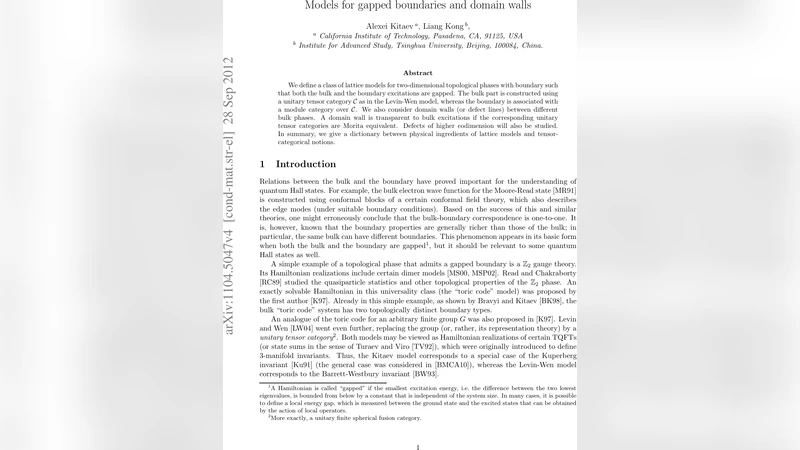
We define a class of lattice models for two-dimensional topological phases with boundary such that both the bulk and the boundary excitations are gapped. The bulk part is constructed using a unitary tensor category $\calC$ as in the Levin-Wen model, whereas the boundary is associated with a module category over $\calC$. We also consider domain walls (or defect lines) between different bulk phases. A domain wall is transparent to bulk excitations if the corresponding unitary tensor categories are Morita equivalent. Defects of higher codimension will also be studied. In summary, we give a dictionary between physical ingredients of lattice models and tensor-categorical notions.
💡 Research Summary
The paper “Models for gapped boundaries and domain walls” develops a comprehensive categorical framework for describing two‑dimensional topological phases with gapped boundaries and defects. Building on the Levin‑Wen string‑net construction, the authors replace the underlying group or representation data by an arbitrary unitary tensor category (UTC) 𝒞. In the Levin‑Wen model, bulk quasiparticles are identified with the simple objects of the monoidal centre Z(𝒞) (the Drinfeld double of 𝒞), and their braiding and fusion are encoded by the braided monoidal structure of Z(𝒞).
The novel contribution of the work is the systematic treatment of boundaries, domain walls (defect lines), and higher‑codimension defects using module categories over 𝒞. A gapped boundary is specified by a left 𝒞‑module category 𝓜. Physically, the labels on boundary edges correspond to objects of 𝓜, and the allowed fusion of boundary excitations is given by the internal tensor product of 𝓜. The bulk‑to‑boundary map is a monoidal functor F : Z(𝒞) → 𝓜, which forgets part of the bulk data and restricts it to the boundary. The authors illustrate this with the toric code (𝒞 = Rep ℤ₂). The two known gapped boundaries—“smooth” and “rough”—are recovered as the module categories Rep ℤ₂ and ℤ₂‑graded Hilb, respectively. The corresponding forgetful functors map bulk anyons (1, e, m, ε) to the appropriate boundary sectors.
Domain walls separating two possibly different bulk phases 𝒞 and 𝒟 are described by a 𝒞‑𝒟‑bimodule category 𝓑. When 𝒞 and 𝒟 are Morita equivalent (i.e., there exists an invertible bimodule), the wall is “transparent”: bulk anyons can pass through the wall without changing their type, up to a braided equivalence between Z(𝒞) and Z(𝒟). In the toric‑code example, a defect line that swaps e and m corresponds to the bimodule Hilb equipped with a Rep ℤ₂‑Rep ℤ₂ bimodule structure; the associated braided auto‑equivalence of Z(Rep ℤ₂) is realized by moving an anyon around the endpoint of the line.
Higher‑codimension defects are incorporated naturally. Codimension‑2 defects (point‑like terminations of domain walls) are modeled by module functors between bimodule categories, i.e., objects in Fun_𝒞(𝓑, 𝓑′). Codimension‑3 defects (junctions of domain walls) correspond to natural transformations between such functors. These categorical objects capture the fusion and braiding of defects, and they match the structures appearing in extended Turaev‑Viro topological quantum field theories.
The authors also provide a “dictionary” translating physical ingredients of lattice Hamiltonians into categorical language: bulk Hamiltonian ↔ UTC 𝒞; bulk excitations ↔ Z(𝒞); boundary condition ↔ 𝒞‑module category; boundary excitations ↔ simple objects of the module; transparent domain wall ↔ Morita equivalence (invertible bimodule); codimension‑2 defect ↔ module functor; codimension‑3 defect ↔ natural transformation. This correspondence clarifies how anyonic data, boundary conditions, and defect networks can be engineered in exactly solvable lattice models.
Overall, the paper establishes that the full set of gapped boundaries, transparent domain walls, and higher‑dimensional defects of a 2D topological phase is completely classified by module-theoretic data over the underlying unitary tensor category. This categorical classification not only unifies previously known examples (such as the toric code boundaries) but also provides a systematic recipe for constructing new models with desired boundary and defect properties, and for understanding their bulk–boundary dualities via the monoidal centre construction.
Comments & Academic Discussion
Loading comments...
Leave a Comment