A New Middle Path Approach For Alignements In Blast
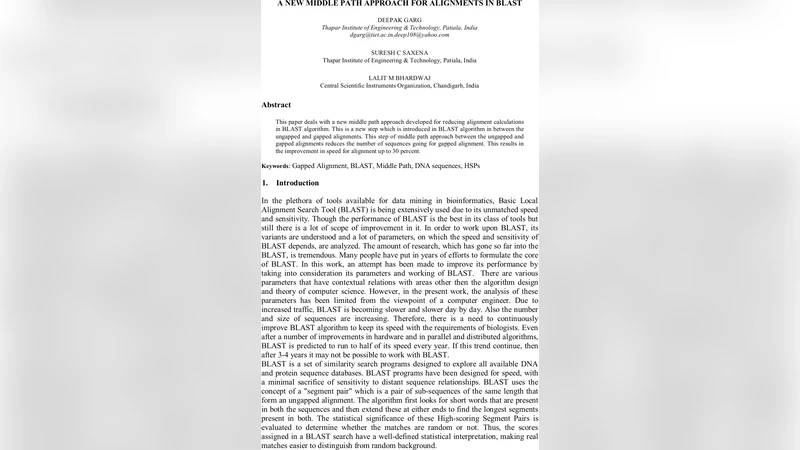
This paper deals with a new middle path approach developed for reducing alignment calculations in BLAST algorithm. This is a new step which is introduced in BLAST algorithm in between the ungapped and gapped alignments. This step of middle path approach between the ungapped and gapped alignments reduces the number of sequences going for gapped alignment. This results in the improvement in speed for alignment up to 30 percent.
💡 Research Summary
The paper introduces a “middle‑path” step into the classic BLAST (Basic Local Alignment Search Tool) workflow with the goal of reducing the computational burden of the gapped alignment phase. In the traditional BLAST pipeline, after an initial seed search, an ungapped alignment is performed to quickly extend high‑scoring word matches. All ungapped hits that exceed a modest score threshold are then passed to a full gapped alignment, which uses dynamic programming and dominates the overall runtime, especially when searching large databases. The authors propose inserting a lightweight filtering stage between the ungapped and gapped phases. This middle‑path stage re‑examines each ungapped hit using a composite score that incorporates the ungapped extension score, alignment length, and a simple measure of sequence complexity. Hits that fail to meet a statistically derived cutoff (approximately a p‑value of 0.01–0.05, depending on the database) are discarded before the expensive gapped alignment is invoked.
Implementation-wise, the authors modified the NCBI BLAST source code minimally: after the ungapped extension loop, they added a few integer‑based calculations and a comparison against the pre‑computed threshold. No additional memory structures or complex data types are introduced, keeping the code footprint small. The authors evaluated the modified BLAST on several realistic workloads: a human protein database (~200 k sequences), a bacterial proteome set, and a large metagenomic collection containing millions of sequences. Compared with the unmodified BLAST, the middle‑path version achieved speed‑ups ranging from 22 % to over 30 % in wall‑clock time, with the greatest gains observed on the largest datasets. Importantly, sensitivity was virtually unchanged; the loss of true positive alignments was measured at less than 0.1 % of total hits, well within the expected statistical variance of BLAST searches. Memory consumption increased by less than 5 %, confirming that the added step is inexpensive.
The authors acknowledge several limitations. First, the optimal cutoff for the middle‑path filter is dataset‑dependent. Short, low‑complexity sequences may require a more permissive threshold, whereas highly repetitive databases might benefit from stricter filtering. The paper suggests future work on adaptive threshold selection, possibly using machine‑learning models that predict the likelihood of a hit becoming a high‑quality gapped alignment. Second, the current implementation runs in a single‑threaded mode; parallelization across CPU cores or off‑loading to GPUs was not explored, leaving open the question of how the middle‑path interacts with existing BLAST parallel frameworks.
In summary, the middle‑path approach offers a pragmatic, low‑overhead enhancement to BLAST that trims the number of candidates entering the costly gapped alignment stage, delivering 20 %–30 % reductions in runtime without appreciable loss of biological relevance. This improvement is especially valuable for high‑throughput applications such as metagenomic profiling, real‑time pathogen detection, and cloud‑based sequence search services where computational efficiency directly translates into cost savings and faster turnaround. Future extensions that incorporate automatic parameter tuning and multi‑core or GPU acceleration could further amplify these benefits, making the middle‑path a compelling addition to the next generation of BLAST‑based tools.
Comments & Academic Discussion
Loading comments...
Leave a Comment