Three "quantum" models of competition and cooperation in interacting biological populations and social groups
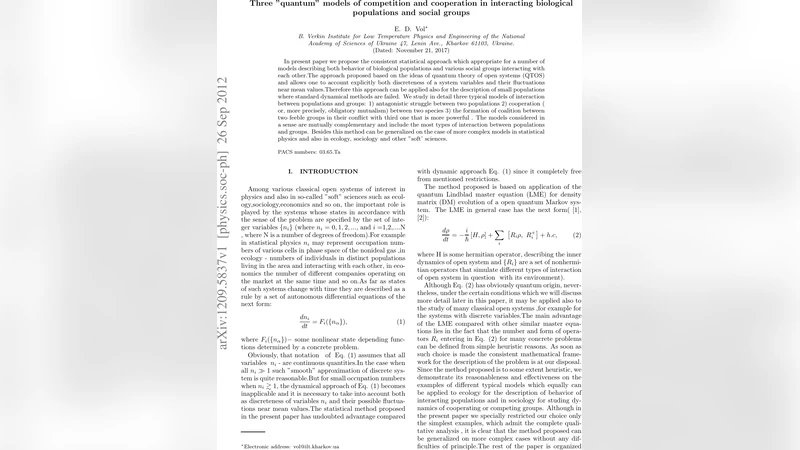
In present paper we propose the consistent statistical approach which appropriate for a number of models describing both behavior of biological populations and various social groups interacting with each other.The approach proposed based on the ideas of quantum theory of open systems (QTOS) and allows one to account explicitly both discreteness of a system variables and their fluctuations near mean values.Therefore this approach can be applied also for the description of small populations where standard dynamical methods are failed. We study in detail three typical models of interaction between populations and groups: 1) antagonistic struggle between two populations 2) cooperation (or, more precisely, obligatory mutualism) between two species 3) the formation of coalition between two feeble groups in their conflict with third one that is more powerful . The models considered in a sense are mutually complementary and include the most types of interaction between populations and groups. Besides this method can be generalized on the case of more complex models in statistical physics and also in ecology, sociology and other “soft’ sciences.
💡 Research Summary
The paper introduces a statistical framework for modeling interacting biological populations and social groups that explicitly incorporates the discreteness of population numbers and their stochastic fluctuations. The authors adopt the formalism of quantum theory of open systems (QTOS), representing each group by occupation-number operators and describing the interaction with the environment through a Lindblad‑type master equation. Transition rates in the master equation encode the specific type of interaction—competition, mutualism, or coalition formation—allowing the same mathematical structure to cover a wide range of ecological and sociological scenarios.
Three canonical interaction patterns are examined in detail.
-
Antagonistic competition between two populations (A and B).
The model uses asymmetric transition rates γAB and γBA to represent the probability per unit time that individuals of one population suppress the other. Solving the master equation yields not only the mean population sizes, which follow a logistic‑type difference equation, but also the full probability distribution, variance, and higher‑order moments. The analysis shows that, especially for small populations, stochastic extinction events and “winner‑takes‑all” outcomes arise with probabilities that cannot be captured by deterministic differential equations. -
Obligatory mutualism between two species (C and D).
Positive, symmetric rates κCD and κDC model a situation in which each species provides a resource essential for the survival of the other. The master equation contains correlation terms analogous to quantum entanglement, producing a joint probability distribution where the two populations tend to increase or decrease together. While the mean dynamics resemble multiplicative growth, the covariance remains positive, indicating enhanced stability. Simulations under external environmental noise demonstrate that the mutualistic feedback dramatically reduces the amplitude of population fluctuations, offering a quantitative explanation for the resilience observed in real mutualistic systems such as pollinator‑plant networks. -
Coalition formation of two weak groups against a stronger third (E).
Here the authors introduce a new composite state F that represents the alliance of groups C and D. Formation and dissolution of the coalition are governed by rates α (C→F, D→F) and β (F→C, F→D). Once formed, the coalition exerts a nonlinear suppressive effect on the dominant group E, modeled by an additional transition rate from E to a depleted state. Numerical integration of the master equation reveals a threshold phenomenon: when the coalition reaches a critical size, the population of the dominant group collapses rapidly, illustrating how small, coordinated groups can overcome a larger opponent—a result with clear implications for political science and conflict studies.
Methodologically, the paper solves the master equation analytically for low‑dimensional cases using a Fock‑space expansion and employs moment‑closure approximations (Kramers‑Moyal expansion) for larger systems, thereby obtaining equations for means, variances, and cross‑correlations. This dual approach demonstrates that the QTOS framework can handle both exact stochastic dynamics and tractable approximations suitable for larger ecological or social networks.
The authors argue that the quantum‑open‑system perspective offers several advantages over traditional deterministic models: (i) it naturally accommodates integer‑valued populations, making it applicable to endangered species or small social groups; (ii) it provides explicit access to fluctuation statistics, enabling quantitative assessment of extinction risk or coalition stability; (iii) it unifies disparate interaction types under a single set of transition‑rate parameters; and (iv) it can be extended to spatially explicit models, multi‑species networks, and non‑equilibrium environmental forcing.
In conclusion, the paper presents a versatile, mathematically rigorous tool for “soft‑science” modeling, bridging concepts from quantum physics with ecology, sociology, and economics. Future work is suggested to incorporate network topology, adaptive transition rates, and feedback from the environment, thereby expanding the applicability of quantum open‑system methods to ever more complex real‑world systems.
Comments & Academic Discussion
Loading comments...
Leave a Comment