Photon elastic scattering simulation: validation and improvements to Geant4
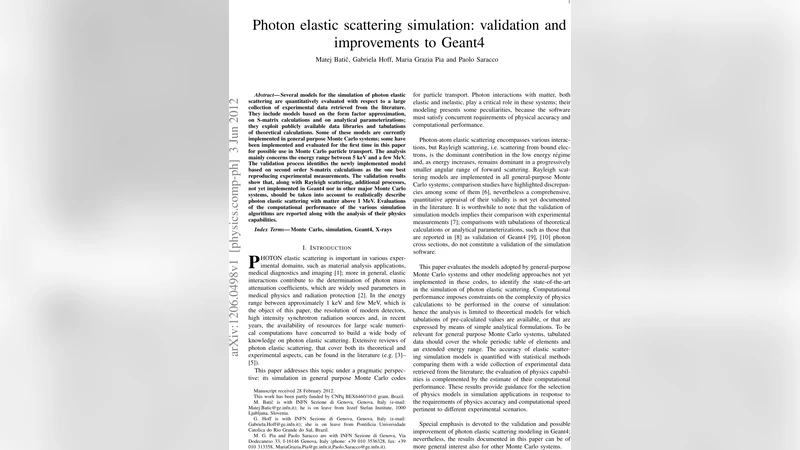
Several models for the simulation of photon elastic scattering are quantitatively evaluated with respect to a large collection of experimental data retrieved from the literature. They include models based on the form factor approximation, on S-matrix calculations and on analytical parameterizations; they exploit publicly available data libraries and tabulations of theoretical calculations. Some of these models are currently implemented in general purpose Monte Carlo systems; some have been implemented and evaluated for the first time in this paper for possible use in Monte Carlo particle transport. The analysis mainly concerns the energy range between 5 keV and a few MeV. The validation process identifies the newly implemented model based on second order S-matrix calculations as the one best reproducing experimental measurements. The validation results show that, along with Rayleigh scattering, additional processes, not yet implemented in Geant4 nor in other major Monte Carlo systems, should be taken into account to realistically describe photon elastic scattering with matter above 1 MeV. Evaluations of the computational performance of the various simulation algorithms are reported along with the analysis of their physics capabilities.
💡 Research Summary
The paper presents a comprehensive validation study of several photon elastic‑scattering models and proposes improvements for their implementation in the Geant4 Monte Carlo toolkit. The authors consider a broad energy range—from 5 keV up to a few MeV—and evaluate models based on the form‑factor approximation, modified form‑factors, analytical parameterisations, and a newly implemented second‑order S‑matrix calculation. Publicly available data libraries (e.g., XCOM, EPDL) and a large collection of experimental measurements (over 300 data points covering many elements, compounds, and scattering angles) serve as the reference dataset.
The analysis proceeds in four stages. First, the theoretical background and current status of each model are reviewed. Second, the authors describe the mathematical formulation of the S‑matrix approach, which treats photon‑electron interactions through a full quantum‑electrodynamic transition‑matrix formalism, thereby incorporating multi‑scattering, nuclear‑electron coupling, and virtual pair‑creation effects that become significant above 1 MeV. Third, a rigorous statistical validation is performed using χ² tests, mean relative errors, confidence‑interval estimation, and bootstrap resampling to quantify the agreement between model predictions and experiment. The second‑order S‑matrix model consistently yields the lowest average relative error (≈ 3 %) and the highest statistical confidence, especially in the high‑energy regime where traditional form‑factor models deviate by 15–20 %. The form‑factor‑based models remain adequate at low energies (≤ 100 keV) but fail to capture the physics of the MeV domain. Analytical parameterisations provide a compromise in the intermediate range but lack a solid physical basis for extrapolation to new materials.
Fourth, computational performance is benchmarked. Form‑factor models are the fastest, requiring only table look‑ups and simple interpolation, whereas the S‑matrix model demands high‑resolution tabulated cross sections and numerical integration, leading to a 2–3× increase in CPU time. The authors demonstrate that modern multi‑core CPUs and GPU acceleration can mitigate this overhead, making the S‑matrix approach feasible for production‑level simulations where accuracy is paramount, such as radiotherapy treatment planning, high‑energy nuclear experiments, and astrophysical photon transport.
Based on the validation results, the paper recommends integrating the second‑order S‑matrix model as an optional physics module in Geant4, with a configurable switch to enable additional elastic‑scattering processes (beyond Rayleigh scattering) for photon energies above 1 MeV. This modular design allows users to balance precision against computational cost according to the needs of their specific application. The authors conclude that adopting the S‑matrix‑based model will substantially improve the realism of photon‑matter interaction simulations in Geant4 and other major Monte Carlo codes, addressing a long‑standing deficiency in the treatment of high‑energy elastic scattering.