$L$-fuzzy strongest postcondition predicate transformers as $L$-idempotent linear or affine operators between semimodules of monotonic predicates
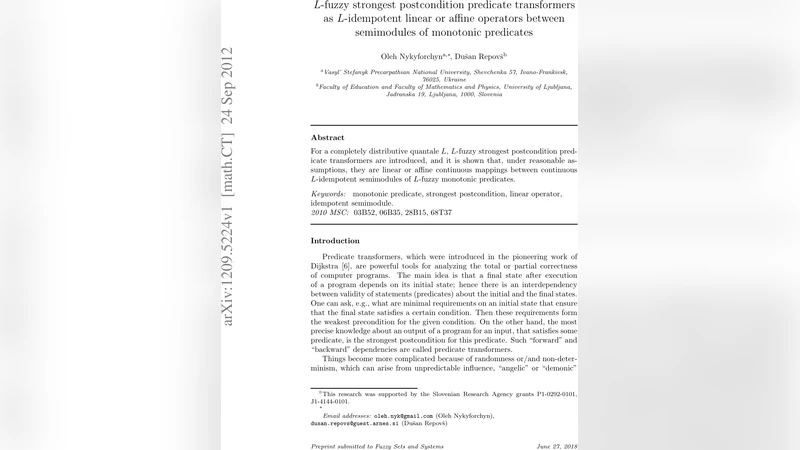
For a completely distributive quantale $L$, $L$-fuzzy strongest postcondition predicate transformers are introduced, and it is shown that, under reasonable assumptions, they are linear or affine continuous mappings between continuous $L$-idempotent semimodules of $L$-fuzzy monotonic predicates.
💡 Research Summary
The paper develops a rigorous mathematical framework for strongest postcondition predicate transformers in the setting of L‑fuzzy logic, where L is a completely distributive quantale. The authors begin by recalling the essential properties of such quantales—complete distributivity, associative multiplication, and the existence of a top and bottom element—and then define L‑fuzzy monotonic predicates as functions φ : X → L over a state space X that are order‑preserving pointwise. These predicates form a continuous L‑idempotent semimodule: the join (⊕) of two predicates is taken pointwise as the lattice join in L, and scalar multiplication by an element a ∈ L is the pointwise quantale multiplication (⊗). Crucially, ⊕ is idempotent (φ ⊕ φ = φ), reflecting the “maximum confidence” interpretation common in fuzzy reasoning.
Program commands are modeled as L‑fuzzy transition relations R ⊆ X × X, assigning to each pair (x, y) a value R(x, y) ∈ L that quantifies the degree to which state x may evolve into state y. Within this setting, the strongest postcondition transformer wp_R is defined by the familiar formula
wp_R(φ)(y) = ⋁_{x∈X} (φ(x) ⊗ R(x, y)),
where ⋁ denotes the join in L. This definition lifts the classical strongest postcondition construction to the fuzzy domain, aggregating over all possible predecessor states and preserving the highest attainable degree of truth.
The central technical contribution is the proof that wp_R is a continuous linear (or, when a constant bottom element ⊥ is admitted, an affine) map between the source and target L‑idempotive semimodules. Linearity is expressed as
wp_R(a ⊗ φ₁ ⊕ b ⊗ φ₂) = a ⊗ wp_R(φ₁) ⊕ b ⊗ wp_R(φ₂),
for any scalars a, b ∈ L and predicates φ₁, φ₂. Affine behavior follows from the preservation of the bottom element: wp_R(φ ⊕ ⊥) = wp_R(φ) ⊕ wp_R(⊥). The proof relies heavily on the complete distributivity of L, which guarantees that joins distribute over multiplication, and on the continuity of the underlying lattice, ensuring that directed suprema are respected by wp_R. Consequently, wp_R preserves directed limits of increasing chains of predicates, a property essential for reasoning about potentially infinite state spaces.
The authors also explore the algebraic nature of L‑idempotent semimodules, emphasizing that they differ from conventional vector spaces: the idempotent addition encodes a “max‑type” combination rather than arithmetic summation, making the structure well‑suited for modeling uncertainty and partial truth. This perspective situates the work alongside tropical and max‑plus algebra, yet the quantale setting provides a richer logical interpretation because the multiplication ⊗ can capture conjunction, implication, or other logical connectives depending on the chosen L.
From a practical standpoint, when L is finite or effectively computable (e.g., a finite chain, the unit interval with a t‑norm, or a powerset lattice), the transition relation R can be represented as an L‑valued matrix and predicates as column vectors. In this representation, wp_R becomes a matrix‑vector product using ⊗ for scalar multiplication and ⊕ for addition, allowing the deployment of standard linear‑algebraic algorithms within fuzzy model‑checking tools. The paper sketches how such an implementation could be integrated into existing verification pipelines, offering a pathway to automated reasoning about programs whose specifications involve graded truth values rather than binary assertions.
Finally, the paper outlines several avenues for future research: extending the theory to quantales that are not completely distributive, handling nondeterministic or concurrent constructs where multiple transition relations must be combined, and applying the framework to real‑time or safety‑critical systems where degrees of confidence are crucial. By marrying quantale theory, idempotent semimodule algebra, and predicate transformer semantics, the authors provide a robust foundation for L‑fuzzy program verification and open the door to a new class of quantitative reasoning tools.
Comments & Academic Discussion
Loading comments...
Leave a Comment