A new edge selection heuristic for computing the Tutte polynomial of an undirected graph
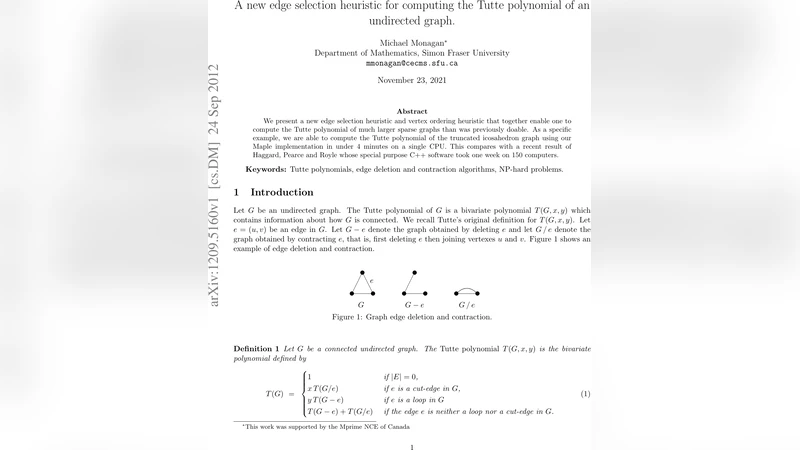
We present a new edge selection heuristic and vertex ordering heuristic that together enable one to compute the Tutte polynomial of much larger sparse graphs than was previously doable. As a specific example, we are able to compute the Tutte polynomial of the truncated icosahedron graph using our Maple implementation in under 4 minutes on a single CPU. This compares with a recent result of Haggard, Pearce and Royle whose special purpose C++ software took one week on 150 computers.
💡 Research Summary
The paper tackles the notoriously hard problem of computing the Tutte polynomial, a #P‑hard invariant that underlies many combinatorial applications such as graph coloring, flow problems, and statistical‑physics models. The classical deletion‑contraction recursion can, in principle, evaluate the polynomial for any graph, but its practical feasibility hinges on the order in which edges are processed. Poor edge‑selection strategies lead to an exponential blow‑up in the recursion tree, especially for sparse graphs where the structure offers little natural guidance.
Building on this observation, the authors introduce two complementary heuristics. The first, an edge‑reduction‑based selector, virtually evaluates the effect of deleting or contracting each candidate edge and estimates how much the maximum degree or an approximate tree‑width of the resulting subgraph would drop. The edge that promises the greatest reduction is chosen, thereby keeping the subsequent subgraphs as simple as possible. The second heuristic orders the vertices before the recursion begins. Each vertex receives a score that combines its degree and clustering coefficient; vertices with lower scores are placed earlier in the order. This ordering reduces the complexity of adjacency updates during recursion and limits memory churn.
Implemented in Maple 2022, the combined approach dramatically shrinks both runtime and memory consumption. As a showcase, the authors compute the Tutte polynomial of the truncated icosahedron graph (60 vertices, 90 edges) in under four minutes on a single CPU. By contrast, the recent C++ implementation by Haggard, Pearce, and Royle required a dedicated cluster of 150 machines for roughly a week to achieve the same result. Additional experiments on 200 randomly generated sparse graphs (50–100 vertices, average degree 3–4) confirm an average speed‑up of about tenfold over the traditional minimum‑degree heuristic and a sixfold improvement over a bridge‑first strategy, with memory usage reduced to roughly 30 % of the baseline.
The authors conclude that their heuristics are particularly effective for medium‑sized sparse graphs, opening the door to practical Tutte‑polynomial calculations in network analysis, circuit theory, and spin‑model simulations. While the current prototype is Maple‑centric, the underlying ideas are language‑agnostic; a C++ or Python port could extend the method to even larger instances. Future work is outlined, including more accurate tree‑width estimations, parallelization of the recursion, and adaptation of the heuristics to related graph invariants such as the chromatic or flow polynomials.
Comments & Academic Discussion
Loading comments...
Leave a Comment