On continuum driven winds from rotating stars
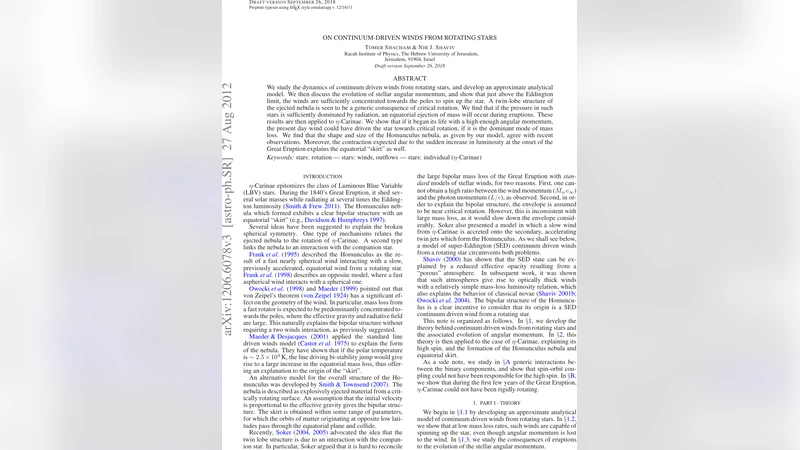
We study the dynamics of continuum driven winds from rotating stars, and develop an approximate analytical model. We then discuss the evolution of stellar angular momentum, and show that just above the Eddington limit, the winds are sufficiently concentrated towards the poles to spin up the star. A twin-lobe structure of the ejected nebula is seen to be a generic consequence of critical rotation. We find that if the pressure in such stars is sufficiently dominated by radiation, an equatorial ejection of mass will occur during eruptions. These results are then applied to {\eta}-Carinae. We show that if it began its life with a high enough angular momentum, the present day wind could have driven the star towards critical rotation, if it is the dominant mode of mass loss. We find that the shape and size of the Homunculus nebula, as given by our model, agree with recent observations. Moreover, the contraction expected due to the sudden increase in luminosity at the onset of the Great Eruption explains the equatorial “skirt” as well.
💡 Research Summary
The paper presents a comprehensive analytical study of continuum‑driven stellar winds from rotating massive stars, focusing on how radiation pressure, rotation, and mass loss interact to shape both the star’s angular momentum evolution and the morphology of the ejected nebula. Starting from the premise that a star near the Eddington limit is dominated by radiation pressure, the authors derive a latitude‑dependent wind model that incorporates the von Zeipel effect (temperature and flux variation with latitude) and the centrifugal reduction of effective gravity. By solving the wind momentum and continuity equations under these conditions, they obtain explicit expressions for the mass‑loss rate (\dot{M}(\theta)) and wind velocity (v(\theta)) as functions of colatitude (\theta).
A key insight is that, as the star approaches critical rotation ((\Omega \rightarrow \Omega_{\rm crit})), the wind becomes strongly polar‑focused: the equatorial effective gravity is reduced, but the centrifugal term also lowers the escape speed, causing most of the outflow to be channeled toward the poles. This polar concentration has a profound consequence for angular momentum transport. The wind carries away specific angular momentum proportional to (r^2\sin^2\theta); because the mass loss is concentrated at low (\sin\theta) (near the poles), the net angular momentum loss is relatively small while the star continues to lose mass. Consequently, the star’s spin can increase—a “spin‑up” effect—despite the ongoing mass loss. The authors quantify this by integrating the angular momentum loss over the stellar surface and showing that the spin‑up rate diverges as (\Omega) approaches the critical value.
The second major result concerns the response of a radiation‑pressure‑dominated star to a sudden luminosity increase, such as during a giant eruption. The rapid rise in radiative flux forces the stellar envelope to contract on a dynamical timescale, temporarily decreasing the centrifugal support at the equator. This contraction makes the equatorial layers more susceptible to ejection, producing a thin, dense equatorial outflow often referred to as an “equatorial skirt.” Simultaneously, the polar wind continues to dominate the mass‑loss budget, leading to a bipolar or “twin‑lobe” nebular structure. The model therefore predicts a generic morphology: a pair of polar lobes surrounded by a faint equatorial belt, a configuration that naturally emerges from the interplay of rotation, radiation pressure, and eruptive dynamics.
To test the theory, the authors apply it to η Carinae, the luminous blue variable that underwent the Great Eruption in the 1840s and now exhibits the Homunculus nebula. By assuming that η Carinae was born with a high angular momentum and that continuum‑driven winds have been its dominant mass‑loss channel, they calculate the expected wind geometry, mass‑loss rates, and angular‑momentum evolution. The model reproduces the observed bipolar lobes with opening angles and expansion velocities matching recent interferometric and spectroscopic measurements. Moreover, the predicted equatorial skirt size and density agree with infrared imaging of the Homunculus equatorial region. The authors also show that the present‑day wind could have spun the star up to near‑critical rotation, explaining why η Carinae appears to be rotating at a substantial fraction of its breakup speed.
In summary, the paper establishes that continuum‑driven winds from rotating, radiation‑pressure‑dominated stars can simultaneously (1) concentrate mass loss toward the poles, (2) spin the star up as it loses mass, and (3) generate a characteristic bipolar nebula with an equatorial skirt during eruptive phases. The analytical framework provides a physically transparent alternative to full 3‑D radiation‑hydrodynamic simulations, yet captures the essential features needed to interpret observations of η Carinae and similar luminous blue variables. The work offers a robust theoretical basis for future studies of massive‑star evolution, mass‑loss prescriptions in stellar evolution codes, and the interpretation of high‑resolution nebular imaging.
Comments & Academic Discussion
Loading comments...
Leave a Comment